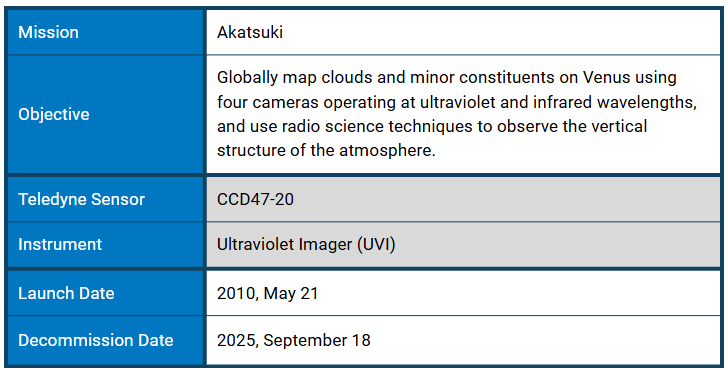
As our closest neighbour, Venus is often referred to as Earth’s sister planet because they share similar orbital periods, age, and are roughly the same size and density. Beyond that, however, they are very, very different.
The oceans, magnetic fields, and plate tectonics found on the Earth do not exist on Venus. With clouds of carbon dioxide (CO2) and sulfuric acid up to 20 kilometres (12 miles) thick, the Venusian atmosphere is about 90 times the pressure of Earth’s. The greenhouse effect caused by the dense CO2 concentrations heats the planet to a searing 465°C (869°F) -- the hottest planet in the Solar System. The few Soviet Venera spacecraft that landed there in the 1970s and 1980s survived only minutes on the surface due to the extreme pressure and temperatures high enough to melt lead.
Extremely strong winds -- up to 100 meters (326 feet) per second -- sweep the Venusian atmosphere, causing clouds to travel around the planet far faster than the planet itself rotates. These high-velocity atmospheric clouds complete one cycle every four terrestrial days, outstripping Venus's slow rotation of 243 terrestrial days -- a phenomenon called super-rotation. Despite the discovery of super-rotation in the 1960's, scientists had little understanding of the mechanisms that cause it. Understanding the elements behind this natural behaviour would advance our understanding not just of Venus, but of other planets as well. Though they are very different, the similarities between Earth and Venus make a unique case study for advancing the understanding of how and why Earth developed an environment that sustains a diversity of life.
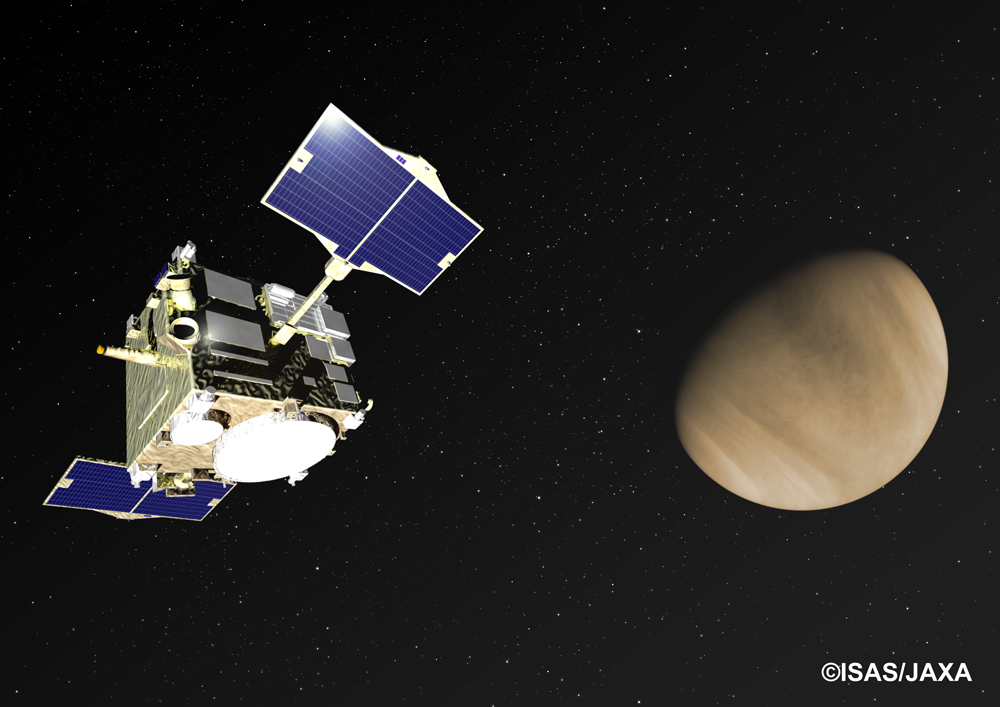
A conceptual image of Akatsuki travelling forward to enter orbit around Venus. Credit: JAXA
Built by the Japan Aerospace Exploration Agency (JAXA), Akatsuki was originally named the Venus Climate Orbiter and was given the code name PLANET-C. After launching in 2010, the space probe was renamed Akatsuki -- which translates to 'dawn'. The mission was Japan's first successful effort to explore another planet. It deployed five cameras to observe the composition and flow of Venus' atmosphere in infrared, visible, and ultraviolet spectra. It was also equipped with an ultra-stable oscillator to sample the vertical structure of the atmosphere using the radio science technique. As they are optimised for different wavelengths, the camera array observed clouds at different altitudes to measure the winds in 3D across the planet.
The original flight path would have placed the spacecraft in orbit around Venus in 2010. A buildup of salt in an engine check valve caused a misfire, forcing Akatsuki to miss the original rendezvous. Five years later, scientists used the smaller attitude thrusters to successfully manoeuvre into a nine-day orbit with a maximum distance — apoapsis — of 310,000 kilometres (193,000 miles). Furthermore, Akatsuki's equatorial elongated orbit with westward revolution complemented the westward rotation of the Venusian atmosphere.
The planned trajectory was to place Akatsuki into a 30-hour orbit with an apoapsis almost four times closer. Despite this setback, Akatsuki still accomplished all of its scientific goals: studying the weather patterns on Venus by continuously mapping and tracking global cloud composition, temperature, and distribution, and investigating volcanic activity and lightning. Akatsuki also detailed Venus’s “unknown absorber”, a mysterious component of the atmosphere that is responsible for absorbing much of the solar energy the atmosphere takes in.
The continuous, long-term observations made by Akatsuki detailed the dynamic nature of Venus by producing 3D maps of the atmosphere, including the temperature and pressure of the air and some of its constituent parts, and how they change over time.
Ultraviolet Imager (UVI)
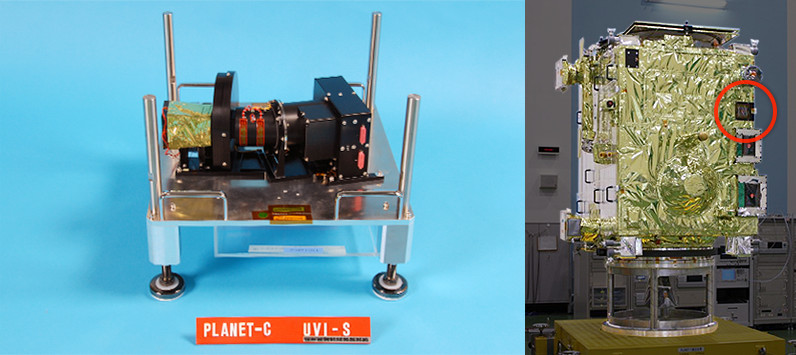 Credit: JAXA
The Ultraviolet Imager (UVI) measured ultraviolet radiation scattered from cloud tops at ~65 kilometres (40 miles) altitude in two bands centred at 0.283 and 0.365 µm wavelengths. The objective was to track the distribution of sulfur dioxide (SO2) -- as related to cloud formation -- and of unidentified chemical substances that absorb ultraviolet radiation. The Venusian atmosphere shows broad absorption of solar radiation between 0.2 and 0.5 µm. SO2 is absorbed between 0.2 and 0.32 µm, while the absorption above 0.32 µm should be due to another chemical that has not yet been identified. Identification of the unknown absorber is important not only for atmospheric chemistry but also for the atmosphere's energy balance and dynamics, as the species influence albedo and heating profiles.
UVI helped discern the spatial distributions of these ultraviolet absorbers and their relationships with the cloud structure. UVI's data also enables researchers to calculate the wind speed at the cloud tops by tracing dark-and-light patterns. Furthermore, the vertical distributions of cloud particles and the haze layer above the main cloud were recorded with limb observations.
The instrument used a Teledyne CCD47-20: a back-thinned, UV-coated, frame-transfer Si-CCD with 1024 x 1024 pixels with a pixel size of 13 µm. The full well was 105e- per pixel, with a signal-to-noise ratio of 120. The spatial resolution was ~16 km at apoapsis and ~6 km at a distance of 5 Rv (30,259 kilometres (18,810 miles)). With a 12° FOV, UVI captured full disc images of Venus at distances >8.5 Rv (51,444 kilometres (31,938 miles)).
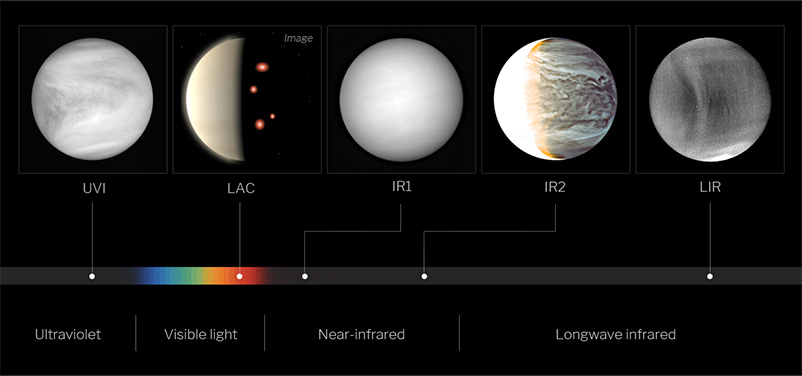
As an observatory satellite orbiting Venus, Akatsuki consisted of five cameras that allow for obtaining images of Venusian atmosphere at various wavelengths between ultraviolet and long-wave infrared. The five cameras were installed facing the same orientation to support simultaneous observation of the Venusian atmosphere. Credit: JAXA
Discovering Stationary Gravity Waves
Scientists discovered a large stationary wave in the upper atmosphere of Venus. It stretched nearly all the way between the north and south poles -- surprising considering the strong winds that are there. Further observations showed that similar waves appeared regularly over several tall mountains on Venus and persisted for about a month after their first appearance. Researchers concluded that they were caused by gravity waves, which are ripples in an atmosphere caused by air moving over rough topography — not to be confused with gravitational waves, which are ripples in spacetime.
A movie of synthesised false colour images of Venus acquired by UVI (Ultraviolet Imager) with 283-nm and 365-nm filters from November 16 to December 7, 2018. Observation date/time in UTC is in upper-left, solar phase angle at sub-spacecraft point is in lower-left, and spacecraft altitude is in lower-right. The images are colourized as follows: the 283-nm image is blue, the 365-nm image is red, and the mixture of both is green. Credit: JAXA
Like Earth and Mars, Venus has a large-scale north-south atmospheric circulation known as the Hadley circulation, which transports heat from the equatorial region toward the poles. The Hadley circulation is the mean flow of the north-south winds during both the day and the night, while the thermal tides will be the origin of the difference between those two times. This should cause east-west winds to weaken globally over time, yet on Venus, the east-wind super-rotation somehow persists. A long-standing question was how much of this second poleward flow is due to the Hadley circulation and how much to winds peculiar to thermal tides.
Using Akatsuki's data, researchers developed an observation method using the ultraviolet cameras to track cloud movements with high precision and successfully mapped detailed wind speeds. Temperatures were also measured using infrared cameras. The results revealed that "thermal tidal waves" (periodic temperature variations caused by the atmosphere heating up during the day under solar radiation and cooling at night) are what drive super-rotation. The forces acting on the atmosphere during thermal tidal waves push upper-atmospheric air near the equator westward, sustaining the ferocious winds. The Hadley circulation is responsible for the circulation of energy and matter, while the thermal tides may affect the maintenance of super-rotation.
Additional Uses of Akatsuki Data
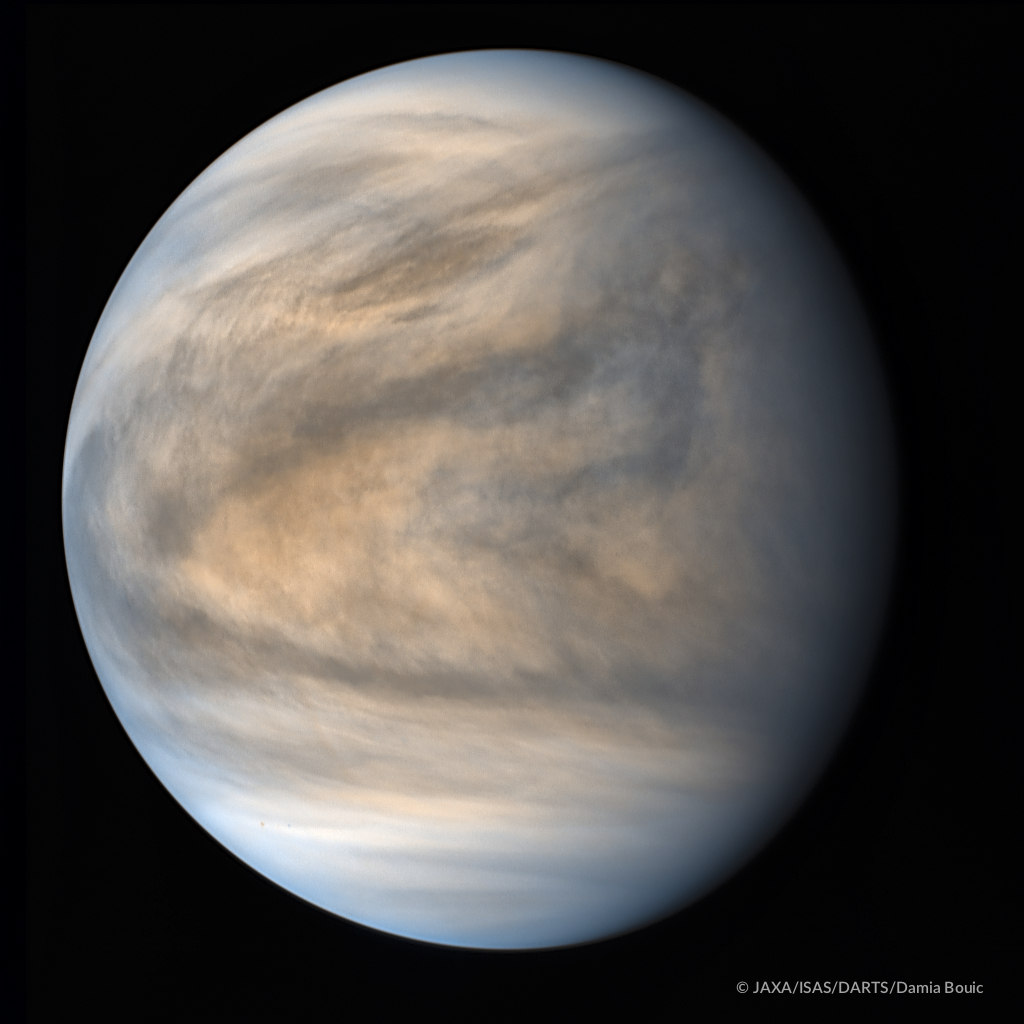
Image taken by UVI
The mission pioneered innovative data assimilation techniques in planetary meteorology, successfully adapting terrestrial weather research methods to Venus’s extreme climate conditions. These methodological advances have applications beyond Venus research, contributing to improved weather modelling capabilities for other planetary bodies. From 2015 until its loss of communication in April 2024, Akatsuki served as humanity’s only operational Venus orbiter, generating hundreds of scientific papers that continue to influence planetary science research. Besides Venus, the Akatsuki data advanced our understanding of meteorological phenomena and fluid dynamics common to other planets including how Earth’s atmosphere formed and continues to evolve. Furthermore, it complemented ESA's Venus Express mission, which also contained Teledyne sensors.
Scientists used Akatsuki’s observations to refine models of atmospheric circulation on Venus and other planets with thick atmospheres. These improvements have practical applications for understanding Earth’s climate system and predicting how other worlds might respond to atmospheric changes. By comparing Venus’s extreme greenhouse effect with Earth’s climate systems, scientists can better predict how planetary atmospheres respond to changing conditions. This knowledge becomes increasingly valuable as researchers study climate change on our own planet.
The probe’s measurements of Venus’s atmospheric composition, temperature variations, and circulation patterns provide real-world validation for computer models that simulate planetary climates. As astronomers continue to search for exoplanets, these models could reveal information about potentially habitable ones.
Works Cited:
NASA (n.d.). Akatsuki. https://science.nasa.gov/mission/akatsuki/
Institute of Space and Astronautical Science. (n.d.). Venus Climate Orbiter Akatsuki. https://www.isas.jaxa.jp/en/missions/spacecraft/past/akatsuki.html
Howell, Elizabeth (2017, September 29). Akatsuki: Japan's Mission to Study Climate of Venus. Space.com. https://www.space.com/38311-akatsuki.html
Institute of Space and Astronautical Science. (2012, July 22). Understanding the nighttime atmospheric circulation on Venus. https://www.isas.jaxa.jp/en/topics/002666.html
Trentini, Yisela Alvarez. (2025). Akatsuki Venus Climate Orbiter. Spacecraft & Vehicles. https://spacecraftandvehicles.com/country/japan/akatsuki-venus-climate-orbiter/
The Planetary Society. (n.d.). Akatsuki, the Venus Climate Orbiter. https://www.planetary.org/space-missions/akatsuki
Venus Climate Orbiter "AKATSUKI / PLANET-C". (2009). 4. Science instruments and targets. https://www.stp.isas.jaxa.jp/venus/E_instrument.html
Venus Climate Orbiter AKATSUKI. (n.d.). Spacecraft / Instruments. https://akatsuki.isas.jaxa.jp/en/mission/spacecraft/
Lee, Y. J., García Muñoz, A., Yamazaki, A., Yamada, M., Watanabe, S., & Encrenaz, T. (2021). Investigation of UV absorbers on Venus using the 283 and 365 nm phase curves obtained from Akatsuki. Geophysical Research Letters, 48, e2020GL090577. https://doi.org/10.1029/2020GL090577
Japan Science and Technology Agency. (2026, April 01). Farewell, "Akatsuki" — Persistent efforts finally crack Venus's mysteries, solar system exploration continues. https://sj.jst.go.jp/stories/2026/s0401-01p.html
Oh! Epic. (2025, September 23). Jaxa Ends 15-year Akatsuki Venus Mission With Miku Payload. https://ohepic.com/jaxa-ends-15-year-akatsuki-venus-mission-with-miku-payload/

