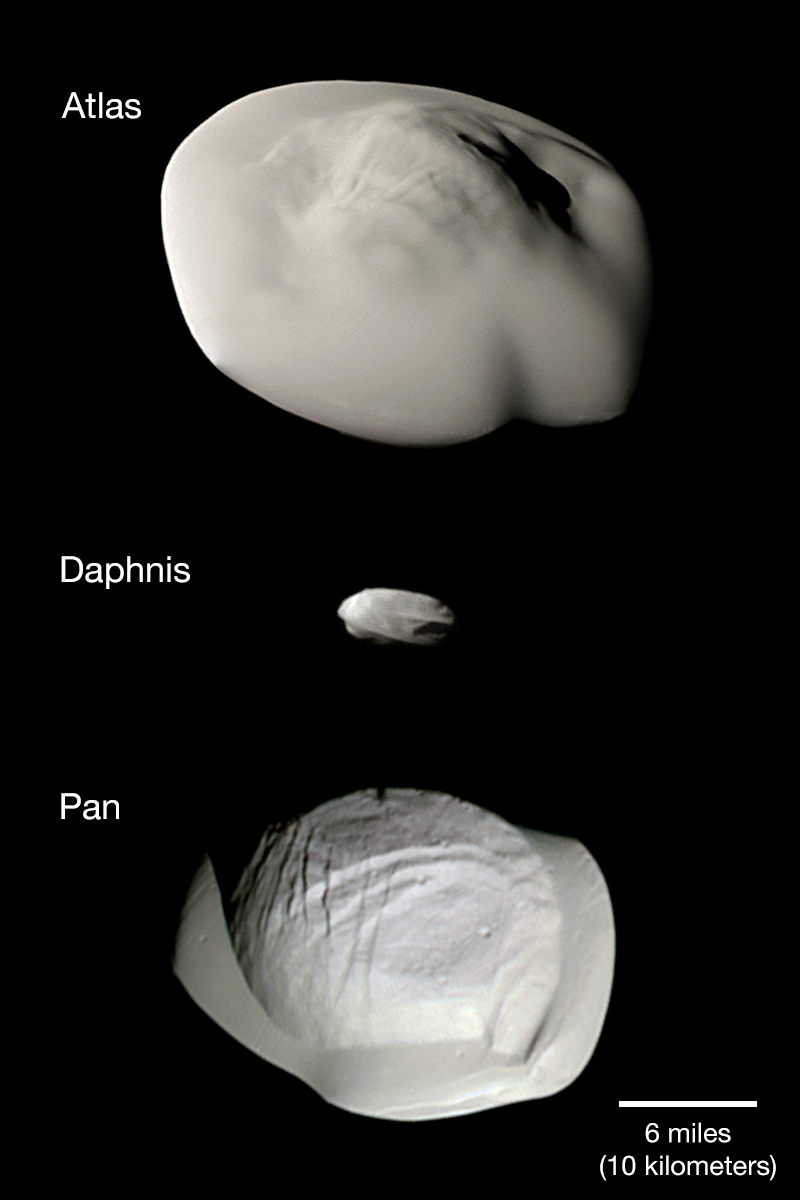
 This montage of views from NASA's Cassini spacecraft shows three of Saturn's small ring moons: Atlas, Daphnis and Pan at the same scale. Credit: NASA/JPL/Space Science Institute
Tracking Storms
Unlike other planets in the Solar System, Saturn seems to store up huge amounts of energy over multiple Earth decades and then release it all at once in the form of a swirling and chaotic lightning storm.
Scientists are unsure why and how the planet behaves this way, but these massive storms occur roughly once every saturnian year – or once every 30 Earth years – and are known as Great White Spots.
Cassini captured the first complete view of the hexagon-shaped jet stream that surrounds Saturn’s north pole and discovered a giant hurricane-like vortex at both of the planet’s poles. It also tracked individual cloud features, to calculate vorticity. Together it all created more information on the atmosphere. Learning how these Saturnian storms could tell scientists more about how terrestrial hurricanes are generated and sustained.
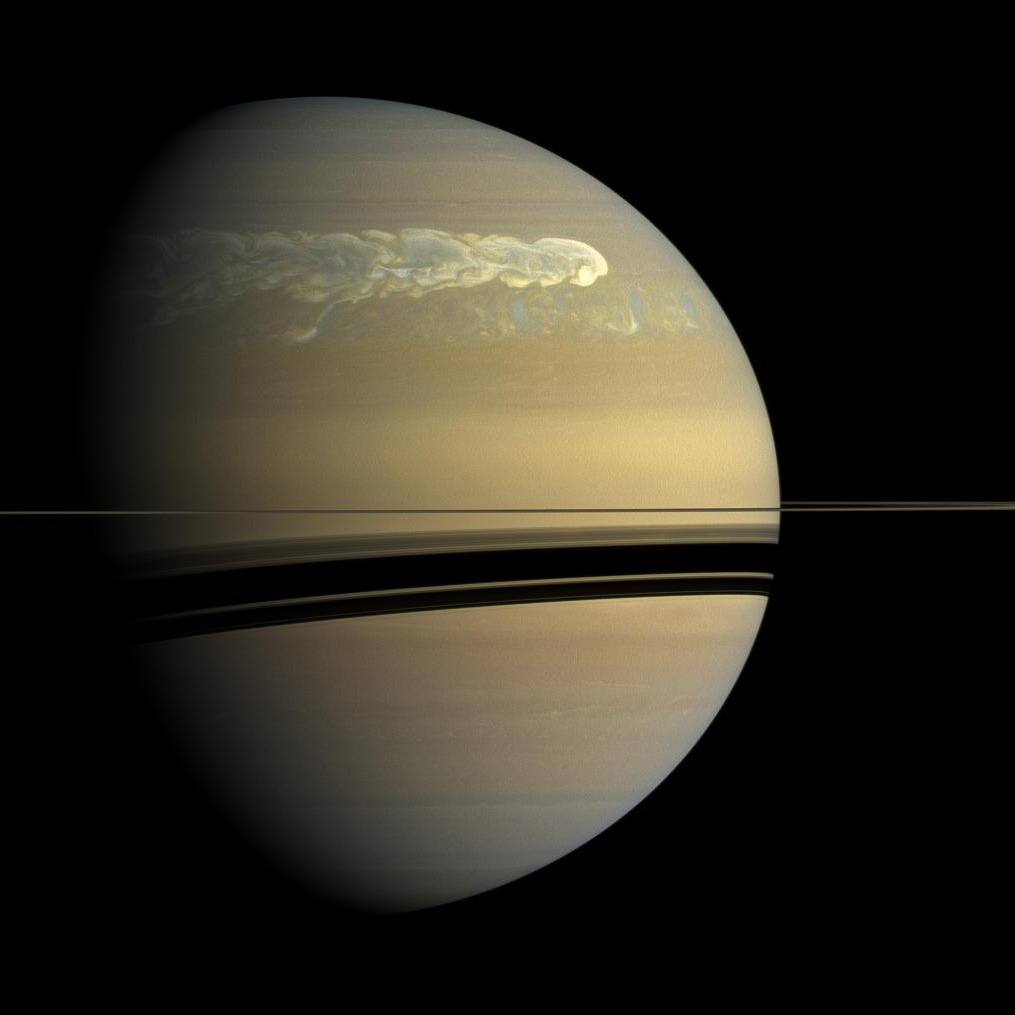
The Great White Spot pictured here, also named the Great Northern Storm, was the largest and most intense storm ever observed on Saturn. It began in late 2010 and lasted for months, but affected the clouds, temperatures and composition of the atmosphere for more than three years. There appear to be two bands of storm, one further north and brighter than the other. In fact, the storm thundered its way around the planet and caught up with itself. Some of the cloud south and west of the storm head can be seen tinged blue as it interacts with other currents in the atmosphere, while the storm head swirls with white and yellow as it heads westward to overtake its subtler tail.
Cassini found this storm to have been so immense and powerful that it was able to disturb the atmosphere at the planet's equator some tens of thousands of kilometres away. This image combines red, green and blue filtered images from Cassini's wide-angle camera to create a real-colour view. These images were taken at a distance of 2.2 million km (1.3 million mi) from Saturn looking towards the sunlit side of the rings from just above the ring plane, and have a scale of 129 km (80 mi) per pixel. Credit: NASA/JPL/Space Science Institute
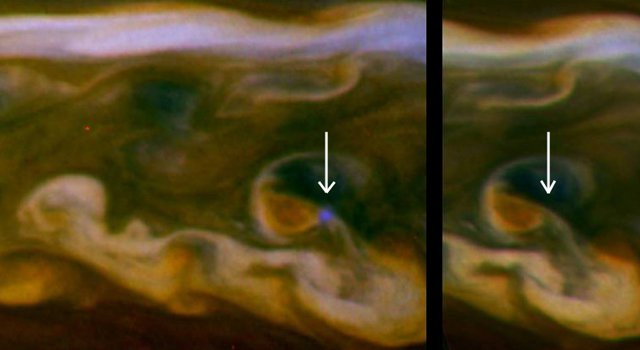
Cassini's ISS captured images of the largest storm seen up-close at the planet, with bluish spots in the middle of swirling clouds. Those bluish spots indicate flashes of lightning and marking the first detection of lightning in visible wavelengths on the side of Saturn illuminated by the sun. The intensity of the flash is comparable to the strongest flashes on Earth. The visible energy alone is estimated to be about 3 billion watts lasting for one second. The flash is approximately 200 km (100 mi) in diameter when it exits the tops of the clouds. From this, scientists deduce that the lightning bolts originate in the clouds deeper down in Saturn's atmosphere where water droplets freeze. This is analogous to where lightning is created in Earth's atmosphere. Credit: NASA/JPL-Caltech/Space Science Institute
Saturn's atmosphere and its rings are shown here in a false color composite made from Cassini images taken in near infrared light through filters that sense different amounts of methane gas. Portions of the atmosphere with a large abundance of methane above the clouds are red, indicating clouds that are deep in the atmosphere. Grey indicates high clouds, and brown indicates clouds at intermediate altitudes. The rings are bright blue because there is no methane gas between the ring particles and the camera. The complex feature with arms and secondary extensions just above and to the right of center is called the Dragon Storm. It lies in a region of the southern hemisphere referred to as "storm alley" by imaging scientists and appears to be a long-lived storm deep in the atmosphere that periodically flares up. Later observations by Cassini tracked smaller storms that broke away from the main system to merge with larger atmospheric features. Credit: NASA/JPL/Space Science Institute
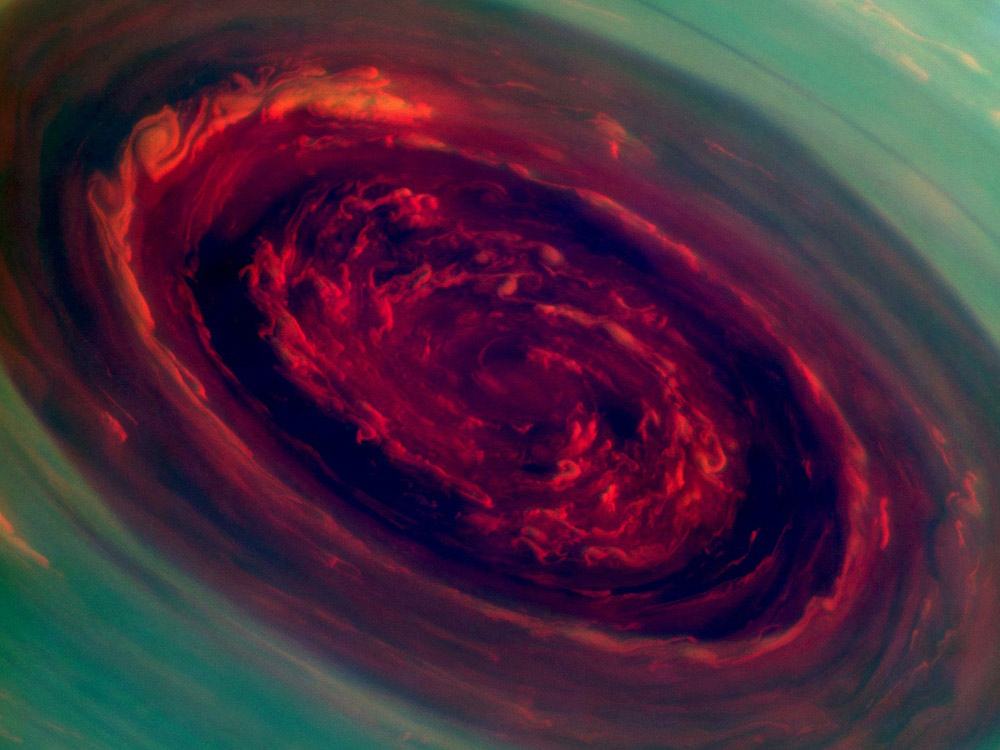
Saturn's south polar vortex (SPV) displays a unique combination of properties as compared to other vortices in the solar system. This false-colour image shows a red, warm central region – the eye – with a nearly cloud-free upper atmosphere above lower, tropospheric clouds. The blue-green ring outside the eye – the eye wall – indicates high clouds and haze, which is consistent with uplifted air. Though it looks surprisingly similar to hurricanes on Earth, the SPV is much larger, with calculations from shadow lengths estimating that the outer wall is 20 - 60 km (12 - 37 mi) high and that the inner wall is 40 - 100 km (25 - 62 mi) high. Additionally, the SPV differs from terrestrial hurricanes in that it is stationary and does not generate over an ocean. Credit: NASA/JPL/Space Science Institute
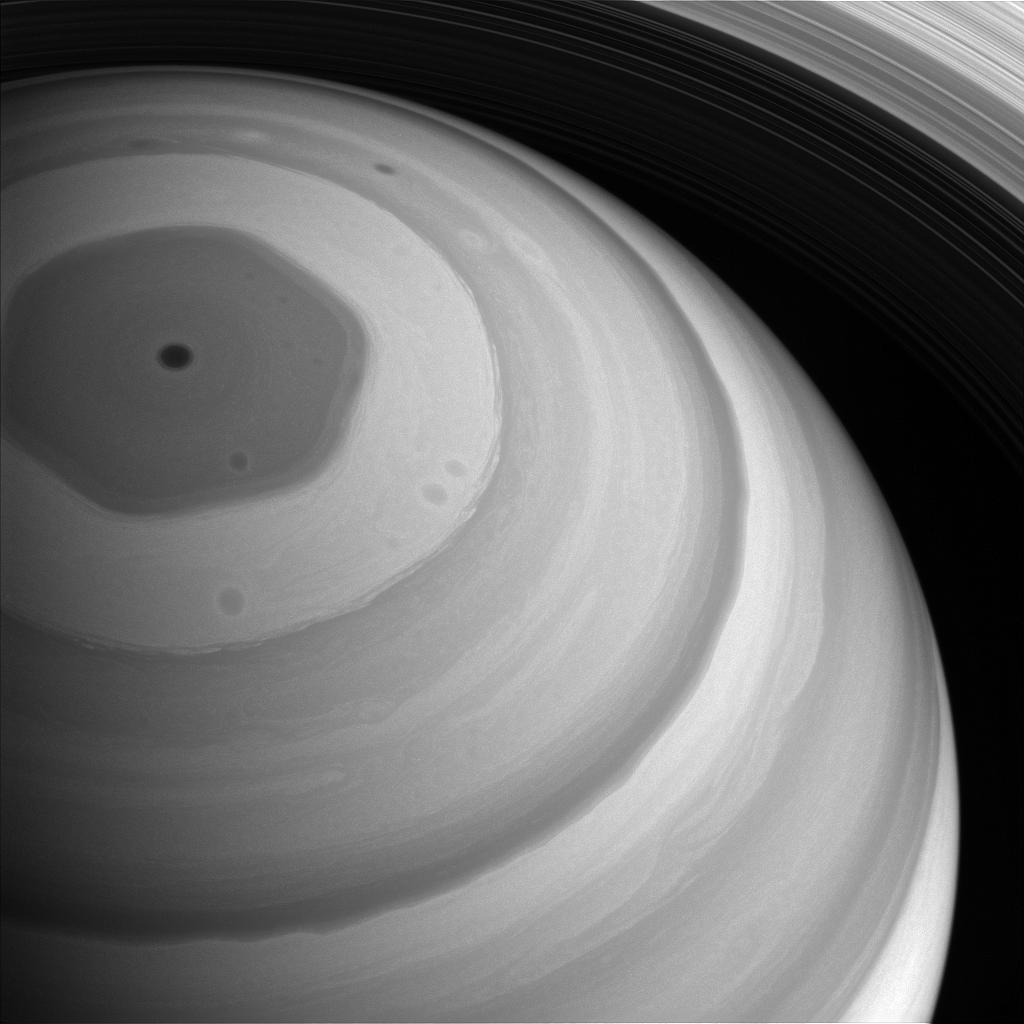
This view looks towards the sunlit side of Saturn's rings, showcasing the planet's distinctive hexagonal vortex region. It was taken at a distance of approximately 1.2 million km (75,000 mi) from Saturn. The image scale is 74 km (46 mi) per pixel. Credit: NASA/JPL/Space Science Institute
The Dynamic Rings of Saturn
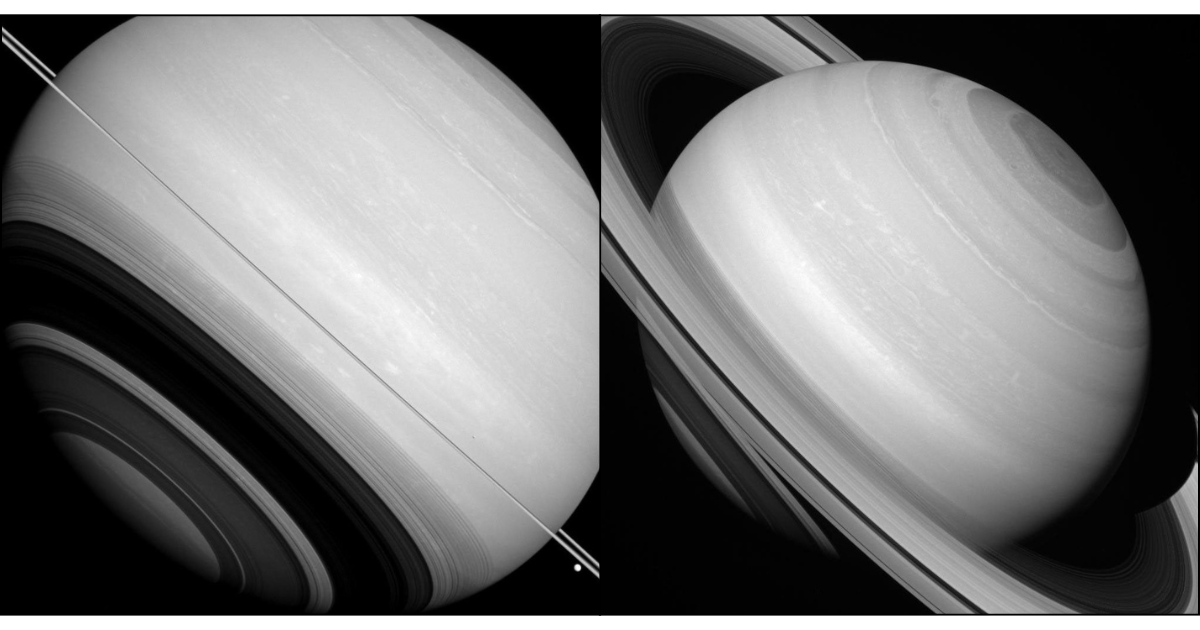 Taken with the ISS wide-angle camera, these images showcase the dazzling rings of Saturn. Made of dust particles, the thin, translucent rings cast shadows across the planet seen as dark bands across the lower portion of the globe. The left image is a nearly edge-on view of the rings taken toward the sunlit side from slightly above the ringplane demonstrating how the orbits of Saturn's moons are offset slightly from the rings. Also visible are the moons Tethys (the large bright body near the lower right hand corner of this image) and Mimas (seen as a slight crescent against Saturn’s disk above the rings, at about 4 o’clock).The right image looks toward the sunlit side of the rings 17° above the ringplane – revealing the shadow of the rings on the planet through the A and C rings themselves. Credit: NASA/JPL/Space Science Institute
Saturn's rings are an optical illusion on a cosmic scale. Though they appear solid in images, the rings are almost completely composed of trillions of chunks of water ice, ranging in size from smaller than a grain of sand to the size of a mountain with each particle orbiting Saturn independently.
Saturn, its rings, and most of its moons all probably formed from a spinning disk of gas and dust within the original solar nebula. As it collapsed toward its center, it would have formed a central sphere which became Saturn, leaving a disk of material orbiting its equator. In addition to the planet itself, that material probably coalesced into most of Saturn's moons. The ring particles may be material that was left over from this process, or they may be the remnants of a moon. In either case, the ring particles would have kept the angular momentum of the original disk, and continued orbiting Saturn in its equatorial plane.
Cassini's ISS examined the morphology of Saturn's enormous rings, the interactions that form them, and the mechanisms that have maintained their fragile, diffuse structure.
Among it's key findings:
Found Saturn’s rings to be active and dynamic — a laboratory for how planets or moons form
Imaged vertical structures in the rings for the first time, and charted undulations ranging over 17,000 km (11,000 mi) through the neighboring C ring to the B ring.
Revealed evidence that a new class of small moonlets resides within Saturn's rings. There may be as many as 10 million of these objects within one of Saturn's rings alone.
Studied features in Saturn’s rings called “spokes,” which can be longer than the diameter of Earth. Scientists think they’re made of tiny icy particles that are lifted by an electrostatic charge and only last a few hours.
Observed some of Saturn’s moons steal ring particles, and other moons contribute particles to the rings. For example, the gravitational influences of seven moons (Pan, Atlas, Prometheus, Pandora, Janus, Epimetheus and Mimas) combine to keep the A ring from spreading out and dissipating.
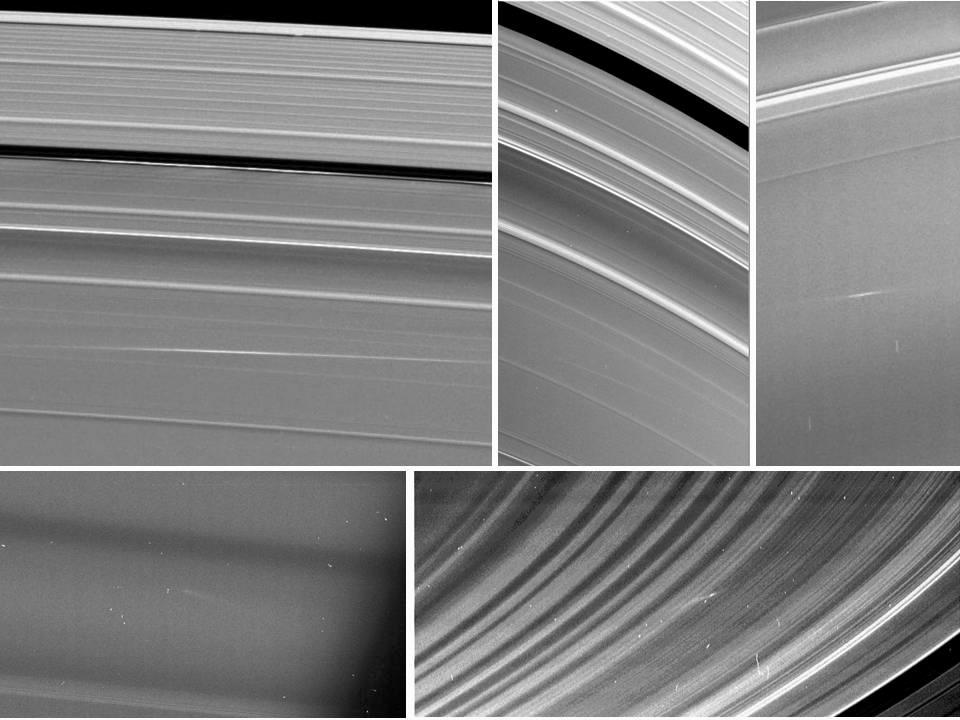
Cassini provided the first direct evidence of small meteoroids breaking into streams of rubble and crashing into Saturn's rings. These observations make Saturn's rings the only location besides Earth, the moon and Jupiter where scientists and amateur astronomers have been able to observe impacts as they occur. Studying the impact rate of meteoroids from outside the Saturnian system helps scientists understand how different planet systems in our solar system formed. Taken with the NAC. Credit: NASA/JPL-Caltech/Space Science Institute/Cornell
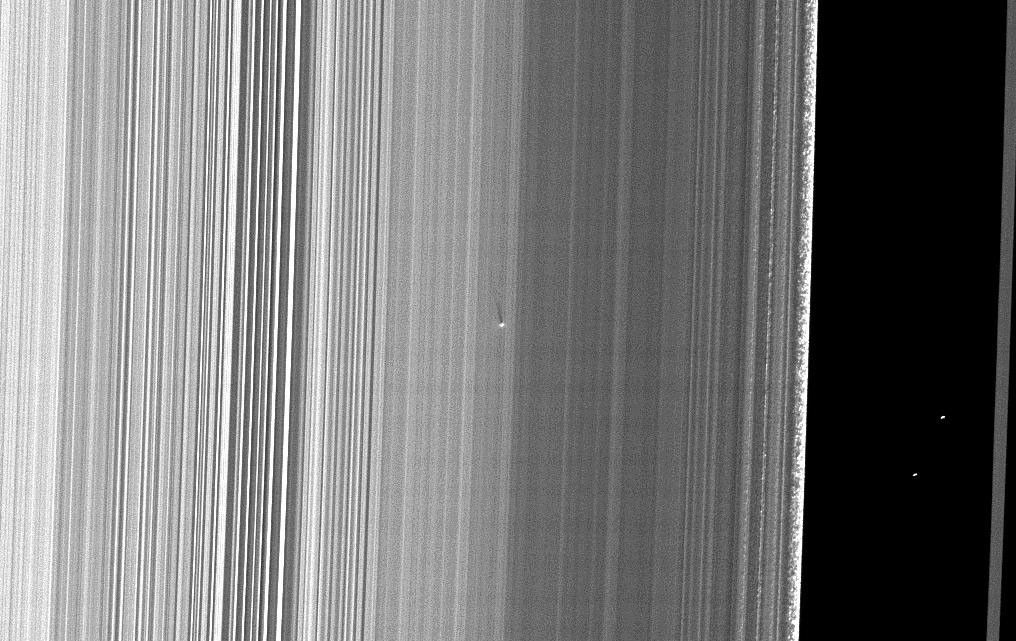
This moonlet – situated about 480 km (300 mi) inward from the outer edge of the B ring – was found by detection of its shadow which stretches 41 ki (25 mi) across the rings. The shadow length implies the moonlet is protruding about 200 m (600 ft) above the ring plane. It is possible that moonlet bodies significantly affect the ring material as it streams past, forcing the particles upward in a "splashing" manner. Credit: NASA/JPL/Space Science Institute
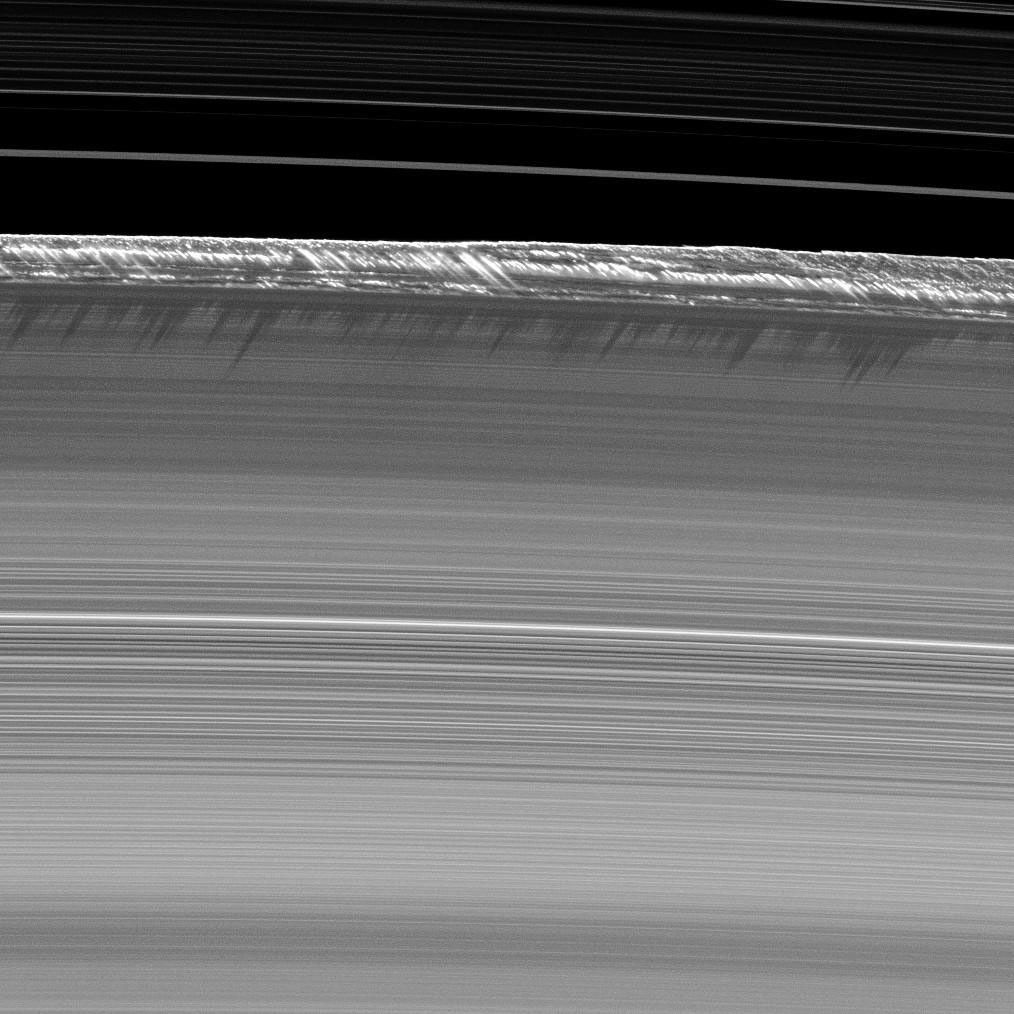
Vertical structures up to 2.5 km (1.6 mi) tall, rise abruptly from the edge of Saturn's B ring to cast long shadows on the ring in this image taken in visible light by the NAC. The main rings – known as A, B, C, and D – spread out 140,000 km (85,000 mi) from the center of Saturn, but they had been thought to be only around 10 m (30 ft) thick, with some particles as large as a building. Cassini observed Saturn during the equinox – the alignment where the sun is directly overhead at noon at the planet's equator. This novel illumination geometry, which occurs every half-Saturn-year, or about 15 Earth years, lowers the sun's angle to the ring plane and causes out-of-plane structures to cast long shadows across the rings' broad expanse, making them easy to detect. Scientists have known about vertical clumps sticking out of the rings in a handful of places, but they could not directly measure the height and breadth of the undulations and ridges until Saturn's equinox revealed their shadows. The view was acquired at a distance of approximately 336,000 km (209,000 mi) from Saturn with an image scale of 2 km (1 mi) per pixel. Credit: NASA/JPL/Space Science Institute
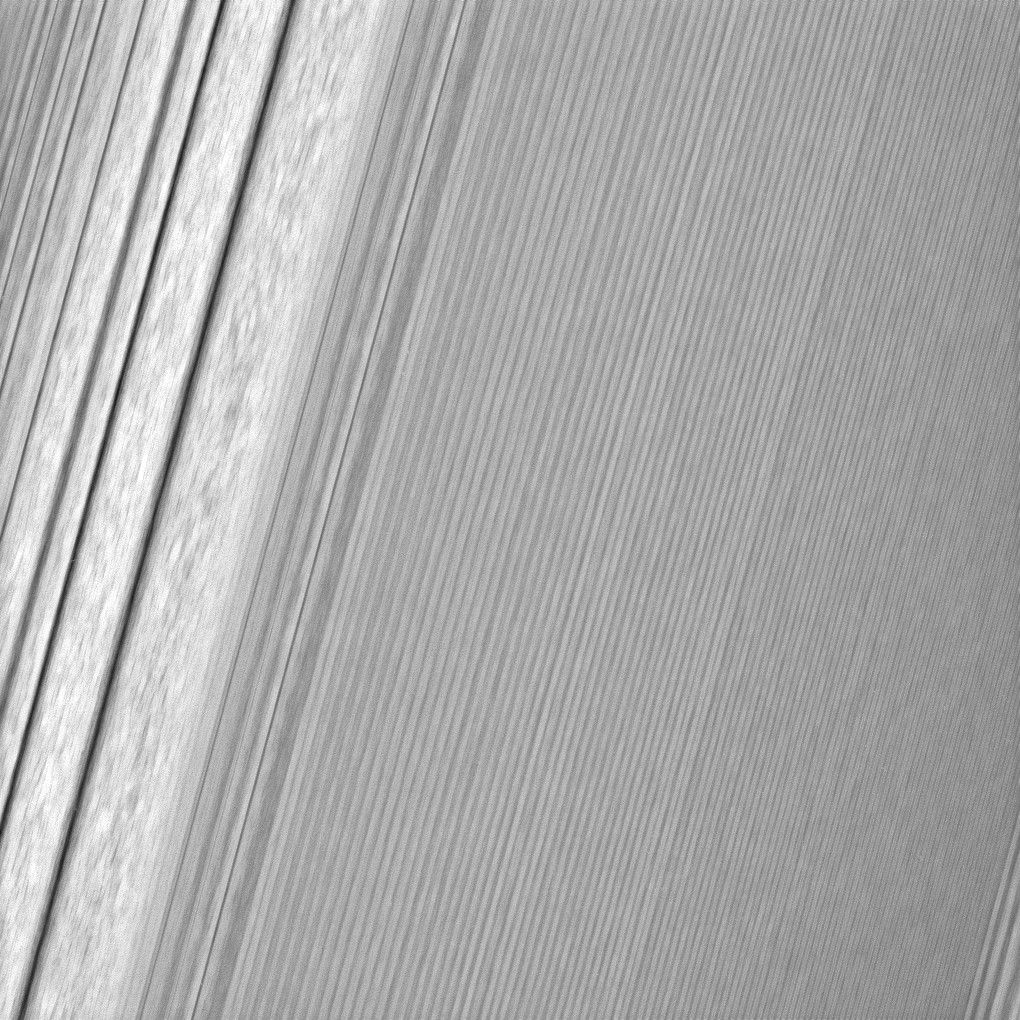
This Cassini image features a density wave in Saturn's A ring (at left) that lies around 134,500 km (83,500 mi) from Saturn. Density waves are accumulations of particles at certain distances from the planet. This feature is filled with clumpy perturbations, which researchers informally refer to as "straw." The wave itself is created by the gravity of the moons Janus and Epimetheus, which share the same orbit around Saturn. Elsewhere, the scene is dominated by "wakes" from a recent pass of the ring moon Pan. Credit: NASA/JPL/Space Science Institute
The Grand Finale

In this mosaic taken by ISS during the last leg of its mission, Saturn looms in the foreground on the left, adorned by ring shadows. To the right, the rings emerge from behind the planet's hazy limb, stretching outward from Cassini's perspective. The view is of the rings' unilluminated face, where sunlight filters through from the other side. The part of the planet seen here is in the southern hemisphere. Credit: NASA/JPL/Space Science Institute
After two mission extensions, Cassini had operated long enough to exhaust almost all its fuel. Thus Cassini was directed to perform a last series of manouevers designated "The Grand Finale". The spacecraft repeatedly climbed high above Saturn’s poles, and dove between Saturn’s uppermost atmosphere and its innermost ring 22 times before burning up in the atmosphere to ensure Saturn's moons remain pristine for future exploration—in particular, the ice-covered, ocean-bearing moon Enceladus, but also Titan, with its intriguing pre-biotic chemistry. The up-close views gathered by Cassini at that time took in both the backlit and sunlit side of the rings. As Cassini plunged into Saturn, it collected rich and valuable information until the very end, capturing incredible views of the planet and the rings.
In addition to the important scientific instruments, Cassini also carried a DVD with 616,400 digitized signatures of people from 81 countries – the first "Send your Name to" disk project.
Cassini's most intriguing finding – revealing that Enceladus has all the ingredients needed for life – energized a new wave of research focusing on exoplanets that could have oceans such as NASA's Europa Clipper mission, which will arrive at Jupiter in April 2030.
Works Cited
BBC News (28 February 2005). Newest Saturn moons given names http://news.bbc.co.uk/2/hi/science/nature/4298053.stm
Dyudina, Ulyana & Ingersoll, Andrew & Ewald, Shawn & Vasavada, Ashwin & West, Robert & Delgenio, Anthony & Barbara, John & Porco, Carolyn & Achterberg, Richard & Flasar, F. & Simon, Amy & Fletcher, Leigh. (2008). Dynamics of Saturn's South Polar Vortex. Science. 319. 1801-1801. 10.1126/science.1153633.
ESA. (2019, September 01). Cassini-Huygens mission objectives. https://sci.esa.int/web/cassini-huygens/2085-objectives/
Ibid. (2019, September 1). Saturn's greatest storm. https://sci.esa.int/web/cassini-huygens/-/60033-saturn-s-greatest-storm
Linda J. Spilker, L.J. (2018, August). The Scientific Achievements of the Cassini-Huygens Mission. Astronomical Society of the Pacific. http://aspbooks.org/publications/513/131.pdf
NASA (2024, November 05). Cassini-Huygens. https://science.nasa.gov/mission/cassini/
Ibid. (2024, November 03). Cassini Orbiter - Imaging Science Subsystem. https://science.nasa.gov/mission/cassini/spacecraft/cassini-orbiter/imaging-science-subsystem/
Ibid. (2024, November 03). Cassini at Enceladus. https://science.nasa.gov/mission/cassini/science/enceladus/
Ibid. (2024, November 03). Cassini: Saturn's Moons. https://science.nasa.gov/mission/cassini/science/moons/
Ibid. (2022, September 14). 10 Things: Why Cassini Mattered. https://science.nasa.gov/missions/cassini/10-things-why-cassini-mattered/
Ibid. (2017, January 29). Close Views Show Saturn’s Rings in Unprecedented Detail. https://science.nasa.gov/missions/cassini/close-views-show-saturns-rings-in-unprecedented-detail/
Ibid. (n.d.). Cassini: FAQ. https://science.nasa.gov/mission/cassini/faq/
Ibid. (n.d.). Cassini at Enceladus: Overview. https://science.nasa.gov/mission/cassini/science/enceladus/
Ibid. (2018, February 15). Cassini Top 10 Science Highlights – 2017. https://science.nasa.gov/missions/cassini/cassini-top-10-science-highlights-2017/
Ibid. (2014, December 08). Translucent Rings. https://science.nasa.gov/resource/translucent-rings/
Ibid. (2023, November 27). Cassini 10 Years at Saturn Top Images. https://science.nasa.gov/missions/cassini/cassini-10-years-at-saturn-top-images/
Ibid. (2013, November 12). The Day the Earth Smiled. https://science.nasa.gov/photojournal/the-day-the-earth-smiled/
NASA-JPL. (2009, September 21) Cassini Reveals New Ring Quirks, Shadows During Saturn Equinox, https://www.jpl.nasa.gov/news/cassini-reveals-new-ring-quirks-shadows-during-saturn-equinox/
Ibid. (2009, January 29). Changes in Titan's Lakes. https://www.jpl.nasa.gov/images/pia11147-changes-in-titans-lakes/
Ibid. (2014, July 28) Surveyor's Map of Enceladus' Geyser Basin. https://www.jpl.nasa.gov/images/pia17188-surveyors-map-of-enceladus-geyser-basin/
Ibid. (2012, July 18). Cassini Spots Daytime Lightning on Saturn. https://www.jpl.nasa.gov/news/cassini-spots-daytime-lightning-on-saturn/
Ibid. (2013, April 25). NASA Probe Observes Meteors Colliding with Saturn's Rings. https://www.jpl.nasa.gov/news/nasa-probe-observes-meteors-colliding-with-saturns-rings/
Space News - SpaceRef ed. (2006, July 27). NASA Reports That Methane Drizzles on Saturn’s Moon, Titan. https://spacenews.com/nasa-reports-that-methane-drizzles-on-saturns-moon-titan/
SETI Institute. (n.d.). First Lightning Flashes on Saturn. https://pds-rings.seti.org/press_releases/pages/PIA12xxx/PIA12575.html

