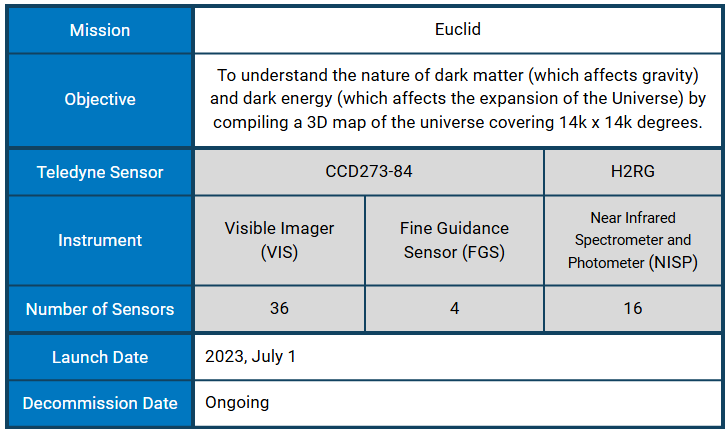
Astronomers have a problem. Either our understanding of the very fundamental physics of the Universe needs to be completely overhauled, or there are two – yet understood – components shaping everything around us.
Until about thirty years ago, astronomers thought that the Universe was composed almost entirely of ordinary matter: protons, neutrons, electrons and atoms. It is now assumed that ordinary matter makes up only about 5% of the Universe, and that the mass-energy budget is actually dominated by two mysterious elements: dark matter – 27% – pulls galaxies together and causes them to spin more rapidly than visible matter alone can account for, and dark energy – 68% – driving the accelerated expansion of the Universe.
After the Big Bang, hydrogen atoms began to cool and massive gas clouds formed inside dark matter clumps, which subsequently condensed into a complex network of intersecting sheets and filaments, separated by large regions with relatively little matter. The arrangement was much like soap bubbles, with clumps of gas arrayed along the walls of the bubbles, clusters of space dust at the intersections, and little material in the centre. As matter accumulated, it pulled more hydrogen and eventually other elements from the surrounding environment, further emptying the “voids”. This interlacing cosmic web became the scaffolding around which galaxies formed through cosmic history.
Dark Energy and Dark Matter
The echoes of the Big Bang continue to shape the Universe. Cosmic expansion was first determined in 1929 by Edwin Hubble, supported by the work of Vesto Melvin Slipher. In 1998, in an effort awarded with the 2011 Nobel Prize for Physics, scientists concluded that the rate of expansion was increasing. This acceleration conflicts with the current understanding of particle physics as the gravitational force exerted by a matter-dominated universe should be slowly decreasing the rate of expansion. The accelerated expansion is attributed to a substance of unknown nature – dark energy.
In 1974, physicist James Peebles – building on the work of Fritz Zwicky and Vera Rubin – compared weight estimates of galaxies based on how much matter could be seen as stars vs an estimate based on a galaxy's movements. These estimates contrasted by a factor of ten when evaluated against the measured true mass of those galaxies. In other words, for every kilogram of visible matter, there appeared to be at least ten kilograms of invisible or 'dark' matter.
Both dark energy and dark matter have not been found to interact with the electromagnetic spectrum on any level, without the emission, absorption or reflectance of a detectable signature. Neither dark matter nor dark energy has yet to be directly observed, despite sufficient evidence to support their existence.
Dark matter has been calculated to take up space and hold mass, and particle physicists determined there is a very faint interaction or influence between dark and ordinary matter, allowing astronomers to theoretically "see" and study it. Dark energy either exists, or scientists need to revamp Einstein's theory of general relativity to explain how gravity works on the scale of the observable universe. In fact, Einstein proposed a modified version of general relativity called unimodular gravity, that alters the understanding of gravity to eliminate dark energy as a potential factor.
The challenge to detect this invisible material was to develop detectors sensitive to the extremely subtle changes of celestial movements and appearance.
Euclid
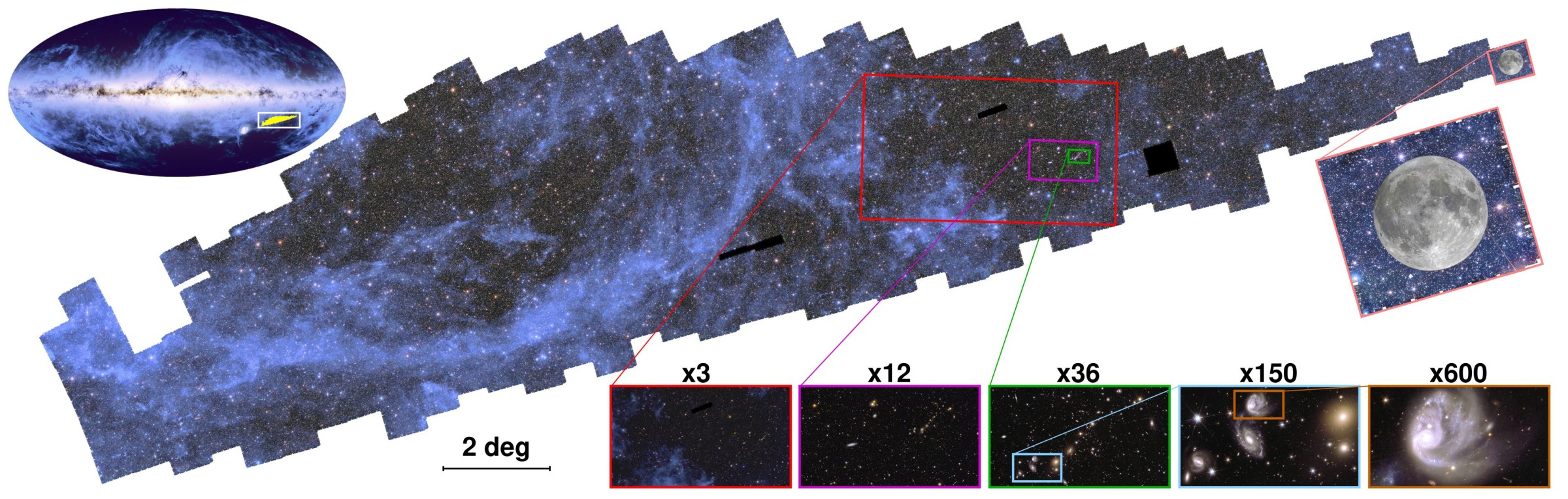 This graphic provides an overview of the mosaic and zoomed-in images. On the top left, an all-sky map (41 000 square degrees) is visible with the location of Euclid’s mosaic on the Southern Sky highlighted in yellow. On the top right, Euclid’s field-of-view in one observation is compared to the area of the full Moon. The mosaic shows the locations of the various zoomed-in images. Above the separate images, the zoom factor is given (from 3 to 600 times enlarged compared to the original mosaic). Credit: ESA/Euclid/Euclid Consortium/NASA
Despite the enormous formative impact dark energy and matter had and continues to exert on the development of the entire cosmic structure, scientists don’t fully understand these phenomena yet. ESA’s Euclid mission is allowing cosmologists to study these competing dark mysteries for the first-time, carrying out a six year survey of about half of the extragalactic sky. This chart of the shape, distance and motion of 1.5 billion galaxies over the past 10 billion light-years will be the largest cosmic 3D map ever made; the accuracy of which will put strong constraints on any fundamental physics theory.
Launched in 2023, the design, production, and operation of Euclid has involved over 3,500 scientists and engineers from 21 countries and more than 300 institutes. Euclid is named after the Greek mathematician Euclid of Alexandria, who lived around 300 BC, and is known for his contributions to geometry. As the density of matter and energy is linked to the geometry of the Universe, the mission was named in his honour.
Euclid creates remarkably sharp visible and infrared images across a deep expanse of the sky, showing the entirety of vast celestial objects and events, while remaining extremely clear, even when zooming in on distant galaxies. The telescope orbits beyond Earth’s infrared-absorbing atmosphere at the distant Earth-Sun L2. L2 also provides a clearer view of deep space, with the Earth, Moon, and Sun always behind the spacecraft, producing an image quality four times sharper than comparative ground-based surveys.
Euclid is a part of ESA’s Cosmic Vision programme – the successor to the Horizon 2000 programme – dedicated to studying the origins of the Universe and the emergence of life. Teledyne developed the essential technology behind these previous missions, including XMM-Newton, Juice, Integral, Plato, Cheops, Gaia, LISA Pathfinder, and BepiColombo.
Euclid will precisely measure the expansion history of the Universe and large scale distribution of matter in the Universe. Its two major surveys – wide-field and deep-field – will be performed in a "step and stare" mode, meaning that the telescope will point and make measurements on about 0.5 square degrees of the sky at a time.
Euclid’s wide field survey will cover 36% of the celestial sphere – about 14,000 square degrees – and image galaxies out to a redshift of z~2.
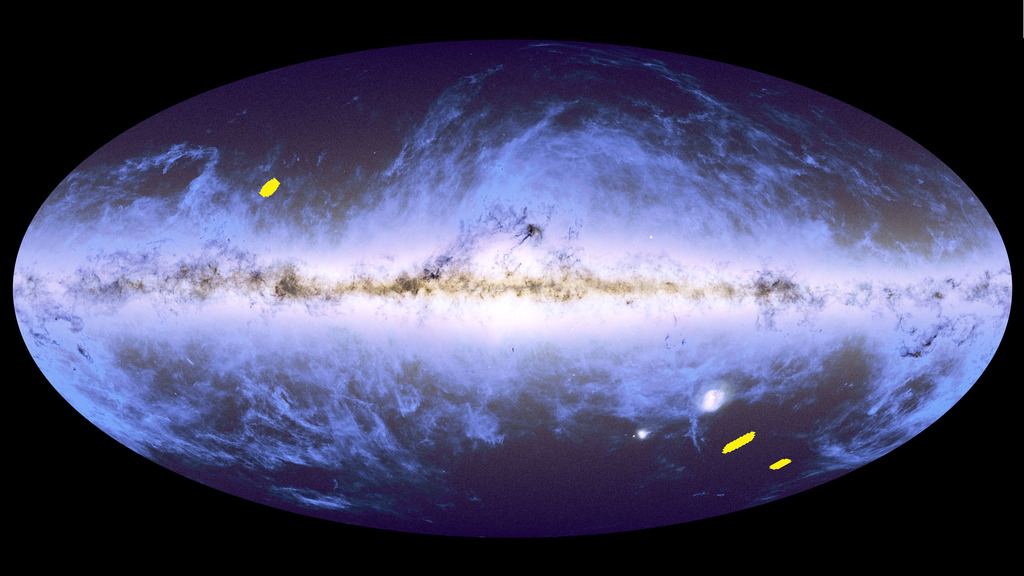 Euclid’s deep-field survey will repeatedly observe three patches of the sky to record objects at ~2 magnitudes deeper than the wide survey. Credit: ESA/Euclid/Euclid Consortium/NASA; ESA/Gaia/DPAC; ESA/Planck Collaboration
Euclid’s three deep-fields were carefully selected to reduce the interference from bright Milky Way stars and the diffuse glow of dust in the Solar System, thus encouraging future multi-wavelength observations targeting the same areas.
Euclid Deep Field North – located very close to the Northern Ecliptic Pole to ensure maximum coverage throughout the year, this area overlaps with a survey region of NASA's Spitzer Space Telescope.
Euclid Deep Field Fornax – encompasses the Chandra Deep Field South, a region extensively surveyed for two decades with ESA's XMM-Newton, the Hubble Space Telescope, and major ground-based telescopes.
Euclid Deep Field South – a celestial area that has not been covered to date by any deep sky survey. Selected with consideration to the capabilities of future ground telescopes like the Vera C. Rubin Observatory – which uses Teledyne detectors.
Visual imager (VIS)
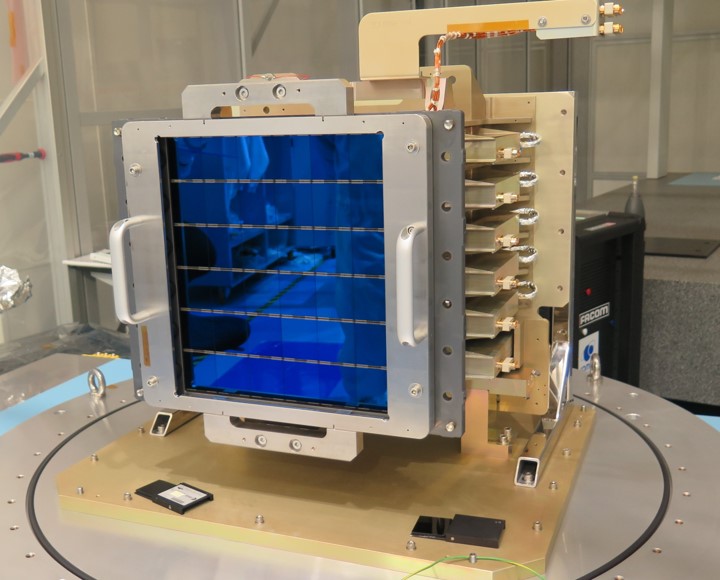
The focal plane of the VIS instrument consists of a square camera of more than 30cm with 36 CCD sensors of 16 million pixels each. Each pixel measures 12 micrometers on each side and has a field of view of the sky of 0.1 arc second, giving a total field of view of 0.55deg², twice the size of the full moon. Credit, M.Berthé/CEA
Euclid’s VIS instrument features the best low-light sensitivity over a broad range of wavelengths at long integration times. It uses a 6x6 mosaic of 4096×4132 12 μm pixel CCDs for a total of about 600 megapixels. The 36 Teledyne CCD273-84 sensors were developed specifically for the Euclid mission. VIS covers the wavelength range from 0.5 - 0.9 µm, with a spectral resolution of 0.1 arcsec.
Fine Guidance Sensor (FGS)
Collocated within VIS, FGS directs the fine attitude measurement at 99.7% confidence with a 75 milli-arcseconds relative pointing error over 700 sec and 7.5 arcsec of absolute pointing error. FGS is equipped with a Teledyne CCD273-84.
Near Infrared Spectrometer and Photometer (NISP)
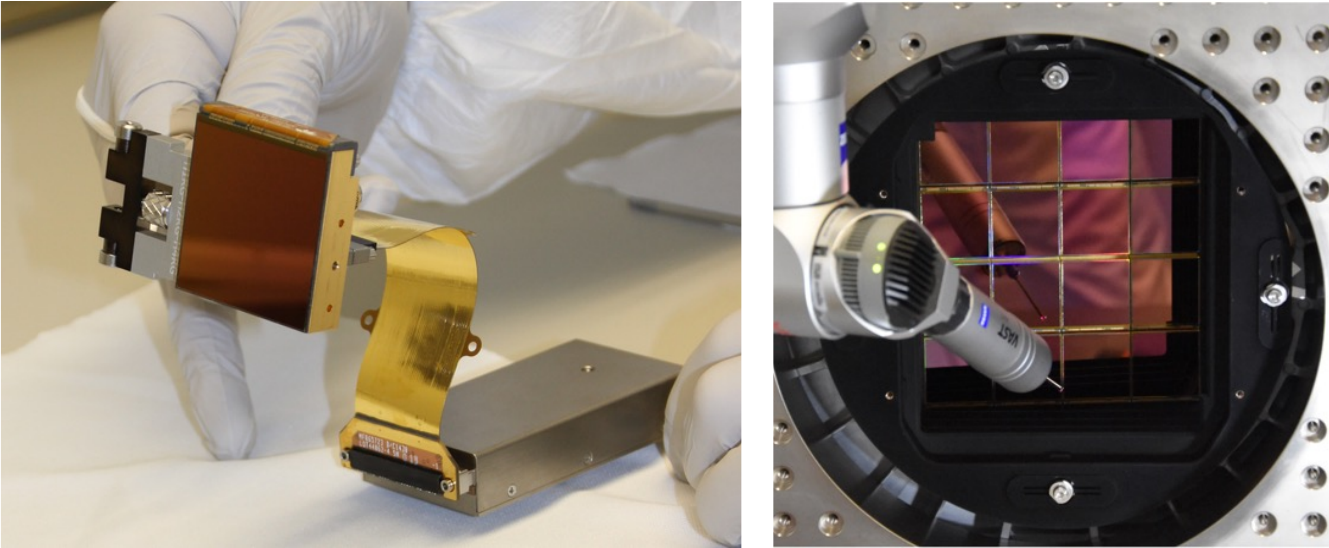 A single NISP H2RG detector “triplet” including detector chip, read-out electronics, and flexible cable on the left. The right image shows the array of 16 detectors in a test setup where their spatial position is measured to ensure that they lie in the same plane. Credit: Euclid Consortium
Covering a field of view of 0.53 deg2 – shared with VIS – the NISP instrument will feature the largest field of view ever flown for an infrared instrument. NISP uses a 4×4 matrix of 2040×2040 18 µm pixel H2RG detectors provided by Teledyne Imaging Systems. NISP’s photometric channel will be equipped with three broad band SWIR filters: Y (.9 -1.192 µm), J (1.192 - 1.544 µm), and H (1.544 - 2µm). The slitless spectroscopic channel of NISP will be equipped with four different low-resolution NIR grisms: Three 'red' grisms (1.250 - 1.85 µm) and one 'blue' grism (.92 - 1.25 µm).
Measuring infrared redshift tells astronomers the rate of the universe's expansion and the strength of dark energy as it accelerates that expansion. Hubble's Law tells us that the distance to a galaxy is related to how fast the expansion of the universe is carrying that galaxy away from us, and the higher the recession velocity, the more distant the galaxy and the higher its redshift – the stretching of light to redder wavelengths as an object moves away.
While the measurement of redshifted light is the only way to accurately calculate the position of distant celestial objects, infrared is not the only part of the spectrum studied by astronomers. The majority of new sources identified by imaging observatories – radio to X-rays – will be readily associated with a known redshift – out to z~2. This eliminates the time-consuming process of redshift follow-up. Missions such as the upcoming Nancy Grace Roman Space Telescope – which will use Teledyne sensors https://www.teledyne.com/en-us/news/Pages/teledyne-completes-delivery-of-flight-detectors-to-the-roman-space-telescope.aspx – will extend the essential science fueled by Euclid helping to trace the distribution of matter across cosmic history. This will unlock a major bottleneck in scientific data processing, releasing an unprecedented amount of data to study fainter galaxies and work to understand how the Universe was created.
Gravitational Lensing
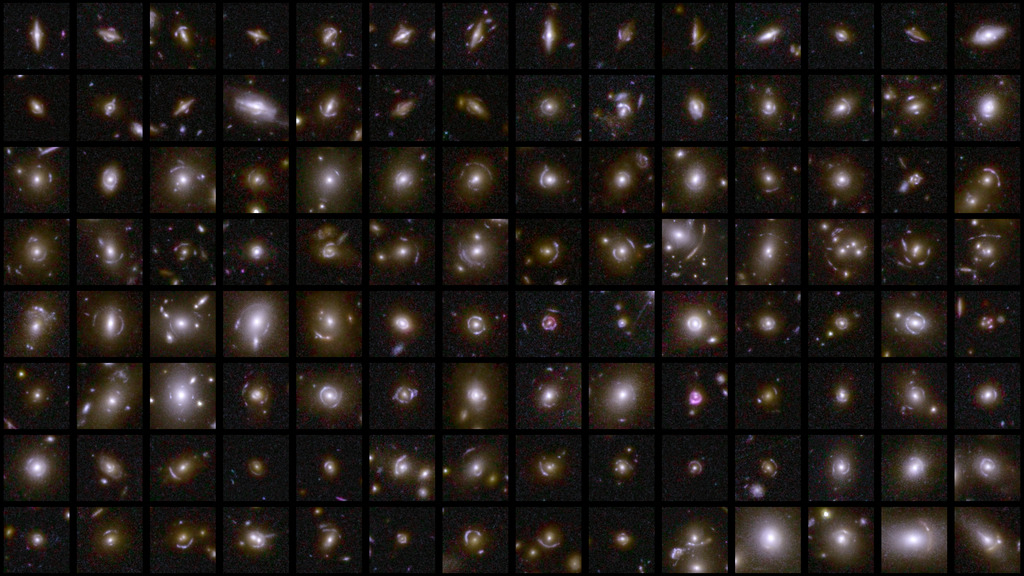 This image shows examples of gravitational lenses that Euclid captured in its first observations of the Deep Field areas. Using an initial sweep by artificial intelligence models, followed by citizen science inspection, expert vetting and modelling, a first catalogue of 500 galaxy-galaxy strong lens candidates was created, almost all of which were previously unknown. With the help of these models, Euclid will capture some 7000 candidates in the major cosmology data release planned for the end of 2026, and in the order of 100,000 galaxy-galaxy strong lenses by the end of the mission, around 100 times more than currently known. Credit: ESA/Euclid/Euclid Consortium/NASA
Euclid performs 'tomography' of dark matter structures by analysing the way dark matter warps the images of more distant galaxies through a phenomenon known as gravitational lensing. Dark matter deflects light because of its gravitational pull – more specifically, its warping of space-time. Light transmitted from a distant object will be distorted when a foreground galaxy and its halo of dark matter acts as a lens, warping the image of a background galaxy along the line of sight towards Euclid. Tracing the path this light travels allows scientists to measure the distribution of dark matter. By doing this with billions of galaxies, Euclid will build a full map of the distribution of dark matter in the entire universe.
Current Progress
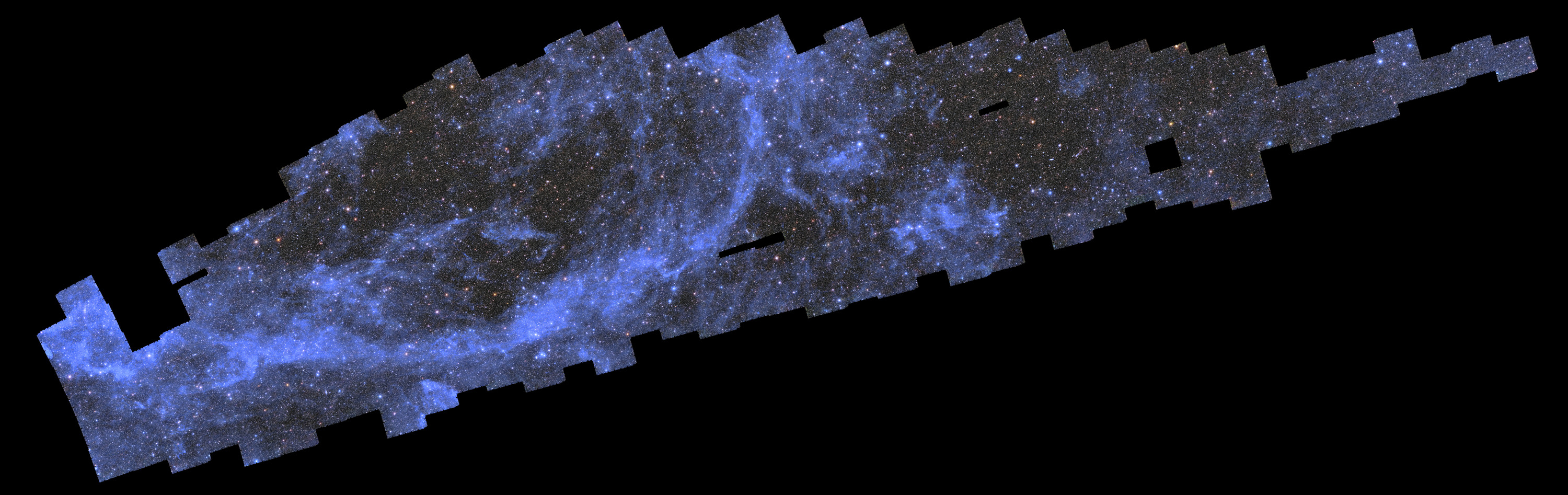
This 208 gigapixels mosaic made by ESA’s Euclid space telescopes contains 260 observations collected between 25 March and 8 April 2024 – just 1% of Euclid’s full survey. In just two weeks, Euclid covered 132 square degrees of the Southern Sky, more than 500 times the area of the full Moon as seen from Earth. The empty regions within the mosaic were intentionally avoided during the survey due to the presence of very bright stars, which would ‘blind’ Euclid’s sensitive instrumentation. Credit: ESA/Euclid/Euclid Consortium/NASA, CEA Paris-Saclay
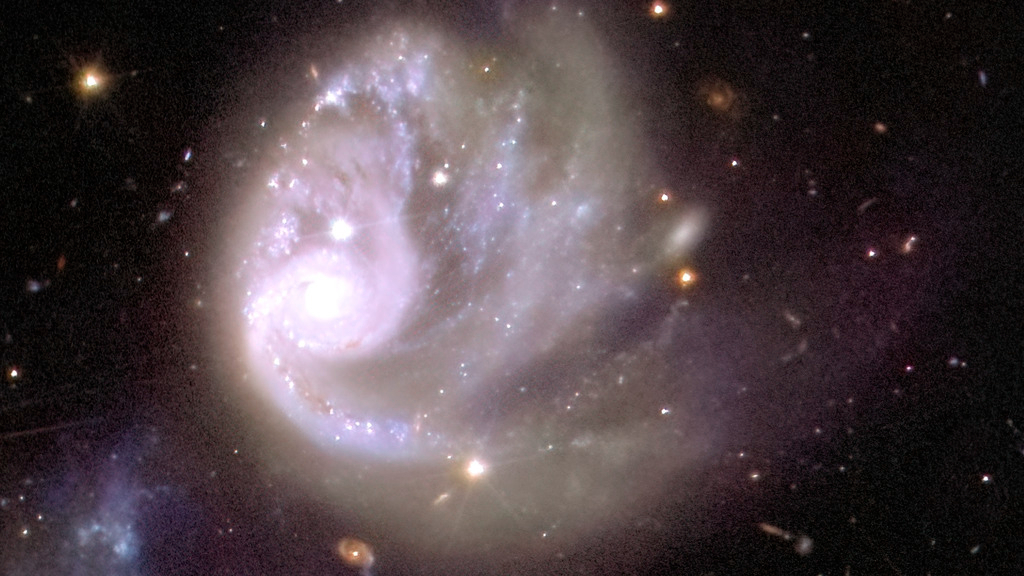 This image shows a detail from the mosaic shown above. The area is zoomed in 600 times compared to the large mosaic. In this image, a single spiral galaxy (called ESO 364-G036) is visible in great detail, 420 million light-years from us. This image shows 0.0003% of the initial image of 208 gigapixels, that is 1/330 000 of the area of the main Euclid mosaic. Credit: ESA/Euclid/Euclid Consortium/NASA, CEA Paris-Saclay
All Euclid data will be made public in three major data releases – DR1, DR2, DR3 – phased with the survey progress, with the final DR3 anticipated a year after the main survey ends in June of 2030. Well-characterised and validated data will be released via ESA’s Euclid Science Archive System and by the NASA/IPAC Infrared Science Archive.
The first batch of survey data catalogued over 26 million galaxies, including 380,000 classified by AI and citizen scientists. In just one week of observation, Euclid revealed galaxies up to 10.5 billion light-years away, as well as hundreds of gravitational lens candidates. Euclid’s new science results include the detection of very faint free-floating planets – planets that don’t orbit stars – in addition to newly identified brown dwarfs.
We have never seen astronomical images like this before, containing so much detail. They are even more beautiful and sharp than we could have hoped for, showing us many previously unseen features in well-known areas of the nearby Universe. Now we are ready to observe billions of galaxies, and study their evolution over cosmic time.
- René Laureijs, ESA’s Euclid Project Scientist.
Works Cited
Cooper, Keith. (2023, July 10). Euclid mission: ESA's hunt for dark matter and dark energy. https://www.space.com/36195-euclid-esa-facts.html
The European Space Agency (ESA). (2025, February). ESA's 'Cosmic Vision'. https://www.esa.int/Science_Exploration/Space_Science/ESA_s_Cosmic_Vision
Ibid. (2023, November 11). Euclid's first images: the dazzling edge of darkness. https://www.esa.int/Science_Exploration/Space_Science/Euclid/Euclid_s_first_images_the_dazzling_edge_of_darkness
Ibid. (n.d.). Euclid overview. https://www.esa.int/Science_Exploration/Space_Science/Euclid_overview
ESA - Science & Technology. (202, July 9). The Euclid space telescope is coming together. https://sci.esa.int/web/euclid/-/the-euclid-space-telescope-is-coming-together
Ibid. (2019, October 29). Euclid - Science Goals. https://sci.esa.int/web/euclid/-/42267-science
Ibid. (2019, October 18). Euclid VIS instrument. https://sci.esa.int/web/euclid/-/euclid-vis-instrument
Ibid. (2019, September 19). Euclid NISP instrument. https://sci.esa.int/web/euclid/-/euclid-nisp-instrument
Ibid. (2020, September 8). What is dark matter? https://sci.esa.int/web/euclid/-/what-is-dark-matter-
Furlanetto, Steven. (2021). Cosmic Dark to Cosmic Dawn. https://cosmicdawn.astro.ucla.edu/
Haynes, Korey. (2024, October 14). Euclid releases stunning first map of the deep sky. https://www.astronomy.com/science/euclid-releases-stunning-first-map-of-the-deep-sky/
National Aeronautics and Space Administration (NASA). (2025, May 02). Dark Energy. https://science.nasa.gov/dark-energy/
Ibid. (2025, August 29). Dark Matter. https://science.nasa.gov/dark-matter/
Ibid. (2024, May 23). New Images From Euclid Mission Reveal Wide View of the Dark Universe. https://www.nasa.gov/missions/euclid/new-images-from-euclid-mission-reveal-wide-view-of-the-dark-universe/
Pappas, Stephanie. (2019, January 17). The Day Edwin Hubble Realized Our Universe Was Expanding. https://www.livescience.com/64527-edwin-hubble-universe-expanding.html

