There are few things more destructive than an asteroid… just ask the dinosaurs. Numerous craters on the moon and Earth attest to past impacts of devastating force.
Scientists are always tracking large asteroids that could potentially strike the Earth. However, the full distribution of near-Earth asteroids (NEAs) is not comprehensively known or detailed, and there is ample evidence that the probability of catastrophic impacts is not negligible.
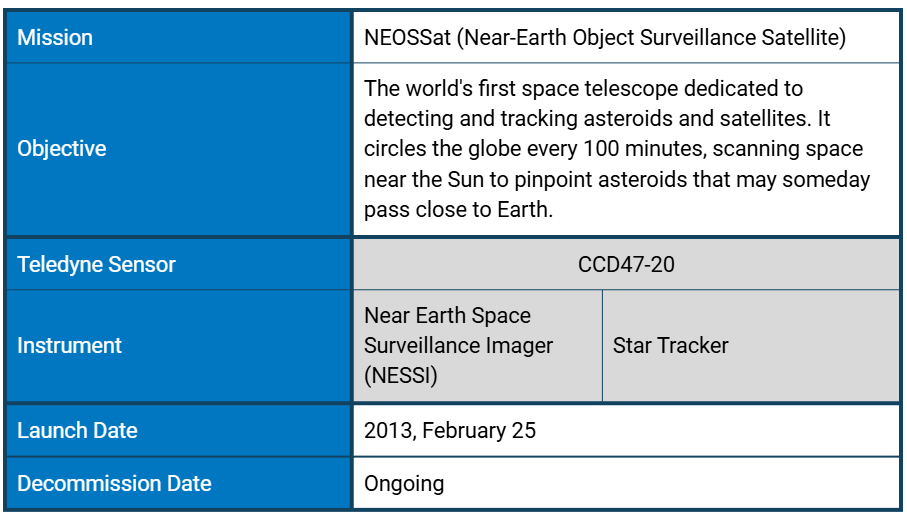
In 2012, the International Astronomical Union (IAU) called for the establishment of an international asteroid early warning system. The following year saw the launch of NEOSSat, the Near-Earth Object Surveillance Satellite. As the world's first space telescope dedicated to tracking both natural and artificial space objects, Canada’s NEOSSat conducts dual-mode space surveillance of Near-Earth Objects (NEOs) – comets and asteroids – and Resident Space Objects (RSOs) – spacecraft and space debris.
NEOSSat is funded by the Canadian Space Agency (CSA) and Defence Research & Development Canada (DRDC). It improves upon the design of the successful MOST mission built on an adaptable, multi-mission microsatellite bus.
Although ground-based telescopes have made significant progress in finding NEAs, space telescopes offer three advantages:
Searching the ecliptic plane at closer elongations to the Sun
Using parallax to discriminate NEAs from those of the main asteroid belt between Mars and Jupiter through distance determinations.
Continuous observation unrestrained by geographic location and the day-night cycle.
Credit: CSA
Deployed to a Sun-synchronous orbit circling the Earth’s poles every 50 minutes, NEOSSat can track objects at a wide range of orbital locations. It offers all-sky target acquisition with precise Fine Point Control, a Track Rate Mode for moving targets, and an extended baffle for low-solar-elongation observations. NEOSSat also enables continual photometry for asteroseismology, exoplanet transits and other transients.
NEOSSat has provided astrometric observations of known asteroids and comets to the Minor Planet Centre (MPC) and has performed extensive imaging of several asteroid close approaches. This helps scientists enhance the state of alert while extending the response lead times. In addition, NEOs contain well-preserved evidence of conditions during the creation of the Solar System. Further characterisation of these asteroids would increase the understanding of how they formed.
Fulfilling the mission objectives required a high degree of pointing stability and rapid agility at rates previously not implemented on a microsatellite. Hundreds of times per day, the satellite quickly spins to point at new locations, each time snapping to a halt and holding steady on a distant target, or precisely tracking a satellite as it progresses along its orbit.
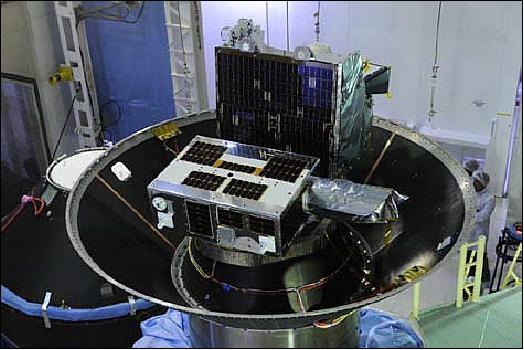
 NEOSSat launch configuration as a secondary payload to PSLV-20 launcher. Credit: CSA
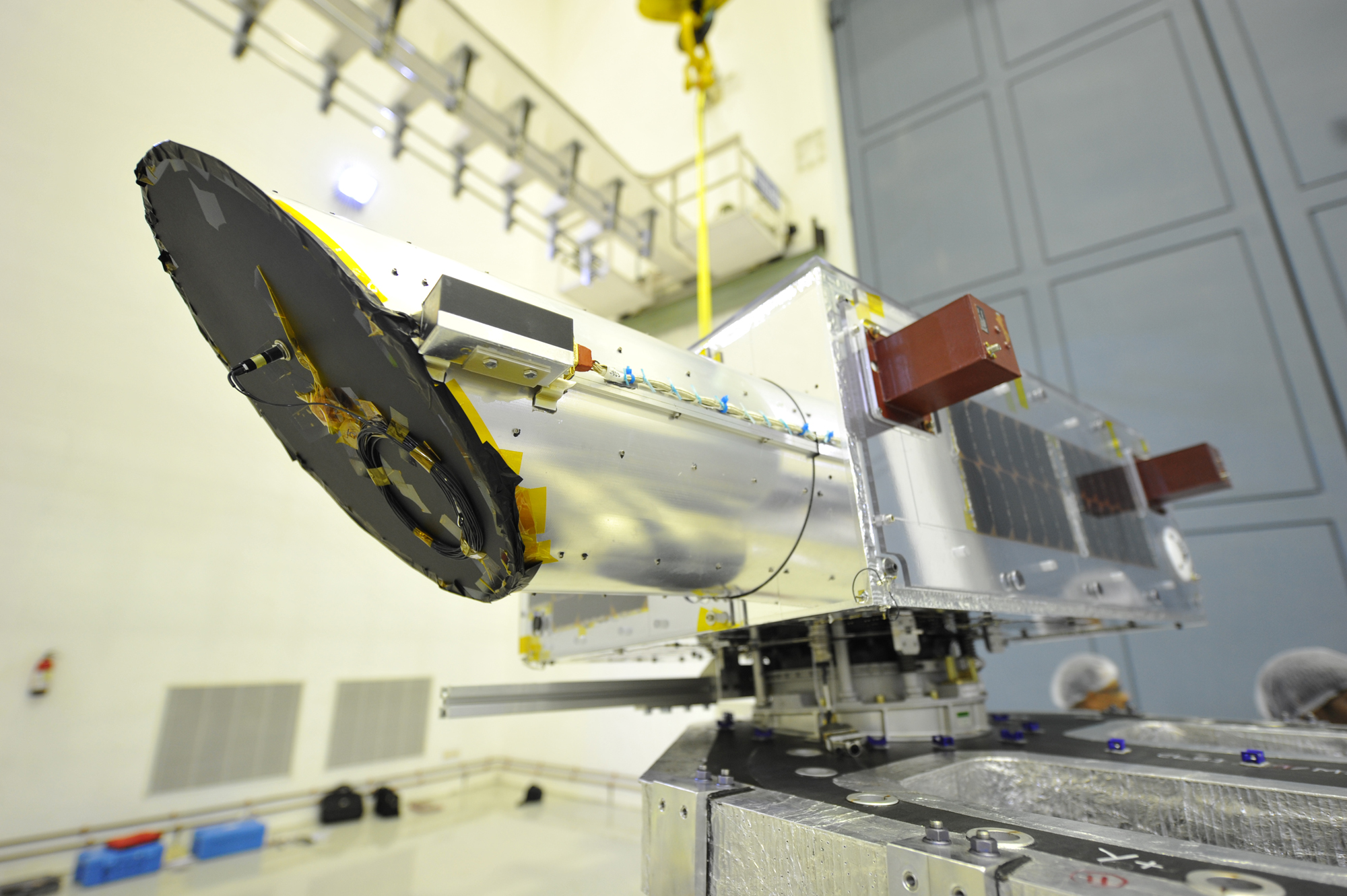
NEOSSat’s primary payload is a 15-cm aperture Maksutov optical telescope, containing two identical 1024 x 1024, 13 µm pixel, CCD47-20 detectors produced by Teledyne Space Imaging. The mid-band coated, frame-transfer CCDs are flight spares from the MOST mission. After passing a technical assessment, they were deemed capable of meeting the science specifications for the mission. The CCDs are side abutted on the same focal plane, but each detector goes to a different instrument: the Near Earth Space Surveillance Imager (NESSI), and a specialized narrow-field star tracker sharing the optical boresight.
The custom star tracker operates with a miniscule 0.8 degrees field of view, working autonomously with an onboard star catalog featuring two million guide stars. Together with an attitude control system design that minimises jitter and induced vibrations, NEOSSat supports high-precision fine pointing at celestial targets with better than one arcsecond stability, and maintains star tracker custody during fine slews to enable highly accurate tracking of fast-moving objects up to 220 arcseconds – well exceeding the original target of 60 arcseconds.
NESSI produces measurements accurate to within 3 arcsec (~600 m in the plane of the sky at geostationary satellite ranges). In addition to the instrument's accuracy, automated image processing for noise reduction enhances detailed data collection. The CCD readout electronics flight software synchronises the operations of the science and star tracker CCDs to eliminate a single source of interference. Also, science images were tasked to include an overscan region that is later analysed automatically in the ground image processing software using Fourier transforms to identify the major interference frequencies and produce clean images by subtracting those noise contributions.
NEOSSat lacks active temperature control, but its optical focus operates best within a specific temperature range. The solution is to insert “cooling” periods, where the satellite’s orientation is controlled relative to the Sun. These thermal stabilisation periods improve the telescope’s optical focus before imaging, reducing the limiting magnitude for 100-second exposures.
Protecting Satellites
Satellites are very expensive, so protecting them from hazardous objects is a paramount concern. As space exploration continues to accelerate, more satellites will be launched into already congested low-Earth orbits. In addition to decades of spacecraft deployments, there is concern about artificially generated space debris. While much less of a risk to the planet, tiny asteroids and small pieces of debris remain a major concern for active spacecraft. This underscores the importance of space situational awareness (SSA) and the utility of object-avoidance prediction models.
Contributing data to the Space Surveillance Network (SSN) – a network of ground-based telescopes and radars located around the world – NEOSSat helps track over 43,500 space objects comprising more than 15,100 tonnes. This information helps coordinate multinational space surveillance activities involving NATO and European allies, such as manoeuvre monitoring, breakup event characterisation, high-value asset tracking, and satellite anomaly characterisation and recovery. Furthermore, NEOSSat has demonstrated strategic value for the Canadian Forces, supplying astrometric and photometric data used for orbit determination and space object characterisation.
NEOSat’s orbit means that the objects it is searching for will be travelling straight at the telescope. Thus, when imaging a target object, the target will appear “stationary”, and the background stars will elongate into streaks. To minimise inference from long streaks, NEOSSat takes short exposures under 10 seconds.
NEOSSat’s highly accurate fine slewing capabilities are used to image RSOs in Track Rate Mode (TRM), where NEOSSat is slewed to match the apparent motion of an RSO, resulting in streaked stars and a point source RSO. TRM imagery maximises the signal-to-noise ratio of RSO signatures on the detector, but requires prior knowledge of the object's trajectory to align the telescope's movement with the target's apparent motion. Since the telescope follows the RSO during imaging, the signal accumulates in a smaller area on the CCD, compared to the more thinly distributed signal in RSO streaks from imagery in Fine Point. During RSO observations, the sensor will obtain full images at a rate of 1 every 10 seconds, with smaller portions of the CCD available at higher rates.
Applying modern image processing and photometric techniques, NEOSSat is now participating in exoplanet research by imaging stars with known transiting exoplanets and directly detecting exoplanet transits. The development and validation of precision photometry with NEOSSat enables new studies in near-Earth object characterisation.
Initially planned for one year, NEOSSat has been operational for well over a decade, vigilantly scouting the sky for dangers, and still collecting accurate data despite the failure of its magnetometer and all torque rods. This data can be used to evaluate NEO populations for potential future missions. NEOSSat’s successor – NEOSurveyor – is planned to launch in 2027 and will also feature detectors from Teledyne Space Imaging.
Works Cited:
Ed. T. Flohrer, R. Jehn, F. Schmitz, V. Abbasi, S. Thorsteinson, D. Balam, J. Rowe, D. Laurin, L. Scott, M. Doyon.(January 2019). THE NEOSSAT EXPERIENCE: 5 YEARS IN THE LIFE OF CANADA’S SPACE SURVEILLANCE TELESCOPE. Proc. 1st NEO and Debris Detection Conference. https://conference.sdo.esoc.esa.int/proceedings/neosst1/paper/494
EOPortal. (2012, June 1). NEOSSat (Near-Earth Object Surveillance Satellite). https://www.eoportal.org/satellite-missions/neossat#neossat-near-earth-object-surveillance-satellite
J. M. Oschmann, Jr., M. W. M. de Graauw, H. A. MacEwen. (2008). Space Telescopes and Instrumentation 2008: Optical, Infrared, and Millimeter. Proc. of SPIE Vol. 7010, 701013. doi: 10.1117/12.789736. https://ia600108.us.archive.org/view_archive.php?archive=/24/items/wikipedia-scholarly-sources-corpus/10.1117.zip&file=10.1117%252F12.789736.pdf
D. Laurina , A. Hildebrandb , R. Cardinalb , W. Harveya , S. Tafazolia. (n.d.). NEOSSat – A Canadian small space telescope for near Earth asteroid detection https://ia800108.us.archive.org/view_archive.php?archive=/24/items/wikipedia-scholarly-sources-corpus/10.1117.zip&file=10.1117%252F12.789736.pdf
B. W. Robert, S. Michael, A. Hildebrand, R. Cardinal. (n.d.). The Near Earth Object Surveillance Satellite: Mission status and CCD evolution after 18 months on-orbit. https://amostech.com/TechnicalPapers/2014/Space_Systems/WALLACE.pdf
Space Environment Statistics. (2025, 21 October). Environment Statistics. https://sdup.esoc.esa.int/discosweb/statistics/
Government of Canada - CSA. (2024, 04 October). Near-Earth Object Surveillance Satellite (NEOSSat). https://www.cadc-ccda.hia-iha.nrc-cnrc.gc.ca/en/neossat/

