The creation of our Solar System began with the Sun, which formed from the
collapse of a giant cloud of gas and dust called a solar nebula; Jupiter --
the most massive of all the planets -- accreted the majority of the leftover
material. Unlike Earth, Jupiter's size allowed it to hold onto its
original composition, thus preserving a record of its formation over 4 billion
years ago. By investigating Jupiter, scientists can trace our solar
system's history to better understand the fundamental processes and
materials that govern its development and the conditions that shaped its
evolution. Furthermore, as our primary example of a giant planet, Jupiter can
provide critical insights into the planetary systems being discovered around
other stars.
According to myth, the Roman god Jupiter -- after whom the planet is named --
was often up to no good. While he attempted to hide his indiscretions behind a
blanket of clouds, his wife Juno had the power to see through them. Launched
in 2011, NASA's Juno satellite possesses a similar clarity of vision. Its
suite of precise instruments peered through the dense clouds of hydrogen and
helium to probe the depths of Jupiter's structure and core, measure the
global abundances of oxygen (water) and nitrogen (ammonia), and map
gravitational and magnetic fields generated by the distribution and motion of
mass within the planet.
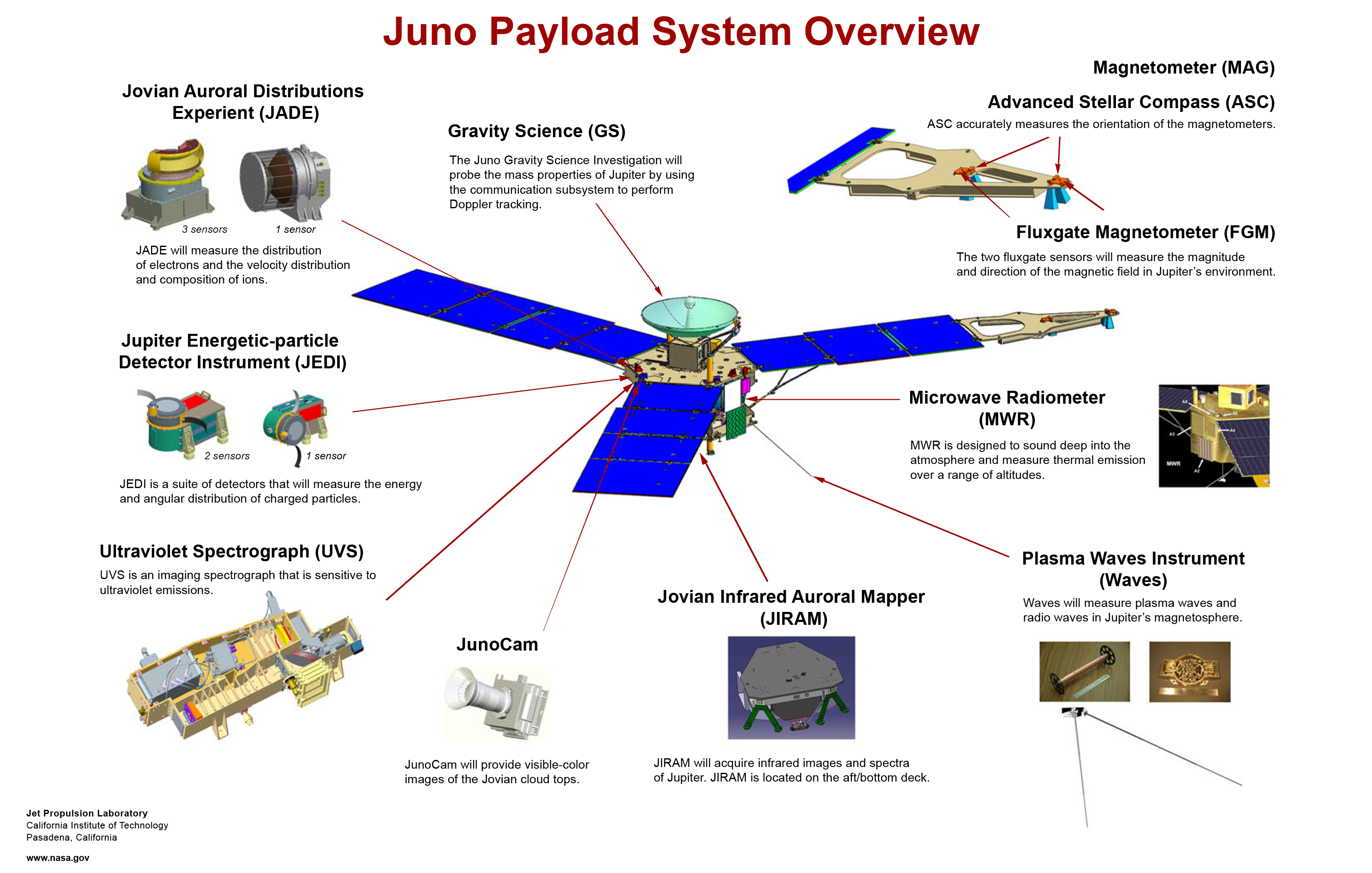 Credit: JPL
Advanced Stellar Compass (ASC) on the Magnetic Field investigation (MAG)
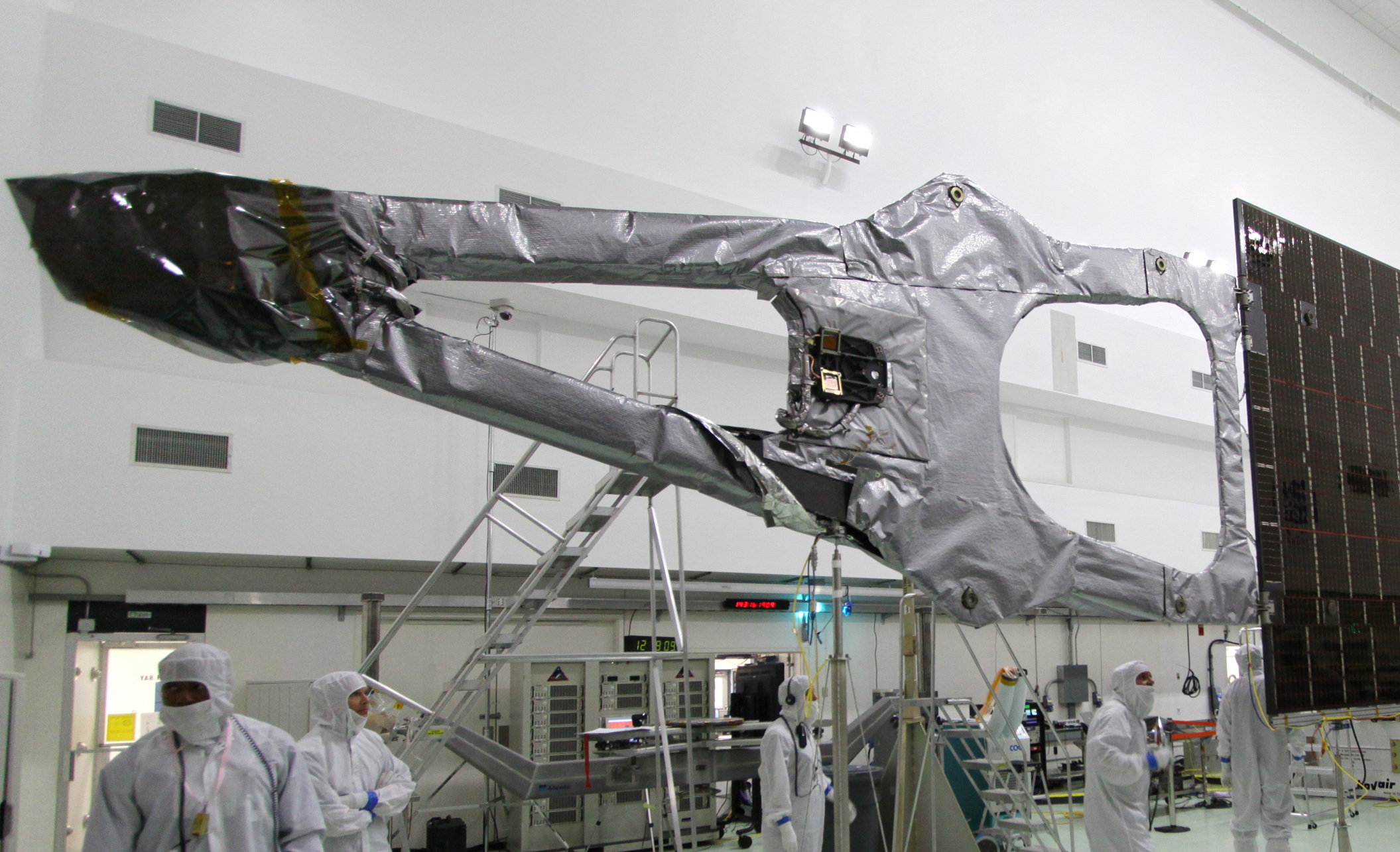
Four star tracker cameras help determine the precise orientation of the
magnetometers as they sense Jupiter's magnetic field. Credit:
NASA/JPL
Juno's Magnetic Field investigation (MAG) conducted the first global, 3D
magnetic mapping of Jupiter, determining highly accurate vector measurements
of the magnetic dynamo from the interior through to the upper reaches of the
polar magnetosphere. Its improved spatial resolution -- orders of magnitude
better than previous missions -- enabled scientists to create a spherical
harmonic model of the Jovian magnetic field with enough detail to support
comparisons with Earth's. This knowledge advances understanding of
Jupiter's internal structure and how its magnetic field is generated by
dynamo action of electrically charged material deep below the surface. Because
Jupiter lacks a rocky crust or continents that interfere with data collection
and accurate analysis, Juno's observations are amongst the most detailed
observations of a planetary dynamo.
MAG consists of two independent magnetometer sensor suites, each comprising a
fluxgate magnetometer (FGM) and a pair of star trackers: the Advanced Stellar
Compass (ASC). FGM measures magnetic field vectors with 100 ppm absolute
vector accuracy, while the ASC plots the location of the FGM's measurement
to a precise ∼20 arcsec. In other words, ASC takes images of stars to
determine the spacecraft's orientation in space, which is vital to
plotting accurate measurements.
The ASC system contains four Camera Head Units (CHUs). Each FGM is mounted
precisely on an optical bench with a pair of collocated CHUs, each equipped
with a Teledyne TH7890M; an optical front-illuminated, interline-transfer CCD
optimised for low-light imaging. This supports the detection of stars and
objects as faint as 7-8 mV.
Each CHU generates an 8-bit grayscale interlaced image -- 752 by 580 pixels --
of the star field, and sends it to a data processing unit (DPU) for
processing. The DPU derives the CHU attitude by comparing the star field with
an on-board star catalogue, which records four attitude solutions for each of
the four CHUs every second.
For mission reliability, the ASC needs to operate fully autonomously. This
requires an effective method to distinguish real stars from other non-stellar
objects -- planets, satellites, asteroids, and debris -- that might appear in
the imager's FOV, and cause an inaccurate attitude reading. The ASC
accepts the identification of a star field only if all of the luminous objects
present in the FOV closely match those in the star catalogue. It also uses the
rotation of the satellite -- about two rpm -- to separate environmental fields
from those that rotate with the spacecraft. This implementation has proven
extremely robust and particularly effective when operating the ASC in
high-radiation environments.
Juno's other instruments have their own small magnetic fields. To avoid
contamination and inaccurate data, the MAG sensors sit as far from the rest of
the spacecraft as possible. They are mounted on the magnetometer boom that
sticks out from one of Juno's solar arrays. As an extra precaution, there
are two sets of MAG sensors; one 10 m (33 ft) from the centre of the
spacecraft and one 12 m (39 ft) from the centre. Scientists compared
measurements from both sensors to remove contamination from the MAG data due
to the spacecraft itself.
Protection from Radiation
Juno also demonstrated how future space missions can protect themselves from
the most intense radiation in the solar system. Jupiter's magnetic field
rotates around the planet and sweeps up charged particles, accelerating them
to very high energies and creating intense radiation that bombards anything
passing near the planet, including spacecraft. Juno deploys two
radiation-dodging tricks which have kept Juno in orbit for over a decade.
To avoid the highest levels of radiation in the belts surrounding Jupiter,
Juno flies in long, looping 53-day orbits that approach the gas giant from the
north and over the poles where radiation is minimal. Additionally, there is a
gap between the radiation belt region and the planet itself. During each
circuit, Juno gets as close as 3,500 km (2,200 mi) to the planet's cloud
tops, allowing it to conduct detailed scientific observations while spending a
limited time bathed in aggressive radiation. The orbital period was chosen to
match Jupiter's rotation period, ultimately covering Jupiter with a
grid-like set of observations near periapsis.
In addition to simply avoiding the worst areas of radiation, Juno also carries
a first-of-its-kind electronics vault: a 180 kg (400 lb) titanium vault at the
centre of the spacecraft. This protects Juno's sensitive electronics from
the barrage of high-energy particles pummeling the spacecraft. At any given
time, the spacecraft is exposed to radiation equivalent to more than 100
million dental X-rays. Anything inside the vault receives about 800 times
less.
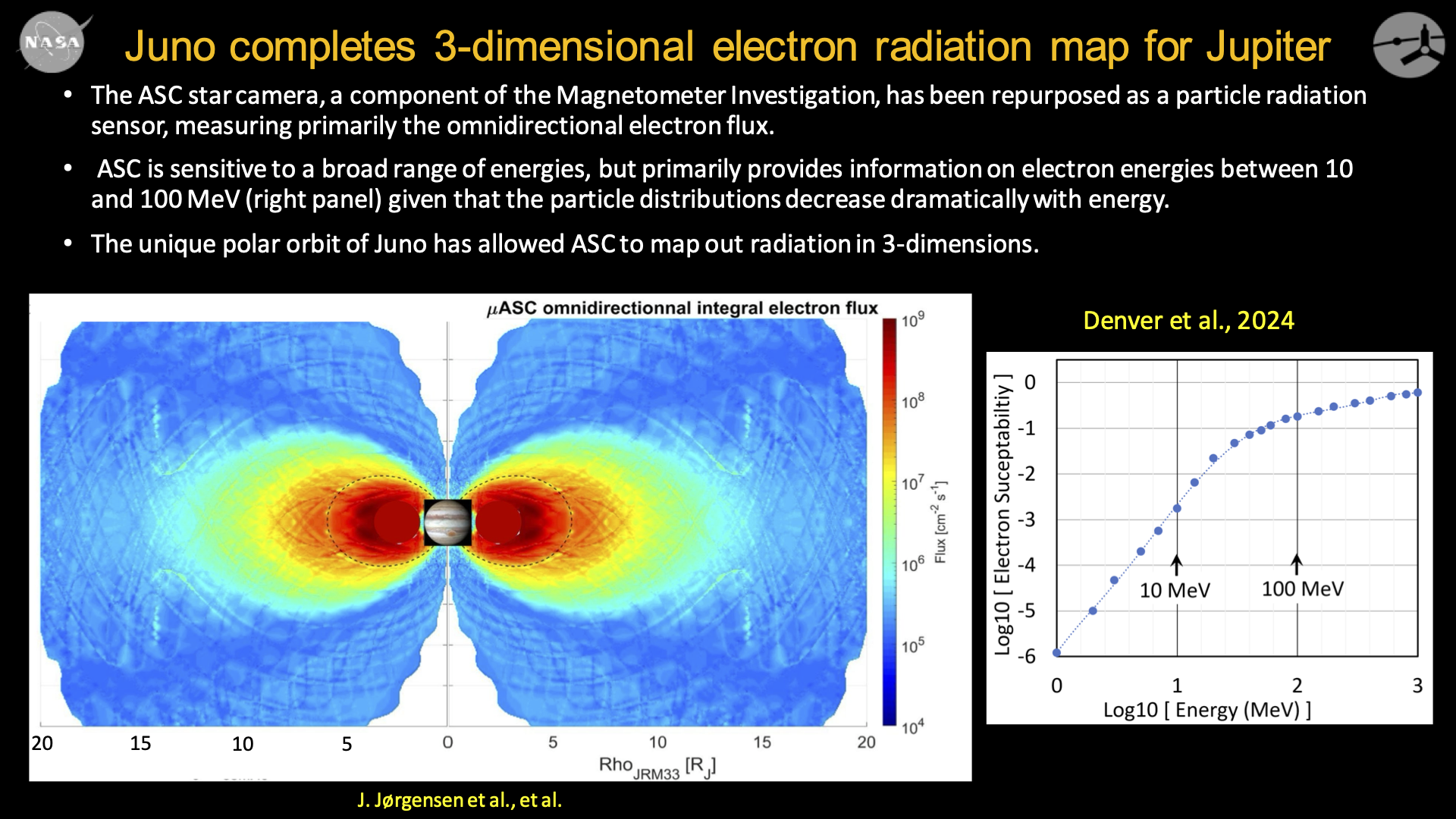
Though the star tracker cameras were not initially designed to measure
radiation, data from Juno developed the first complete 3D radiation map of
the Jupiter system. Along with characterising the intensity of the
high-energy particles near the orbit of the icy moon Europa, the
map shows how the radiation environment is sculpted by the moons
orbiting near Jupiter's rings. Credit : Jørgensen et al.
The CCD-based CHU instruments are inherently susceptible to hard radiation --
also called ionising radiation. Given the intensity of the radiation
bombardment, some energetic particles will inevitably get through, appearing
on CCD images as bright spots. By counting the number of such isolated bright
pixels, an estimate of the number of charged particles penetrating the CCD can
be established, eventually constraining the local external omnidirectional
radiation flux (omniflux). Since it wasn't until after launch that
scientists realised the feasibility of charting radiation levels using the ASC
sensors, they developed a program to instruct the ASC to perform a
bright-pixel count and include the rate in the attitude telemetry, providing
an energetic-particle omniflux measurement at high time resolution.
src="https://www.youtube.com/embed/-N7nRh5v1Iw"
title="Jupiter's Magnetic Field from Juno"
frameborder="0"
allowfullscreen=""
>
This animation illustrates Jupiter's magnetic field at a single moment
in time. The Great Blue Spot, an-invisible-to-the-eye concentration of
magnetic field near the equator, stands out as a particularly strong
feature. The grey lines -- called field lines -- show the field's
direction in space, and the depth of the colour corresponds to the strength
of the magnetic field (with dark red and dark blue for regions with strongly
positive and strongly negative fields, respectively). Credit:
NASA/JPL-Caltech/Harvard/Moore et al.
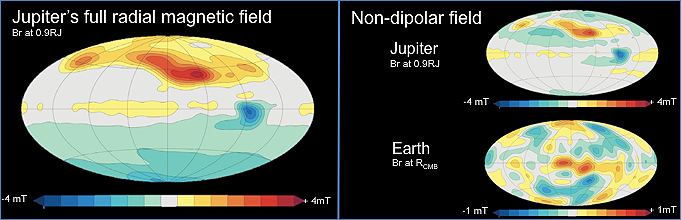
Credit: Moore, K. et al. (2018). Nature DOI 10.1038/s41586-018-0468-5
While scientists knew Jupiter had an intense magnetic field, Juno's
observations revealed it to be larger and more intense than expected –- in
some places more than 30 times as powerful as the one surrounding Earth.
Jupiter's magnetic field is not created by the churning of liquid metal as
on Earth. Rather, the dynamo that generates the Jovian gravity field is liquid
metallic hydrogen. Under very high pressure, gases can turn into liquids.
Jupiter contains an ocean of hydrogen which -- under the extreme atmospheric
pressure -- further compresses hydrogen into a 'super' fluid known as
liquid metallic hydrogen, enabling it to conduct electricity as if it were
metal. The spinning strands of liquid metal are what power Jupiter's
massive dynamo.
Juno discovered that Jupiter's magnetic field is wonky and asymmetric,
with more variation in the northern hemisphere than the south.
By comparing magnetospheric data from NASA's past Jupiter missions with
the latest model of Jupiter's magnetic field from years of Juno
observations, scientists confirmed the first extraterrestrial detection of an
internal magnetic field that changes over time, a phenomenon called secular
variation. Jupiter's deep atmospheric -- zonal -- winds likely cause the
change, shearing the magnetic fields and stretching them around the planet.
One notable site of variation is an area designated the Great Blue Spot -- an
intense, localised concentration of magnetism near the equator. Distinct from
Jupiter's iconic red storm, the Great Blue Spot is buffeted east and west
by zonal winds and could circumnavigate the planet in 350 years.
This animation illustrates how the magnetic field surrounding Jupiter's
moon Ganymede (represented by the blue lines) interacts with and disrupts
Jupiter's magnetic field (represented by the orange lines). During the June 2021 close approach to Ganymede by NASA's Juno
spacecraft, the MAG and Jovian Auroral Distributions Experiment (JADE)
instruments aboard the spacecraft recorded data showing evidence of the
breaking and reforming of magnetic field connections between Jupiter and
Ganymede. Studying Ganymede's magnetic field can provide scientists with
clues about the nature of the salty water reservoir suspected to exist deep
under the moon's surface. Credit: NASA/JPL-Caltech/SwRI/Duling
The Juno probe has lasted far beyond its design lifetime of five years. This
is a particularly impressive achievement, given the extreme radiation
surrounding Jupiter. The unprecedented accuracy of Juno's
instruments has revealed detailed insights into Jupiter specifically and
planetary formation in general. Juno's operation has also contributed to
preparations for upcoming planetary exploration missions, including
Teledyne-built missions like Europa Clipper and JUICE, which is set to arrive
at Jupiter in 2031.

In addition to the important science, Juno also carries items of historical
and educational significance. The Italian Space Agency provided a plaque
depicting astronomer Galileo Galilei and handwritten text from his journal
describing what would later be known as the Galilean moons: Jupiter's
largest satellites – Io, Europa, Ganymede, and Callisto. These were the
first moons discovered beyond Earth. Credit: NASA/JPL-Caltech/KSC
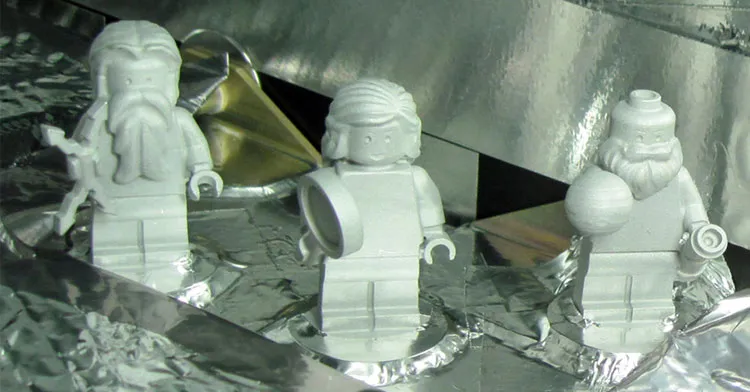
Also secured to the spacecraft, as part of a joint outreach program between
NASA and the LEGO Group, Juno carries a set of three LEGO mini-figurines.
Cast in aluminium and shielded under a thermal blanket, they represent
Galileo, who is carrying a telescope, the Roman god Jupiter (wielding a
lightning bolt), and the goddess Juno, his wife (holding a magnifying glass,
ready to investigate). Credit: NASA/JPL-Caltech/KSC
Works Cited
Andrews, Robin George. (August 19, 2025). NASA's Juno Mission Leaves
Stunning Legacy of Science at Jupiter.
https://www.scientificamerican.com/article/how-nasas-juno-probe-changed-everything-we-know-about-jupiter/
Connerney, J.E.P., Benn, M., Bjarno, J.B. et al. The Juno Magnetic Field
Investigation. Space Sci Rev 213, 39–138 (2017).
https://doi.org/10.1007/s11214-017-0334-z
Denver, T., Sushkova, J., Jørgensen, J.L. et al. The Juno ASC as an Energetic
Particle Counter. Space Sci Rev 220, 86 (2024).
https://doi.org/10.1007/s11214-024-01120-y
NASA's Jet Propulsion Laboratory. (n.d.). The Giant Planet Story is the
Story of the Solar System.
https://www.jpl.nasa.gov/news/press_kits/juno/science/
Ibid. (2019, May 20). NASA's Juno Finds Changes in Jupiter's Magnetic
Field.
https://www.nasa.gov/missions/juno/nasas-juno-finds-changes-in-jupiters-magnetic-field/
NASA. (n.d.). Juno - Active Missions.
https://science.nasa.gov/mission/juno/
Ibid. (2025, March 03). Juno measures 3-dimensional high energy electron
radiation surrounding Jupiter.
https://www.missionjuno.swri.edu/science-findings/juno-measures-3d-high-energy-electron-radiation-surrounding
Ibid. (2024, August 20). Danish Instrument Helps Juno See Radiation.
https://www.missionjuno.swri.edu/news/danish-instrument-helps-nasa-s-juno-spacecraft-see-radiation
Ibid. (2022, December 14). NASA's Juno Exploring Jovian Moons During
Extended Mission.
https://www.nasa.gov/missions/europa-clipper/nasas-juno-exploring-jovian-moons-during-extended-mission/
Ibid. (2022, March 01). Juno Spacecraft Probes the Source of Jupiter's
Magnetic Field.
https://www.missionjuno.swri.edu/science-findings/juno-spacecraft-probes-the-source-of-jupiter-magnetic-field
Ibid. (2020, December 02). Surprising North-South Asymmetry in Jupiter's
Magnetic Field.
https://www.missionjuno.swri.edu/science-findings/surprising-north-south-asymmetry-in-jupiter-s-magnetic-field

