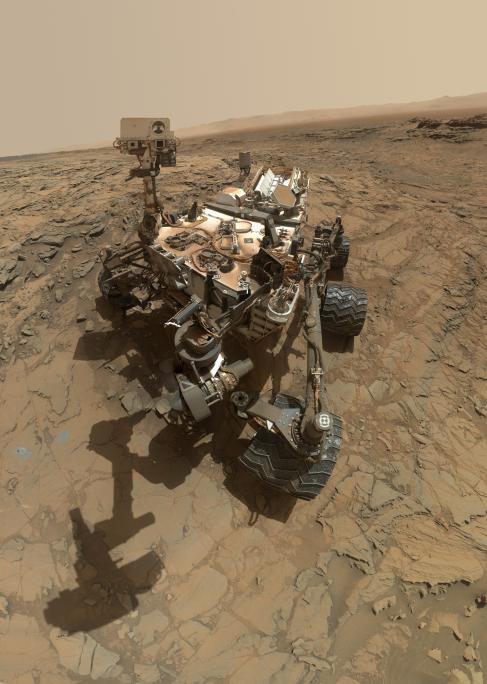
This selfie taken by the rover shows the Chemistry and Camera (ChemCam) instrument atop the rover. A drilled hole for soil sampling appears grey near the lower left corner of the image. Credit: NASA/JPL-Caltech/MSSS
Although the dusty surface of Mars looks desolate today, Mars likely had lakes and perhaps rivers at some point in its planetary evolution – water sources which may have supported microbial lifeforms before it’s climate dried up. One such location is the Gale Crater – a massive impact crater left on the surface of Mars after an ancient space rock collision. Over millennia, the crater formed a deep lake where sediment accretions wore away to form the 5.5 km (18,000 ft) Mount Sharp.
Aiming to find early signs of life, NASA's Mars Science Laboratory mission travelled to the red planet seeking to land its car-sized Curiosity rover on Aeolis Palus in the Gale Crater. In August 2012, the rover successfully demonstrated a new technique and survived the infamous “seven minutes of terror”. As the landing module descended, it deployed a parachute in the thin atmosphere of Mars, then hovered over the surface with rockets as the sky crane lowered the rover to the surface.
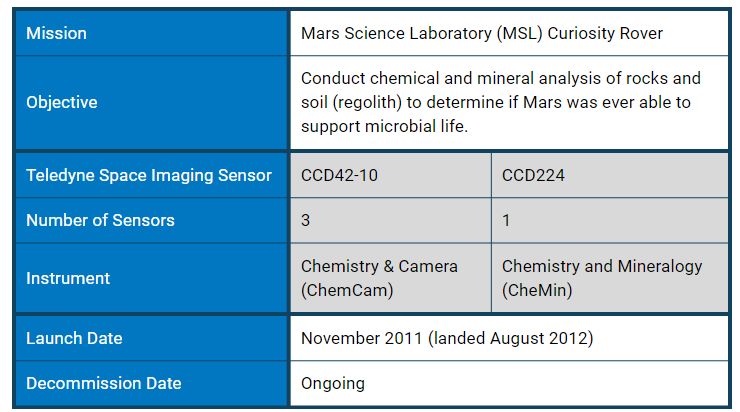
Curiosity has eleven different scientific instruments working together to discover more about the climate and geology of Mars and the feasibility of future human exploration. Teledyne technology powers two instruments to measure the chemical, isotopic, and mineralogical composition of the Martian geology: ChemCam, which measures the elemental composition of the rock, and CheMin, which conducts mineral analyses.
ChemCam (Chemistry and Camera)

This RMI mosaic shows the location of LIBS targets. Credit: https://www.msl-chemcam.com
Developed by the French CESR laboratory and the Los Alamos National Laboratory, ChemCam is a suite of remote sensing instruments: a laser-induced breakdown spectroscopy (LIBS) and a Remote Micro Imager (RMI) telescope. LIBS provides elemental compositions of rock and soil, while the RMI captures high-resolution images of LIBS sampling areas for context and documentation. The Teledyne e2v CCD42-10 variant used in ChemCam was back-thinned to maximise sensitivity and coated with a custom graded anti-reflection coating to match the spectroscopic requirements of the mission.
ChemCam is the first to deploy the process of Laser Induced Breakdown Spectroscopy (LIBS) on a planetary science mission. The LIBS instrument can target a rock or soil sample from up to 7 m (23 ft) away, using a 1067 nm infrared laser to vaporize the area exciting electrons into component gases. The spectrum emitted by the ball of plasma is observed with a series of three spectrographs in the visible, near-UV and near-infrared ranges, between 240 nm and 800 nm. Typically, the laser fires 30 shots at a single point, gathering spectroscopic readings from the vaporized rock for each laser shot, and samples multiple points on a chosen target.
Each element emits a unique light spectrum allowing scientists to determine the chemical makeup of each sample. LIBS makes it possible to detect and quantify the major oxides: SiO2, Al2O3, FeOT, MgO, TiO2, CaO, Na2O, and K2O.
Primarily, RMI captures high-resolution images of LIBS targets. Able to discern a human hair from seven feet away, RMI has a higher resolution than the navigational camera (Navcam) and the color mast cameras (Mastcam). As such, it has also been used to reconnaissance upcoming terrain and image distant features such as the rim of Gale Crater.
Depending upon their respective orbits, it can take anywhere from 6 to 44 minutes to send a single message between Mars and Earth. To maximise data acquisition, Curiosity was programmed to fill communications gaps by randomly aiming ChemCam at new sample targets. In 2015, NASA scientists upgraded ChemCam with software adapted from the older Opportunity rover. Using AI analysis, this upgrade improved the success rate of prime target selection from 24% to 94%.
Still functioning, ChemCam has been helping make groundbreaking discoveries collecting more than 800,000 individual spectra from more than 2,500 samples and firing its laser over 1 million times. The Gale Crater samples analyzed by ChemCam fall under two distinct soil types: a fine-grained mafic material that is more representative of global Martian soils or dust and a coarse-grained felsic material that originates from local Gale crater bedrock.
CheMin (Chemistry and Mineralogy)

This side-by-side comparison shows the X-ray diffraction patterns of two different samples collected from rocks on Mars by NASA's Curiosity rover. At left is a pattern of data from analysis of the "Cumberland" rock target in the "Yellowknife Bay" area investigated by Curiosity in 2013. The pattern at right is from the "Confidence Hills" target which was the first rock drilled after Curiosity reached the base of Mount Sharp in September 2014. Credit: NASA/JPL-Caltech/Ames
Minerals – like a time capsule – provide a record of the temperature, pressure, and chemical ingredients present at the time they formed. Using the first X-ray diffraction experiment on another planet, CheMin can identify minerals such as phosphates, carbonates, sulfates, silica, and clay minerals that can help preserve biosignatures, or evidence of life.
Winner of the NASA Government Invention of the year, CheMin analyzes the chemical composition of rocks and soils using X-ray diffraction and fluorescence without the need for liquid reagents. It is sensitive enough to detect individual minerals that are present at the 3% level and above, and was developed by NASA’s Ames Research Center and Jet Propulsion Laboratory.
Curiosity drills samples from the Martian surface and pours the resulting fine powder into a sample holder inside the instrument. The powder is hit with an X-ray beam producing simultaneous 2-D X-ray diffraction patterns and energy-dispersive histograms captured by a CCD. Raw CCD frames are processed on board the rover to reduce the data volume. Scientists can use the angular relationships of light and the Bragg equation to figure out the spaces between the atoms in a mineral.
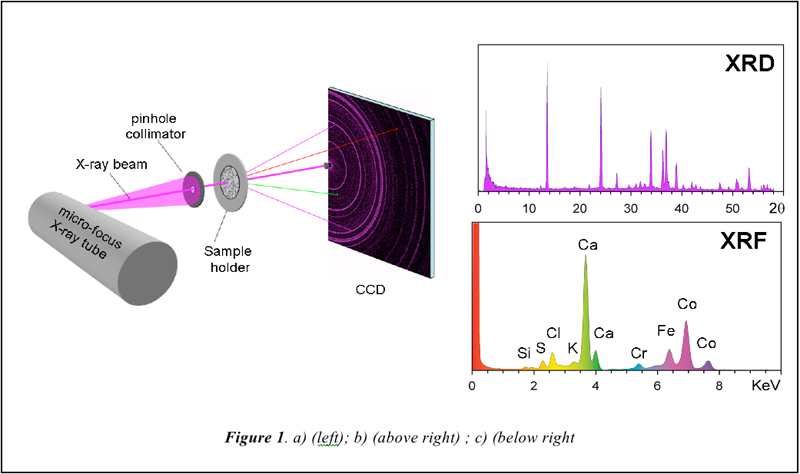
Geometry of the CheMin XRD/XRF instrument. a) (left) overall geometry of CheMin; b) (above right) XRD 2θ plot obtained by summing diffracted photons from the characteristic line of the X-ray source (colored magenta in Figure 1a); c) (below right) X-ray fluorescence spectrum obtained by summing all of the X-ray photons detected by the CCD (XRF photons from the sample shown schematically in green and red in Figure 1a). Credit: www.geochemsoc.org
CheMin uses a Teledyne e2v CCD224, an energy-discriminating imaging sensor array optimised for the detection of x-rays in a space environment. This high-performance imaging sensor is based on Teledyne Space Imaging’s CCD technology originally implemented in the European Space Agency’s XMM-Newton X-Ray observatory, where it still operates successfully in the EPIC Instrument.
As of December 2022, Curiosity has analyzed 42 samples of soil and rock. Its 27 sample cells can be emptied and reused for additional analyses with less than 5% contamination. The chemical analysis of Martian soils reveals more than just geologic information. Using identified minerals and geochemical modelling, scientists determined the carbon dioxide levels in Mars’ atmosphere were much lower than predicted by climate models when lakes occupied Gale Crater. Since carbon dioxide is a potent “greenhouse gas”, it could not have been responsible for warming – and subsequently drying – the planet.
Confirmation of Liquid Water: Proof of Ancient Martian Life?
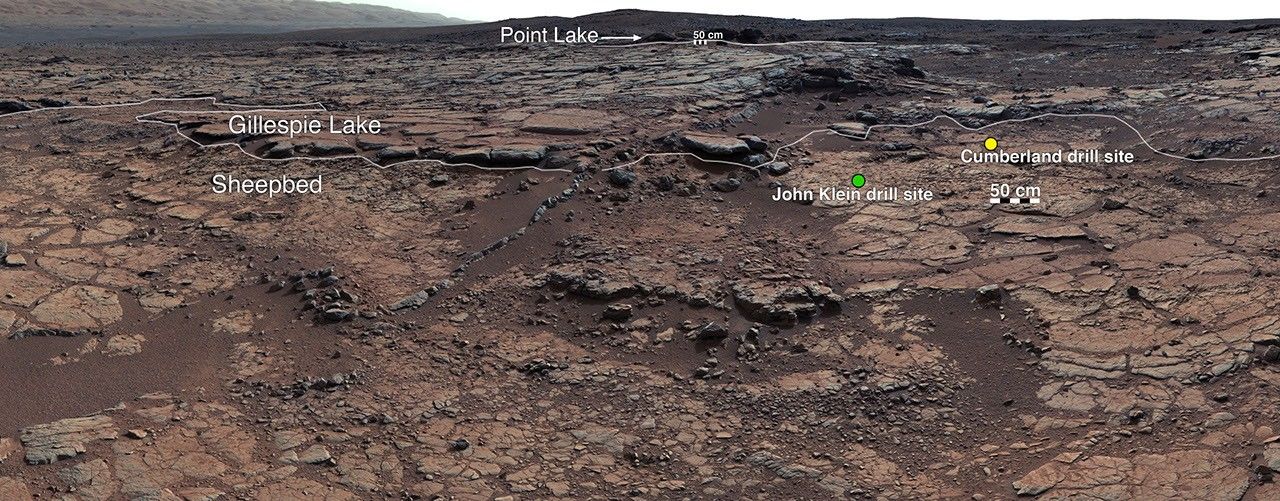
View of Yellowknife Bay formation with drilling sites. Credit: NASA/JPL-Caltech/MSSS
Curiosity characterised the first habitable environment on another planet, finding sulfur, nitrogen, oxygen, phosphorus and carbon – organic carbon compounds that are key ingredients for life – and confirming that Gale Crater once contained liquid water. Exciting as this result is, the actual confirmation of life remains beyond the scope of Curiosity’s parameters.
When Curiosity reached Mount Sharp, it confirmed that over 1,000 vertical feet of rock formed originally as mud at the bottom of a series of shallow lakes. Analysis of the minerals in rocks next to cracks and fractures revealed that water slowly drained over a billion years through the sedimentary rock formed from soil deposits at the bottom of the lake. An analysis of rocks enriched in mineral salts showed that the climate on Mars was not as stable as once thought, with alternate cycles of very wet and very dry over a period of around one million years.
X-ray diffraction analysis has revealed the presence of several minerals, including feldspar, pyroxenes and olivine, and suggested that the Martian regolith in the sample was similar to the "weathered basaltic soils" of Hawaiian volcanoes. hold a geological record of complex igneous processes not observed on Earth until much later in our planet’s history.
CheMin found an unexpected mineral called tridymite. Tridymite is generally associated with explosive volcanism on Earth and was not thought to be important – or even present – on Mars. The discovery leads scientists to rethink the volcanic history of Mars and the conditions and mechanisms in which tridymite may form.
Scientists also detected a large spike in methane levels on Mars at a level of about 7 parts per billion (compared to the usual 0.3 ppb to 0.8 ppb). This was a notable finding because in some circumstances, methane is an indicator of microbial life. ChemCam discovered manganese oxides in fracture fills, indicating that higher levels of atmospheric oxygen could have once existed there.
Curiosity Stays Curious
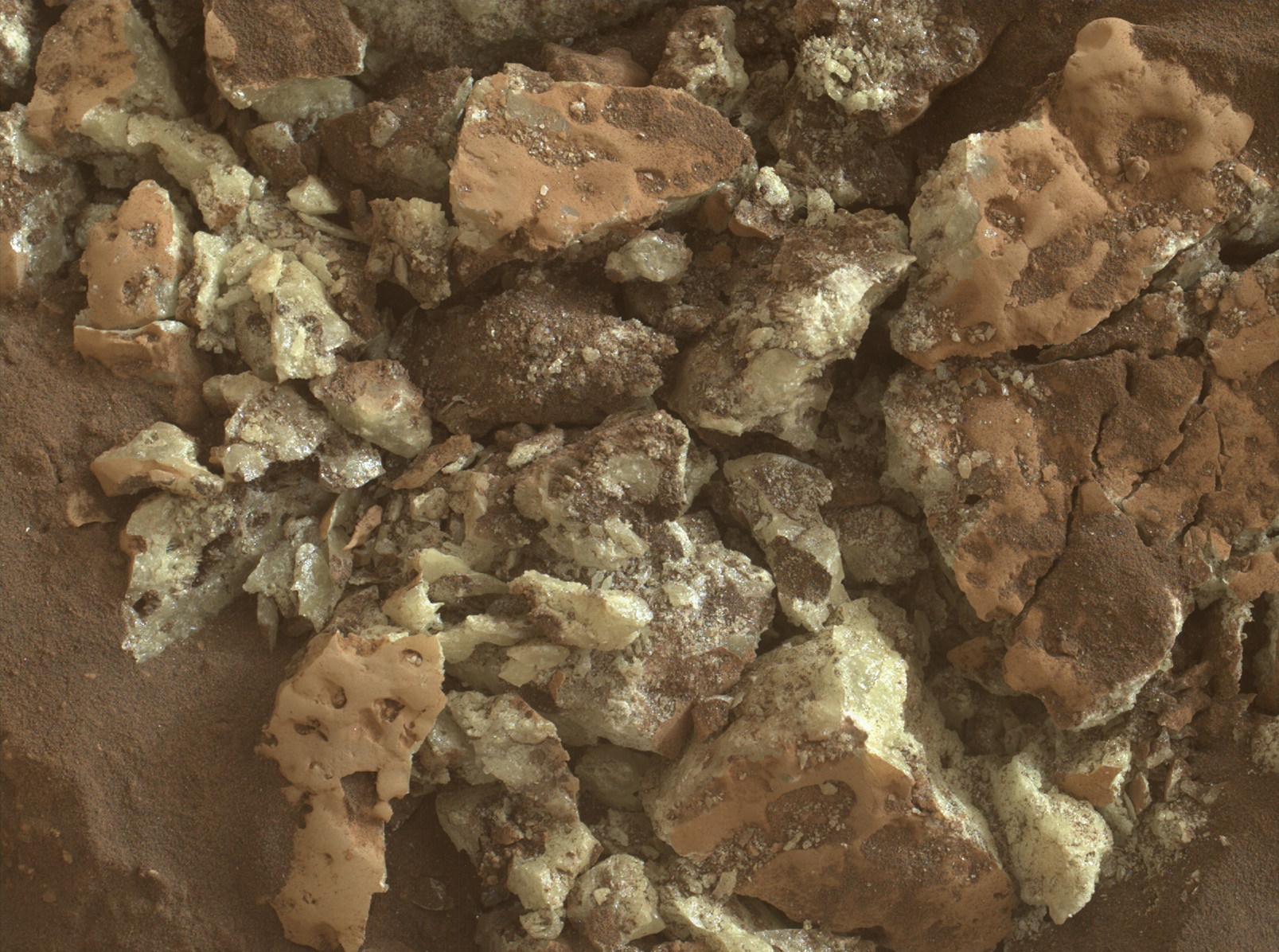
These sulfur crystals were found inside a rock after NASA’s Curiosity Mars rover happened to drive over it and crush it on May 30, 2024, the 4,200th Martian day, or sol, of the mission. This rock was nicknamed “Convict Lake” after a location in California’s Sierra Nevada. Credit: NASA/JPL-Caltech/MSSS
Curiosity’s primary mission lasted about two years. Still active, the rover has travelled more than 29 km (18 mi) exploring three geologically distinct sites of Gale Crater to determine the ‘habitability' of these sites. That driving has produced interesting and sometimes surprising results such as the discovery of elemental sulfur – a rare natural formation discovered by accident when the rover examined a crushed rock that it had run over.
Curiosity and other Mars science missions are a key part of NASA’s Moon to Mars efforts, building on decades of robotic exploration to send humans to the Red Planet in the 2030s. Curiosity's rover design was the basis for NASA's 2021 Perseverance mission. A collaborative effort between the U.S. and France, more than 70 researchers and engineers work as a single team distributed across more than 20 institutions worldwide.

