What can studying our nearest celestial neighbours tell us about our own Solar System and the Universe?
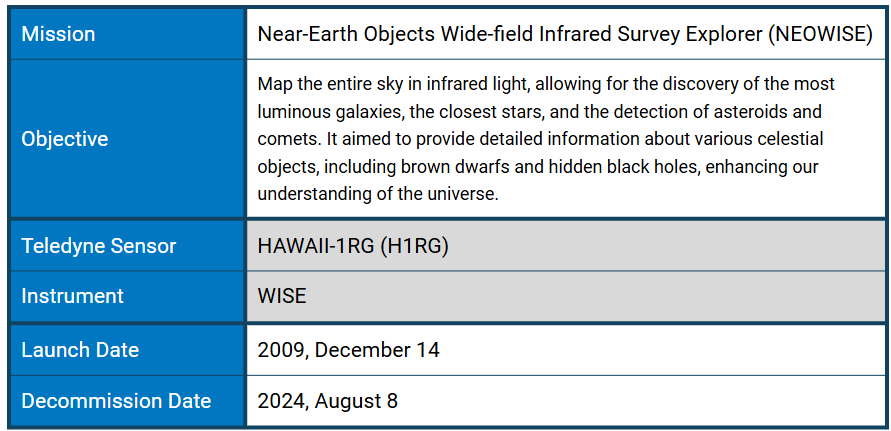
Launched in 2009, the Wide-field Infrared Survey Explorer (WISE) space telescope utilised advanced detector technology to scan the entire sky in infrared light with the highest degree of sensitivity. All-sky surveys are essential astronomical data sources for discovering new targets of interest. Many modern surveys have imaged the sky at various wavelengths, and WISE filled a crucial gap in mid-infrared observations, uncovering objects never seen before, including the nearest and coolest stars, the most luminous galaxies in the Universe, exploding white dwarf stars, and the darkest near-Earth asteroids and comets.
Part of NASA’s Explorers Program, WISE was equipped with a four-channel imager that operated in a single mode, taking overlapping snapshots of the sky with a 47 arcminute field of view. The WISE instrument was mounted to a 40 cm (16 in) telescope and deployed reimaging optics to direct light to four infrared detector arrays. Each focal plane array contained over one million pixels and was optimised for a specific wavelength band: 3.4, 4.6, 12 and 22 μm. After completing its initial ten-month mission, WISE depleted its hydrogen coolant, which cooled the detectors optimised for 12 and 22 μm wavelengths. However, the 3.4 and 4.6 μm HgCdTe HAWAII-1RG detectors – developed by Teledyne Space Imaging – could still operate normally. Thus, NASA redesignated the mission NEOWISE with a new objective focusing on tracking near-Earth objects (NEOs).
NEOWISE orbited the Earth at an altitude of 525 kilometres (326 miles), circling the poles about 15 times a day along our planet's terminator, the line that divides Earth between day and night. This orbit allowed NEOWISE to remain in continuous sunlight, with its solar arrays facing the Sun and the telescope barrel pointing away from the Sun. Furthermore, the orbit enabled NEOWISE to record an image every 11 seconds across the entire sky.
During its primary mission, WISE detected more than 158,000 minor planets, 34,000 of which were entirely new discoveries. Over more than a decade, NEOWISE surveyed the entire sky 21 times, taking more than 1.5 million infrared measurements of around 44,000 different objects in the solar system. NEOWISE also characterised the orbits, sizes, and compositions of more than 3,000 near-Earth objects, including about 1,600 newly discovered objects.
Furthermore, NEOWISE data is being used to conduct long-term monitoring of almost 1,000 protostars to gain insights into the early stages of star formation.
What Did NEOWISE Find?
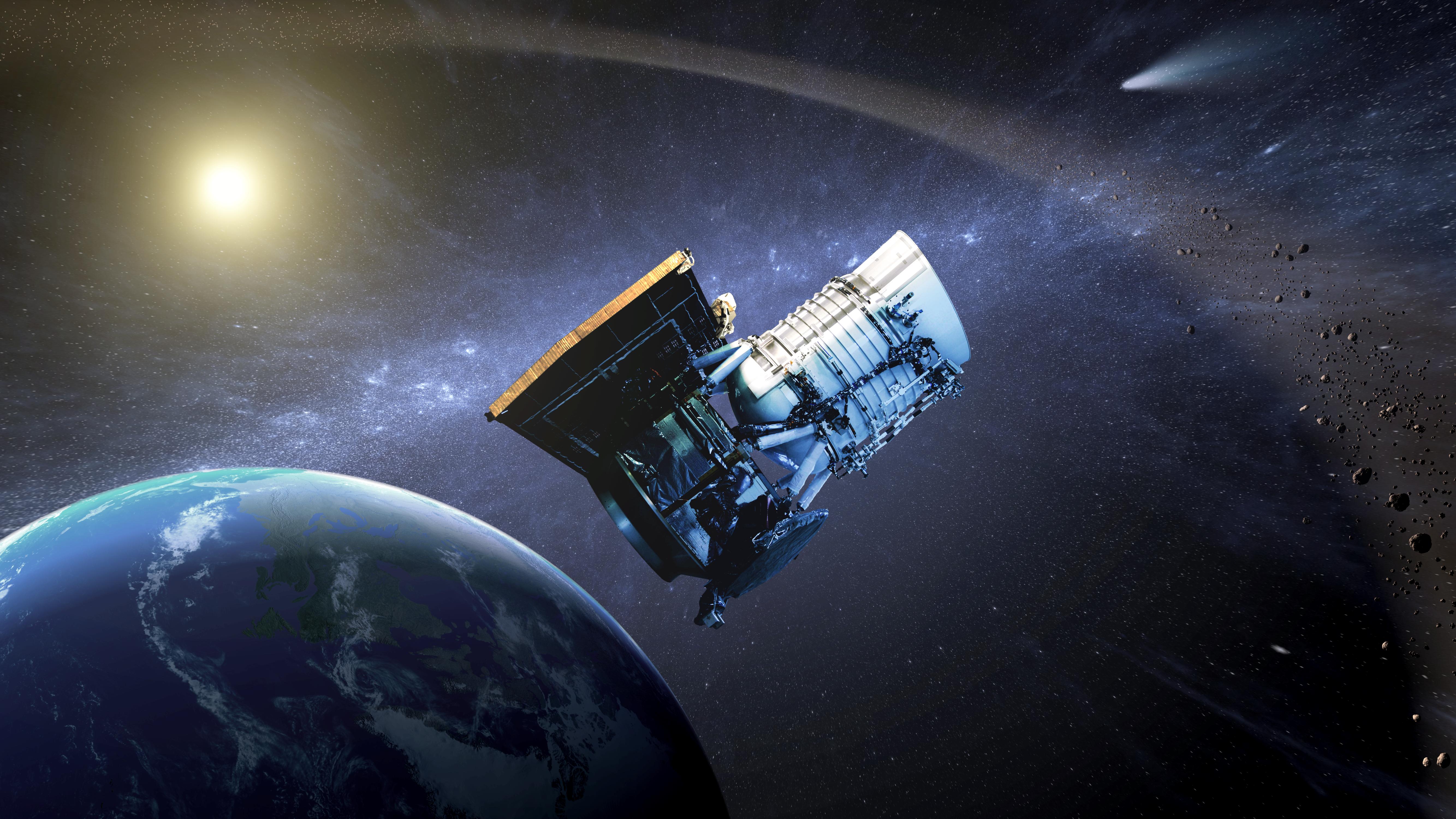 This artist's concept shows WISE in its orbit around Earth. Credit: NASA/JPL-Caltech
The final data release from NEOWISE encompassed over 26 million images and nearly 200 billion sources detected by the telescope. This vast catalogue of celestial objects helps answer fundamental questions about the origins of planets, stars and galaxies. NEOWISE provided a complete inventory of nearby young stars and their dusty disks, as well as of the debris disks associated with planetary systems around thousands of older nearby stars. The unique objects detailed by NEOWISE are helping astronomers decipher the mysteries of the Universe.
Brown Dwarfs
Brown dwarfs are stars that began to form but ultimately failed to accumulate the mass needed to initiate the fusion of hydrogen into helium. These faint, Jupiter-like balls of gas slowly radiate away their heat of formation. Their masses range from 13 to 80 times that of Jupiter, with the upper limit defining the mass at which nuclear fusion could ignite.
A more complete count of brown dwarfs near the Sun reveals how efficient star formation is in our galaxy and how early it began. Using data from NEOWISE, astronomers found about 260 brown dwarfs within just 65 light-years of our Sun, including the first confirmation of a Y dwarf – the coldest brown dwarfs.
NEOWISE also detected two T dwarfs with highly unusual compositions – the most planetlike brown dwarfs yet seen among the Milky Way's oldest population of stars. These unique objects look like typical brown dwarfs when viewed at certain infrared wavelengths, but do not resemble any other stars or planets at other IR wavelengths. Astronomers hope to use these unique brown dwarfs to learn more about exoplanets.
Lastly, a team of researchers and citizen scientists discovered 13 new red dwarfs and brown dwarf binary systems in NEOWISE’s data – a 60% increase in the number of red-brown binary systems. Red dwarfs are the smallest fusion stars, so these unique systems sharpen the distinction between stars and planets. Understanding the upper and lower limits of planets and stars would help astronomers define exactly what it means to be a planet, a star, or something else entirely.
Ultra-Luminous Infrared Galaxies (ULIRGs)
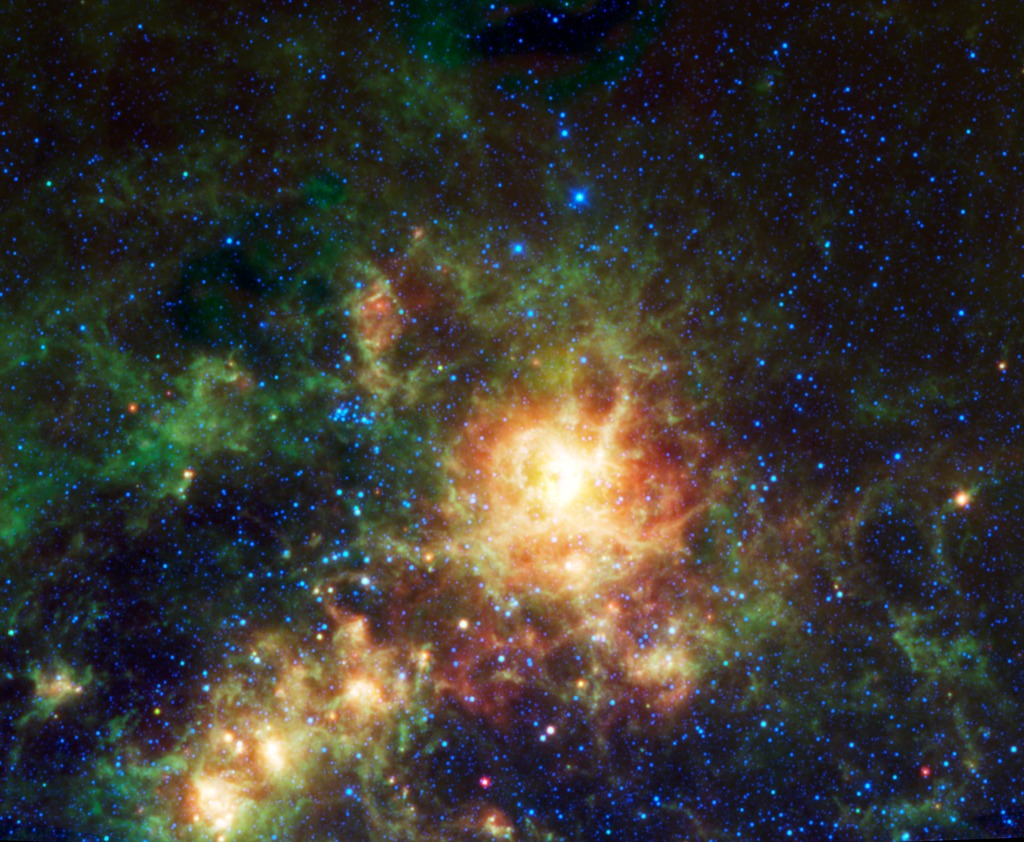 Located in the southern constellation of Dorado, the Tarantula Nebula is a giant star-forming region in the Large Magellanic Cloud. At about 1,900 light-years across, the Tarantula Nebula is the largest star-forming region known in the entire Local Group of galaxies. All four infrared detectors aboard WISE were used to make this mosaic. The image spans an area of 1.4 x 1.2 degrees on the sky or about 3 times as wide as the full Moon, and 2.5 times as high. Colour is representational: blue and cyan represent infrared light at wavelengths of 3.4 and 4.6 μm, which is dominated by light from stars. Green and red represent light at 12 and 22 μm, which is mostly light from warm dust. Credit: NASA/JPL-Caltech/UCLA
Called ultra-luminous infrared galaxies, or ULIRGs, these objects shine with the light of more than a trillion suns. The most luminous galaxy confirmed - discovered by WISE and known by its catalogue number, WISE J224607.55-052634.9 - radiates with 350 trillion times the luminosity of the Sun. NEOWISE was sensitive enough to detect the most luminous ULIRGS out to a lookback time of when the Universe was only 3 billion years old.
Studies have suggested that ULIRGs are more frequent at greater distances, indicating that they were more common in the past and have died out with time. As ULIRGs aged, they ran out of gas and dust with which to form new stars. Thus, the luminosities of ULIRGs diminish over time as their stellar orbits settle into regular orbits. Nearby elliptical and lenticular galaxies may be the evolved states of many ULIRGs.
Comets
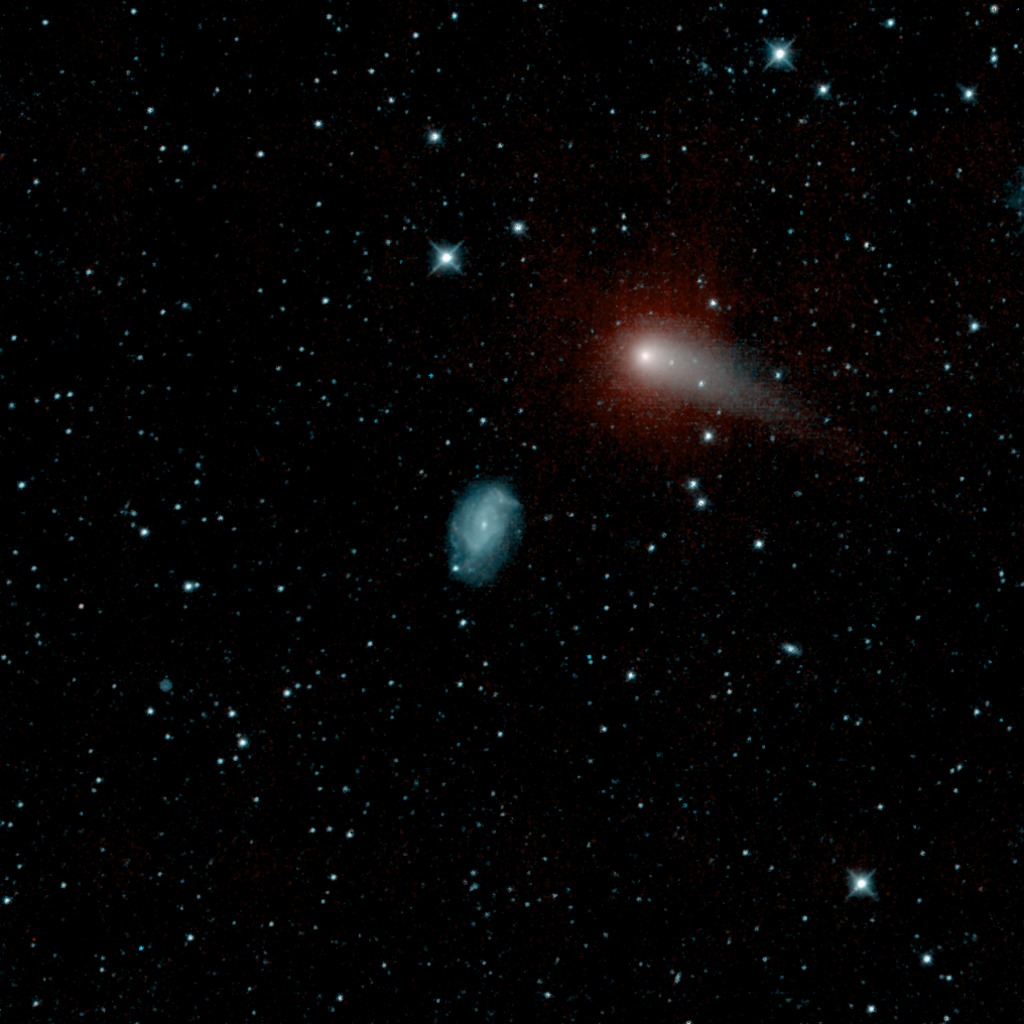
The Pan-STARRS comet is relatively close to Earth: 230 million kilometres (143 million miles). It is seen passing a much more distant spiral galaxy, called NGC 3726, which is about 55 million light-years from Earth, or 2 trillion times farther away than the comet. The image was made from data collected by two infrared channels: the longer-wavelength channel – centred at 4.6 μm – mapped to red, and the shorter-wavelength channel – centred at 3.4 μm – mapped to cyan. Credit: NASA/JPL-Caltech
A comet is a ball of dust and ice left over from the formation of the solar system. As it approaches the Sun and heats up, its surface releases gas and dust, which are then blown back by the solar wind into a long tail. These distant objects can take hundreds or thousands of years to complete a single orbit, making their detection very difficult. Without a large data set of comets, it’s hard to draw definitive conclusions about their properties.
NEOWISE discovered 25 comets, greatly expanding the data available for study. Astronomers also found that there are about seven times more long-period comets measuring at least one kilometre (0.6 miles) across than had been predicted. Researchers further observed that in eight months, three to five times as many long-period comets passed by the Sun as had been predicted.
Asteroids
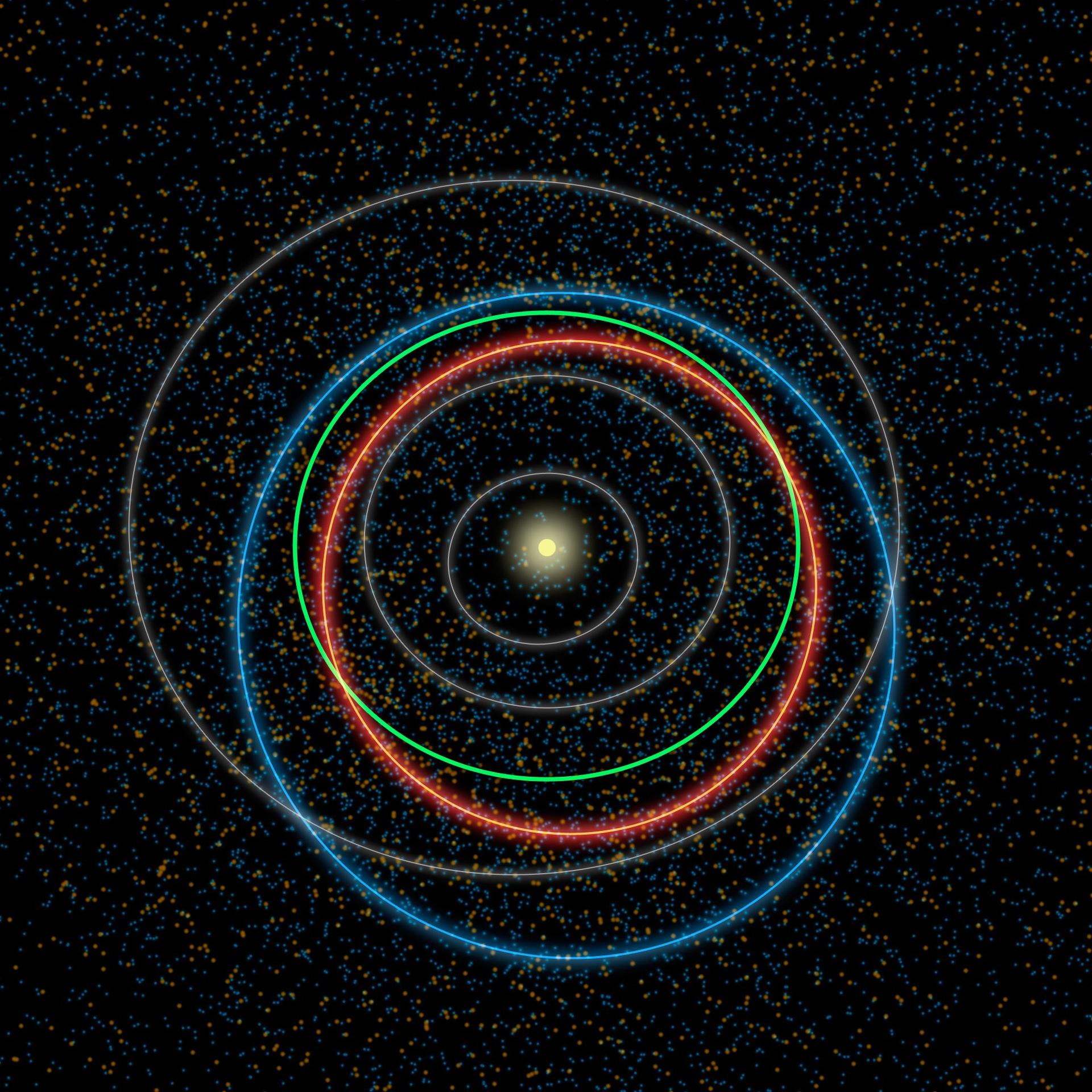
Results from NASA's NEOWISE survey find that more potentially hazardous asteroids, or PHAs, are closely aligned with the plane of our solar system than previous models suggested. Earth's orbit around the Sun is shown in green; the orbits of Mercury, Venus, and Mars, extending outward from the Sun, are shown in grey. The blue orbit represents a typical near-Earth asteroid, while the orange orbit represents a typical PHA, which comes within 5 million miles (about 8 million kilometres) of Earth and is larger than 330 feet (100 meters). NEOWISE has provided the best overall look at the PHA population yet, refining estimates of their numbers, sizes, orbital types, and potential hazards. Credit: NASA/JPL-Caltech
As the dinosaurs found out, asteroids can be a problem. NEOWISE focused on finding near-Earth asteroids to protect the Earth.
Asteroids reflect very little light, making their detection with visual wavelengths very difficult. Fortunately, infrared light is a much easier way to find them. Asteroids are heated up by the Sun and radiate that heat back into space – a process known as thermal emission – making them glow in infrared light. The smaller an asteroid, the fainter its thermal emission. The NEOWISE instruments could detect thermal emissions from near-Earth objects with high sensitivity, enabling the detection of small asteroids.
NEOWISE data has been used to set limits on the numbers, orbits, sizes, and probable compositions of approximately 164,000 asteroids throughout our solar system, and enabled the discovery of the first known Earth Trojan asteroid. Trojan asteroids share an orbit with a planet, orbiting the Sun ahead of or behind the planet. These observations are helping scientists understand the sizes and types of near-Earth asteroids, their trajectories through the Solar System, and what to do if we find one on a collision course with Earth. Asteroid observations by the WISE space telescope and the analysis of those observations by the NEOWISE project have provided more information about the diameter, albedo, and other properties, than all other sources combined.
Black Holes
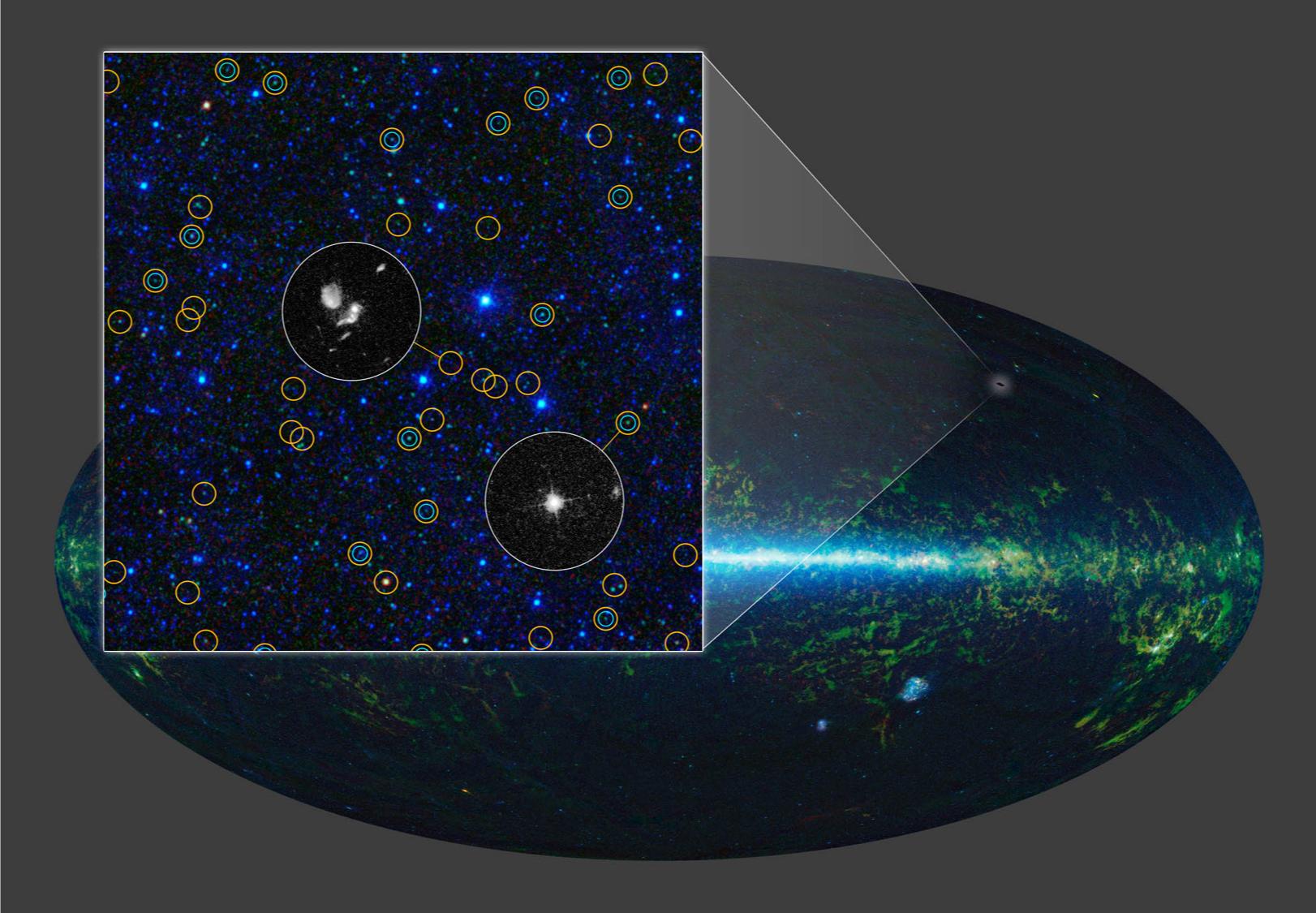
Peering more than 10 billion light-years into the distance, NEOWISE found tens of millions of actively feeding supermassive black holes across the whole sky. The orange circles highlight those the telescope identified in a small patch of sky; the two zoomed-in images came from the Hubble Space Telescope. The blue circles indicate black holes detected using visible-light imagers. In most cases, that light is blocked by dust. Credit: NASA/JPL-Caltech/UCLA
NEOWISE’s data has also improved the understanding of black holes. The original WISE survey discovered millions of supermassive black holes at the centres of distant galaxies. In a recent study, scientists used NEOWISE data and a technique called echo mapping to measure the size of disks of hot, glowing gas surrounding distant black holes, which are too small and too distant for any telescope to resolve.
Every six months, NEOWISE completes one trip halfway around the Sun, taking images in all directions. Stitched together, those images form an “all-sky” map showing the location and brightness of hundreds of millions of objects. Using 18 all-sky maps from the spacecraft, scientists have created a time-lapse movie of the sky, revealing changes spanning a decade. Comparing the maps can reveal distant objects that have changed position or brightness over time, what’s known as time-domain astronomy. Credit: NASA/JPL-Caltech, WISE-NEOWISE movies compiled by Dan Caselden
Researchers will continue to rely on the vast archive of NEOWISE observations to make new discoveries. Future missions such as NEO Surveyor – planned for launch in 2027 and featuring detectors from Teledyne – will increase the data on near-Earth objects.
Atmospheric drag slowly shifted NEOWISE's orbit to the point where it could no longer observe without sunlight or reflected Earthlight entering the telescope. This effectively ended its mission, and NASA decommissioned the spacecraft in 2024. The next year it burned up in the Earth’s atmosphere.
Works Cited:
Hirabayashi, T., Kim Y. (2025, February 7). NEOWISE, the NASA mission that catalogued objects around Earth for over a decade, has come to an end. The Conversation. https://theconversation.com/neowise-the-nasa-mission-that-cataloged-objects-around-earth-for-over-a-decade-has-come-to-an-end-237921
Myhrvold, N. (2018, June 18). An empirical examination of WISE/NEOWISE asteroid analysis and results. Icarus, volume 314, pages 64-97. https://doi.org/10.1016/j.icarus.2018.05.004
NASA. (2009, September 9). WISE Mapping the Infrared Sky. https://www.jpl.nasa.gov/news/press_kits/wise-factsheet.pdf
NASA - Jet Propulsion Laboratory. (2019, December 13). Celebrating 10 Years of the WISE Spacecraft. https://www.jpl.nasa.gov/news/celebrating-10-years-of-the-wise-spacecraft/
NASA - Jet Propulsion Laboratory. (2016, December 29). NASA's NEOWISE Mission Spies One Comet, Maybe Two. https://www.jpl.nasa.gov/news/nasas-neowise-mission-spies-one-comet-maybe-two/
NASA - Jet Propulsion Laboratory. (2023, December 13). NASA’s NEOWISE Celebrates 10 Years, Plans End of Mission. https://www.nasa.gov/missions/neowise/nasas-neowise-celebrates-10-years-plans-end-of-mission/
NASA. (2011, August 31). WISE - Wide-field infrared Survey Explorer; Science Overview. https://wise.ssl.berkeley.edu/science.html
NASA. (2011, August 31). WISE - Wide-field infrared Survey Explorer; Science: Ultra-Luminous InfraRed Galaxies. https://wise.ssl.berkeley.edu/science_ultra.html
NASA. (2009, December 3). Wide-field Infrared Survey Explorer Launch; Press Kit/December 2009. https://wise.ssl.berkeley.edu/documents/wise%20launch%202009-12-03.pdf
Swafford, I. (nd). Final data and undiscovered images from NASA’s NEOWISE. The NEOWISE Project. https://neowise.ipac.caltech.edu/news/neowise20241126/
The NEOWISE Project. (2020, July 10). Two Bizarre Brown Dwarfs Found With Citizen Scientists' Help. https://neowise.ipac.caltech.edu/news/neowise20200710/
The NEOWISE Project. (2017, July 25). Large, Distant Comets More Common Than Previously Thought. https://neowise.ipac.caltech.edu/news/neowise20170725/
The NEOWISE Project. (2019, April 15). NEOWISE Celebrates Five Years of Asteroid Data. https://neowise.ipac.caltech.edu/news/neowise20190415/
The Planetary Society. (nd). NEOWISE, near-Earth asteroid tracker. https://www.planetary.org/space-missions/neowise

