Current estimates place the age of the Universe to be under 14 billion years old, leading us to think of its evolution over a long-term, geologic time scale. However, the most consequential events that shaped that evolution, happen in seconds.
The most powerful explosions ever detected, gamma ray bursts (GRBs) produce the elemental building blocks for stars and planets. Studying how the massive amount of energy generated by these explosions interacts with the surrounding environments, helps scientists understand the formation of galaxies and the Universe itself.
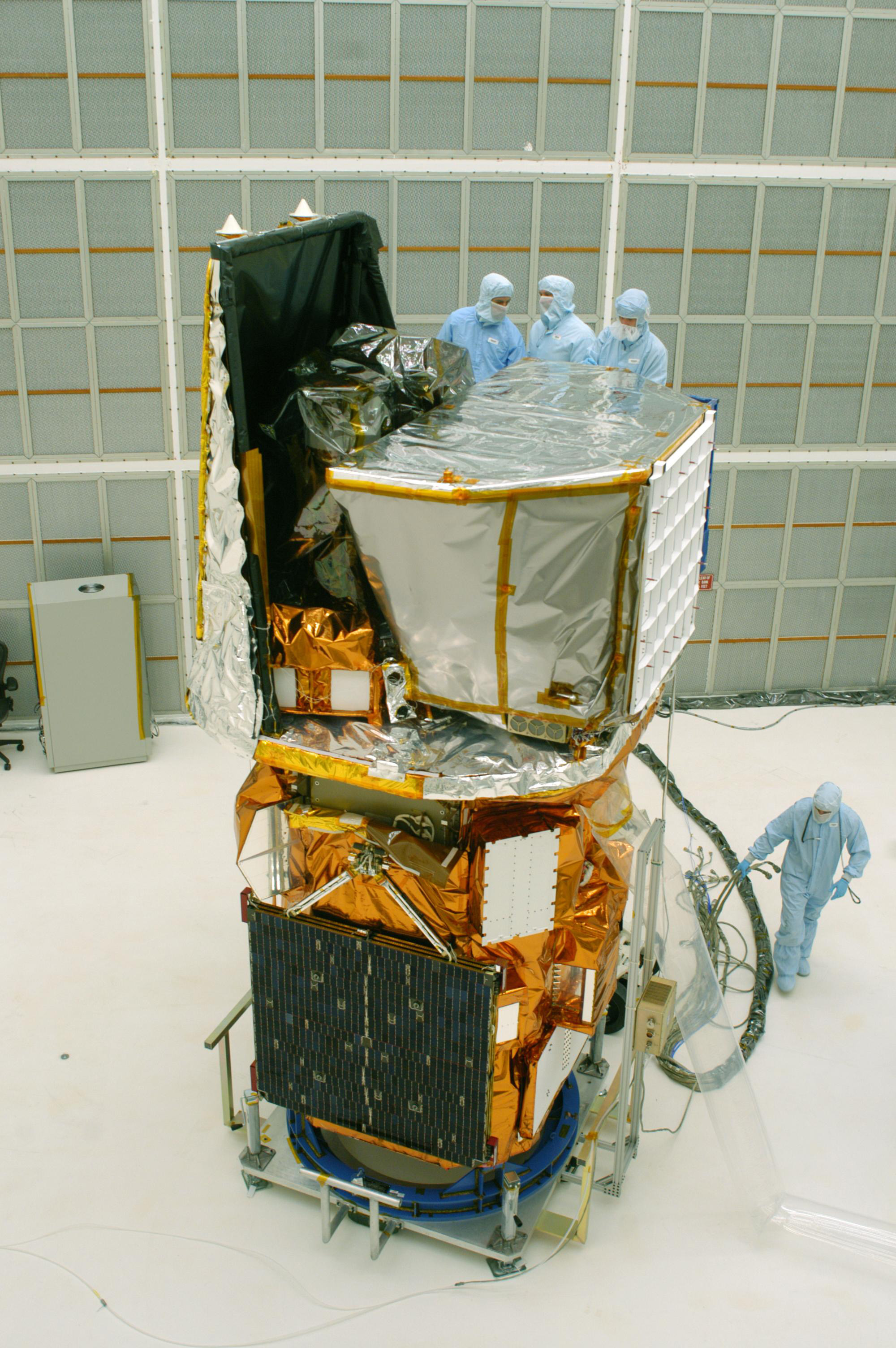
In Hangar AE at Cape Canaveral Air Force Station, Spectrum Astro workers look at the final pieces of protective cover on the Swift spacecraft that must be removed. Credit: NASA's Goddard Space Flight Center
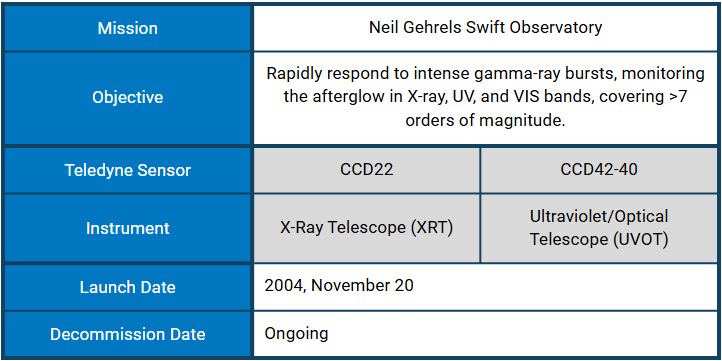
GRB’s happen suddenly, in unpredicted locations, and fade quickly making them challenging targets for scientific observation and study. Launched in 2004 as part of NASA’s medium explorer (MIDEX) program, the Neil Gehrels Swift Observatory is equipped with three coaligned telescopes to acquire detailed data on GRBs. Originally named the Swift Gamma-Ray Burst Explorer – after the Swift bird which catches its prey while in flight – NASA renamed the mission in 2018 following the passing of Swift's original Principal Investigator, Neil Gehrels.
Credit: NASA’s Goddard Space Flight Center
Swift’s unique feature is the ability to observe GRBs in multiple wavelengths and – importantly – quickly orient its instruments to gather detailed data. Within 20-70 seconds of detecting a burst, the spacecraft will “swiftly” and autonomously repoint itself to aim the X-ray Telescope (XRT) and Ultraviolet/Optical Telescope (UVOT) at the burst to enable high-precision X-ray and optical positions and spectra to be determined. The positions will then be relayed to the ground for use by a network of observers at other telescopes.
Using a wide-field gamma ray telescope – Burst Alert Telescope (BAT) – Swift can detect a new GRB then slew to aim the two other telescopes – both equipped with Teledyne detectors: XRT and UVOT. Once the GRB is detected, Swift can automatically reposition to focus on the target within 20-70 seconds. This is a gigantic improvement to older instruments which took around eight hours to start gathering data. By that time, the most extreme and interesting physics had often dissipated.
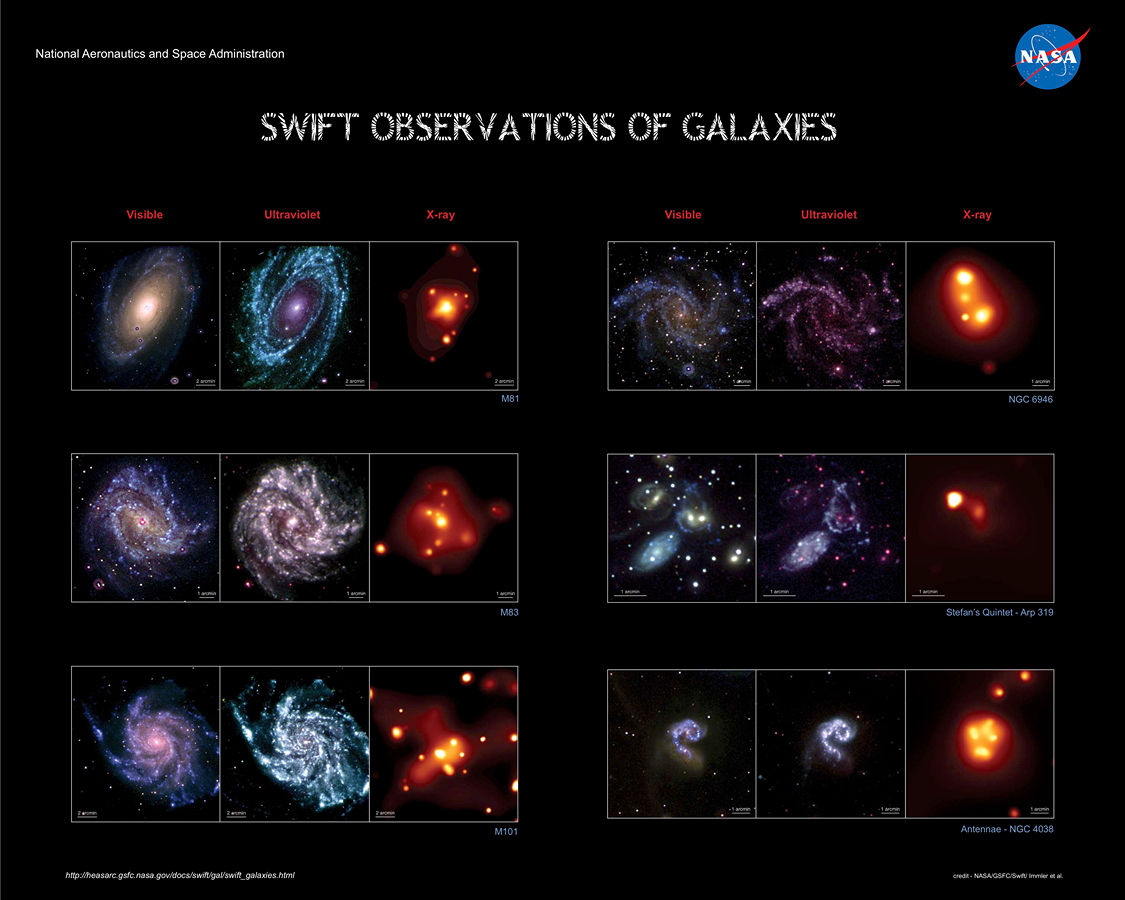
Swift's multiwavelength observations of galaxies. Credit: High Energy Astrophysics Science Archive Research Center (HEASARC), Dr. Andy Ptak (Director), within the Astrophysics Science Division (ASD) at NASA/GSFC
Swift has determined redshifts for most of the detected bursts allowing scientists to calculate distance and record absolute brightness. Swift also provides detailed multi-wavelength light curves for the duration of the afterglow allowing scientists to probe the physical environment in which the event took place. Key data taken by Swift is relayed to the ground in near real-time, allowing the GRB Coordinate Network (GCN) to immediately distribute it for follow-up observations and study with ground and space-based instruments such as the Hubble Space Telescope, NEOWISE, Integral and the James Webb Telescope.
There are two types of GRB; long and short burst.
Long burst GRBs produce a flare of gamma rays that last over two seconds up to several minutes. Thought to be caused by the black holes forming at the center of core-collapse supernova explosions from massive stars. The ejected material heats the surrounding medium creating an observable afterglow, emitting visible, UV, and lower-energy X-ray light. Near the black hole, a cloud of extremely hot particles – called the corona – produces higher-energy X-rays.
Short burst GRBs last less than two seconds, and are likely caused by the collision of two compact objects such as neutron stars and are followed by flares of visible and infrared light called kilonovae. As neutron stars are the remnants of supernova explosions, there is little material left over to produce strong afterglow emission.
It was originally believed that only short bursts produced kilonovae, but data collected by Swift revealed that kilonovae can be produced by some long bursts as well.
X-ray Telescope (XRT)
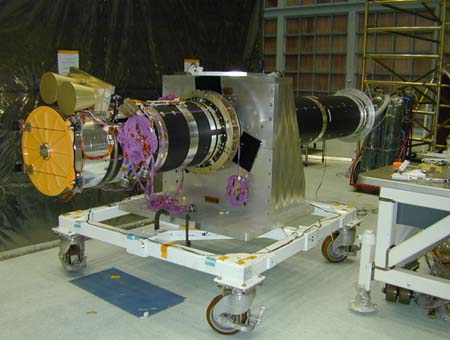
Credit: NASA's Goddard Space Flight Center
The XRT is a sensitive, flexible, autonomous X-ray CCD imaging spectrometer designed to measure the position, spectrum, and brightness of gamma-ray bursts (GRBs) and afterglows over a wide dynamic range covering more than 7 orders of magnitude in flux. XRT, using a Teledyne CCD22, can pinpoint GRBs to 5-arcsec accuracy within 10 seconds of target acquisition covering X-ray 0.2 - 10 keV bands. A special “open-gate" electrode structure enables excellent low energy QE, while high resistivity Si provides a depletion depth of 30 - 35 µm maximising QE at high energies.
In addition to GRBs, XRT also conducts a sensitive hard X-ray survey of the sky contributing to our understanding of astronomical X-ray sources. The targets range from comets and star clusters to supernova remnants, nearby galaxies and active galaxies powered by supermassive black holes.
UV/Optical Telescope (UVOT)
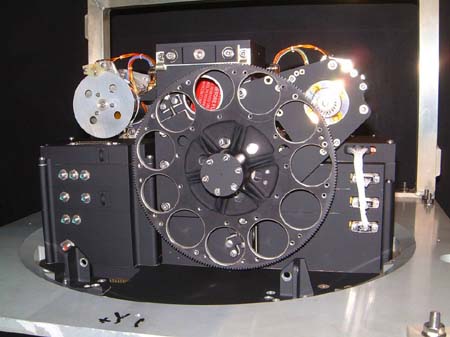
Credit: NASA's Goddard Space Flight Center
UVOT is uniquely suited for afterglow studies. Essentially a copy of the XMM-Newton Optical Monitor (OM), UVOT takes images and obtains spectra via a grism filter. Spectra is taken for the brightest UV/optical afterglows to determine the redshift via the observed wavelength of the Lyman-alpha cut-off. UVOT observations enable optimal ground-based observations by providing rapid optical images of the GRB field so that any optical or infrared counterpart can be quickly identified and studied. Additionally, stars in the FoV of the UVOT provide an astrometric grid for the GRB field.
The Teledyne CCD42-40 detector used in UVOT is a copy of two micro-channel plate intensified CCD (MIC) detectors from the OM instrument on XMM-Newton. They are photon counting devices capable of detecting very low signal levels, allowing UVOT to detect faint objects over 0.17 - 0.65 µm. The design is able to operate in a photon counting mode, unaffected by CCD read noise and cosmic ray events on the CCD.
UV wavelengths cannot be clouded out, and would not be attainable from ground-based instruments due to absorption by Earth’s atmosphere. Other types of UVOT science include exploring emissions from the centers of active galaxies, studying regions undergoing star formation, and identifying some of the rarest and most exotic stars known.
Achievements:
In well over two decades of operation, Swift has detected approximately 1800 GRBs.
Combined observations with Integral and Fermi used the magnifying power of a cosmic lens to explore the inner regions of a supermassive black hole.
Recorded killernovae produced by both long and short burst GRBs. Prior data had only captured killernovae produced by short burst GRBs.
Discovered a black hole producing extremely rapid X-ray variations over two years with the X-ray brightness repeatedly rising and falling by 10% every few minutes. Such changes, called millihertz quasiperiodic oscillations, are difficult to detect around supermassive black holes and have been observed in only a handful of systems to date. Furthermore, the fluctuation period dropped from 18 minutes to just 7 — the first-ever measurement of its kind around a supermassive black hole. These changes could be from an orbiting body moving at half the speed of light.
Discovered the most energetic type of cosmic explosion since the big bang: a new category of cosmic events astronomers are calling “extreme nuclear transients.” Swift was critical in confirming that these events are related to black holes, not stellar explosions or other phenomena. These events release more energy than 100 supernovae.
Observed a burst that was over 6 billion light years away, but bright enough to be seen with the naked eye
Recorded a burst from when the universe was just 500 million years old – at the time it was the most distant object ever seen by humans.
Detected an extraordinarily powerful GRB – referred to as the Brightest Of All Time (BOAT) – reshaping the understanding of gamma-ray burst jets and their underlying mechanisms as well as the study stellar deaths, black hole births, and the fundamental forces of the Universe.
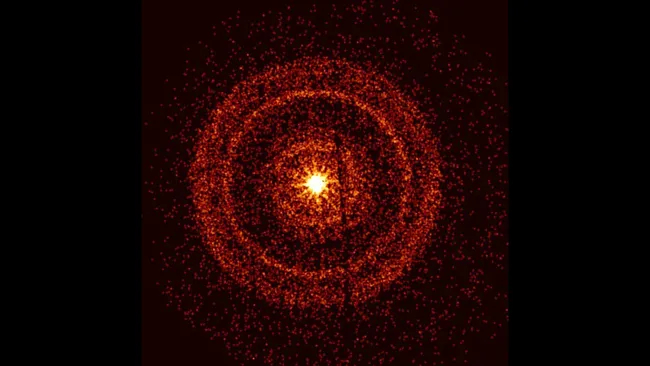
The Brightest (GRB) of All Time (BOAT) was detected on October 9, 2022. Dubbed GRB 221009A, the explosion appeared in the constellation Sagitta and occurred 1.9 billion years ago. The striking image obtained using Swift’s XRT shows bright rings in the afterglow emission. The rings were formed when X-rays scattered from otherwise unobservable dust layers within our galaxy that lie in the direction of the burst. Credit: NASA/Swift/A. Beardmore (University of Leicester)
Black Hole Devouring A Star
In late March 2011, NASA's Swift satellite alerted astronomers to intense and unusual high-energy flares from a new source in the constellation Draco. They soon realized that the source, which is now known as Swift J1644+57, was the result of a truly extraordinary event - the awakening of a distant galaxy's dormant black hole as it shredded and consumed a star. The galaxy is so far away that the radiation from the blast has traveled 3.9 billion years before reaching Earth. Credit: NASA's Goddard Space Flight Center
A gas cloud encounters two supermassive black holes. The complex interplay of gravitational and frictional forces causes the cloud to condense and heat. Some of the gas is ejected from the system with each orbit of the black holes. Credit: F. Goicovic et al. 2016
Works Cited:
Bad Astronomy News Network. (2024, December 24). Two decades of the Swift high-energy Universe. https://badastronomy.beehiiv.com/p/two-decades-of-the-swift-high-energy-universe
European Space Agency (ESA). (2015, June 7). Astronomers use cosmic gravity to create a ‘black-hole-scope’ https://www.esa.int/Science_Exploration/Space_Science/Astronomers_use_cosmic_gravity_to_create_a_black-hole-scope
Penn State: Mission Operations Center for Swift. (n.d.). Overview of the Swift X-ray Telescope. https://www.swift.psu.edu/xrt/
Penn State: Mission Operations Center for Swift. (n.d.). The Ultra-violet Optical Telescope (UVOT). https://www.swift.psu.edu/uvot/
National Aeronautics and Space Agency (NASA). (2025, June 04). 3 Black Holes Caught Eating Massive Stars in NASA Data.https://science.nasa.gov/science-research/astrophysics/3-black-holes-caught-eating-massive-stars-in-nasa-data/
NASA. (2025, January 15). Astronomers Catch Unprecedented Features at Brink of Active Black Hole. https://science.nasa.gov/universe/black-holes/supermassive-black-holes/astronomers-catch-unprecedented-features-at-brink-of-active-black-hole/
NASA. (2024, November 19). NASA’s Neil Gehrels Swift Observatory: 20 Years of Observation. https://swift.sonoma.edu/swift20/science/
NASA. (2022, December 07). NASA’s Fermi, Swift Capture Revolutionary Gamma-Ray Burst. https://svs.gsfc.nasa.gov/14255
NASA. (2014, August 7). Swift's Ultraviolet/Optical Telescope (UVOT). https://swift.gsfc.nasa.gov/about_swift/uvot_desc.html
NASA. (2012, December 28). Swift. https://www3.nasa.gov/mission_pages/swift/bursts/swift-images.html
NASA. (2002, May 2). NASA Visualization Rounds Up the Best-Known Black Hole Systems https://www.nasa.gov/universe/nasa-visualization-rounds-up-the-best-known-black-hole-systems/
NASA. (n.d.). Swift Factsheet. https://swift.gsfc.nasa.gov/about_swift/Sci_Fact_Sheet.pdf
NASA Space News. (2025, July 30). GRB 221009A: The Brightest Cosmic Explosion Ever Seen Is Rewriting Space Science. https://nasaspacenews.com/2025/07/grb-221009a-the-brightest-cosmic-explosion-ever-seen-is-rewriting-space-science/
Space.com. (2023, October 5). What are gamma-ray bursts? https://www.space.com/gamma-ray-burst.html
University of Leicester. (2024, November 19). Leicester scientists celebrate anniversary of game-changing satellite. https://le.ac.uk/news/2024/november/swift-anniversary

