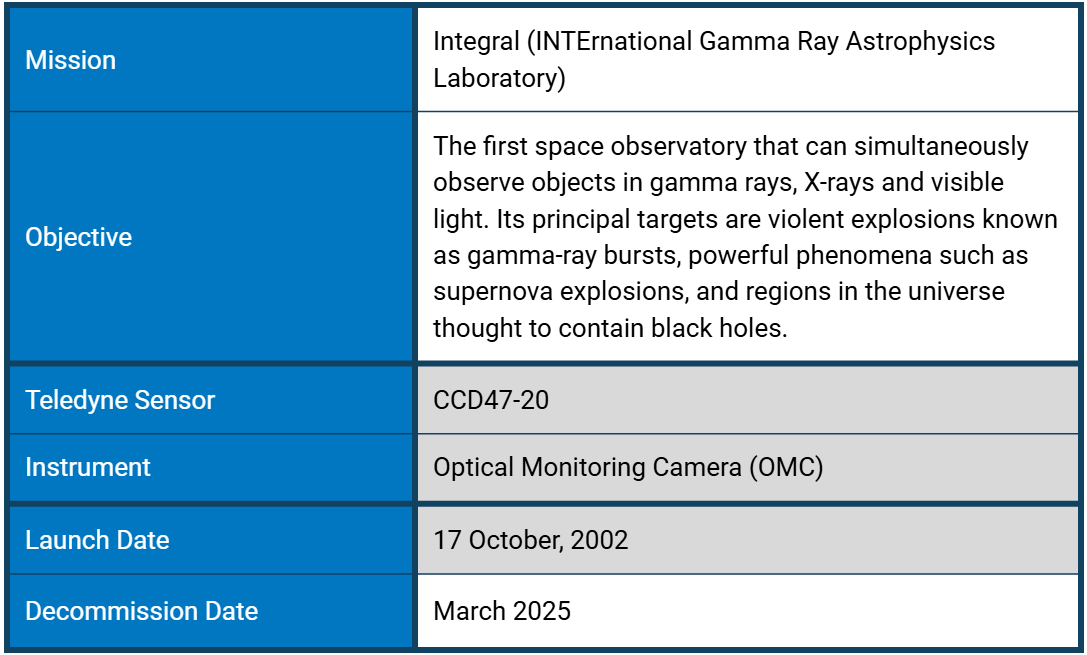
Creation and destruction are closely related – a connection best embodied by the catastrophic events surrounding the formation of the universe as massive stellar explosions produced the elemental building blocks of planets. Though occurring billions of years ago, these violent explosions emitted gamma radiation which can be observed by current astronomers, bolstering our understanding of where the basic chemical elements of the universe came from.
Produced by stars exploding, matter falling into black holes and celestial objects colliding, gamma radiation has the shortest wavelengths and highest energy in the electromagnetic spectrum. Part of ESA’s Horizon 2000 program, Integral (INTErnational Gamma Ray Astrophysics Laboratory) was the most sensitive gamma ray observatory when it was launched in 2002.
Integral’s payload consists of two gamma ray instruments: SPI spectrometer and IBIS imager, and two monitors, JEM-X X-ray monitor and OMC optical monitor. All four instruments are co-aligned to simultaneously observe the same 900 square degree region of the sky. This complementary data helps scientists identify celestial objects releasing gamma rays and perform more complete analysis.
Integral was built on the same bus as
XMM-Newton. For 22 years, it used a combination of fine spectroscopy and gamma ray imaging to observe the universe's most violent and exotic objects such as compact objects – black holes, neutron stars, white dwarfs, supernovae, and gamma ray bursts – as well as the broader structure of galaxies, clusters, and cloud complex regions.
Gamma rays are absorbed by the Earth’s atmosphere. Integral was placed in a highly elliptical inclined orbit that circled Earth every three days. From an altitude over 40,000 km to 150,000 km at perigee, this orbit allowed the spacecraft long periods of observations away from background radiation interference.
Integral collects weekly scans of the galactic plane. These are building-up into a detailed survey. Each weekly scan consists of a "slew, stop, stare" profile along a saw-tooth track. This ongoing monitoring of the galactic plane detected transient sources, and established time-resolved mapping of the galactic plane in continuum and diffuse line emission.
OMC (Optical Monitoring Camera)
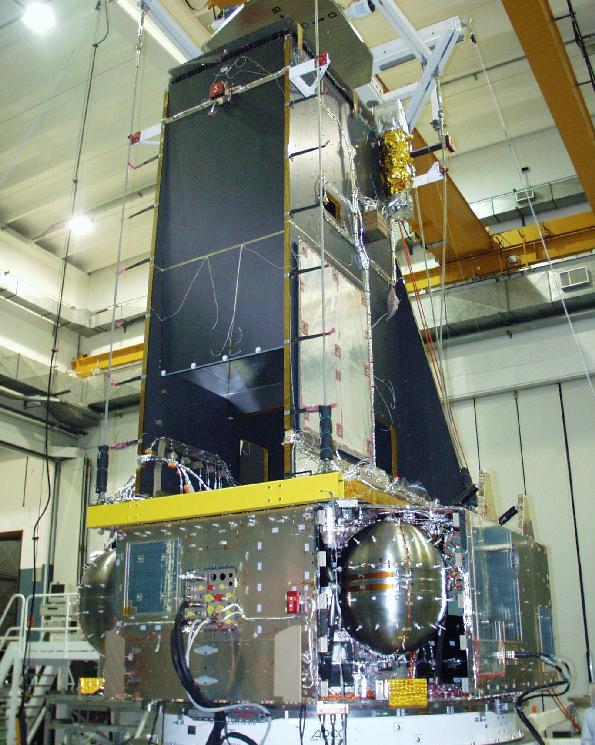
OMC flight model on spacecraft payload module. Credit: ESA
A wide-field optical instrument, OMC is the first instrument to make long observations of the visible light coming from gamma ray and X-ray sources. Multi-band observations are particularly important in high energy astrophysics where variability is typically rapid, unpredictable and of large amplitude.
The OMC consists of a passively cooled, large-format Teledyne CCD47-20 (2061x1056 pixels) working in frame transfer mode (1024x1024 image area, and 1024x1024 storage area that is not exposed to light). The CCD is located in the focal plane of a 50 mm diameter lens including a Johnson V-filter to cover the 500 - 600 nm (CCD: 850 nm) wavelength range. This design, with a frame transfer time of around 2 ms, allows continuous measurements and makes it unnecessary to have a mechanical shutter. OMC is mounted on top of the satellite and is sensitive to stars with a visual magnitude up to 19.7.
The instrument was built by collaborating scientific institutes in Spain (INTA/LAEFF Madrid, University of Valencia, University of Barcelona), Ireland (UCD (University College Dublin), Belgium (University of Liege), United Kingdom (MSSL Dorking) and Czech Republic (Astrophysical Institute).
Achievements:
- The discovery of over 700 new hard X-ray sources, doubling the known number of such sources.
- Conclusively settled a longstanding debate surrounding the origin of the Milky Way’s soft gamma ray emission by showing that a hundred individual sources account for the entirety of this emission.
- Generated the first large-scale sky map of emission at 511 keV, a wavelength of radiation produced by positron annihilation, showing the presence of large amounts of antimatter – rather than dark matter as previously proposed – in the central parts of our Galaxy. These positrons are produced as massive stars explode and leave behind radioactive elements that decay into lighter particles.
- The first detection of radioactive titanium and radioactive cobalt in supernovae.
- Provided proof of the Galaxy-wide origin of radioactive aluminium, from which the current rate of supernovae in the Milky Way can be determined. Using this data, astrophysicists estimate one supernova occurs every 50 years.
- Made the first measurement that one in four active galaxy nuclei (AGN) is Compton-thick in a complete AGN sample. In Compton-thick AGN, the nucleus is obscured by large amounts of gas and dust.
- A Nobel Prize winning discovery linking gamma ray flashes to the gravitational waves released by the collision of two neutron stars. This proved the connection between short gamma ray bursts and double neutron star mergers. Gamma rays were observed in
collaboration with other astronomy missions equipped with Teledyne sensors: SOHO, Swift,
Hubble, European Space Observatory’s VLT, James Webb Space Telescope,
XMM-Newton, BepiColumbo, and
Gaia.
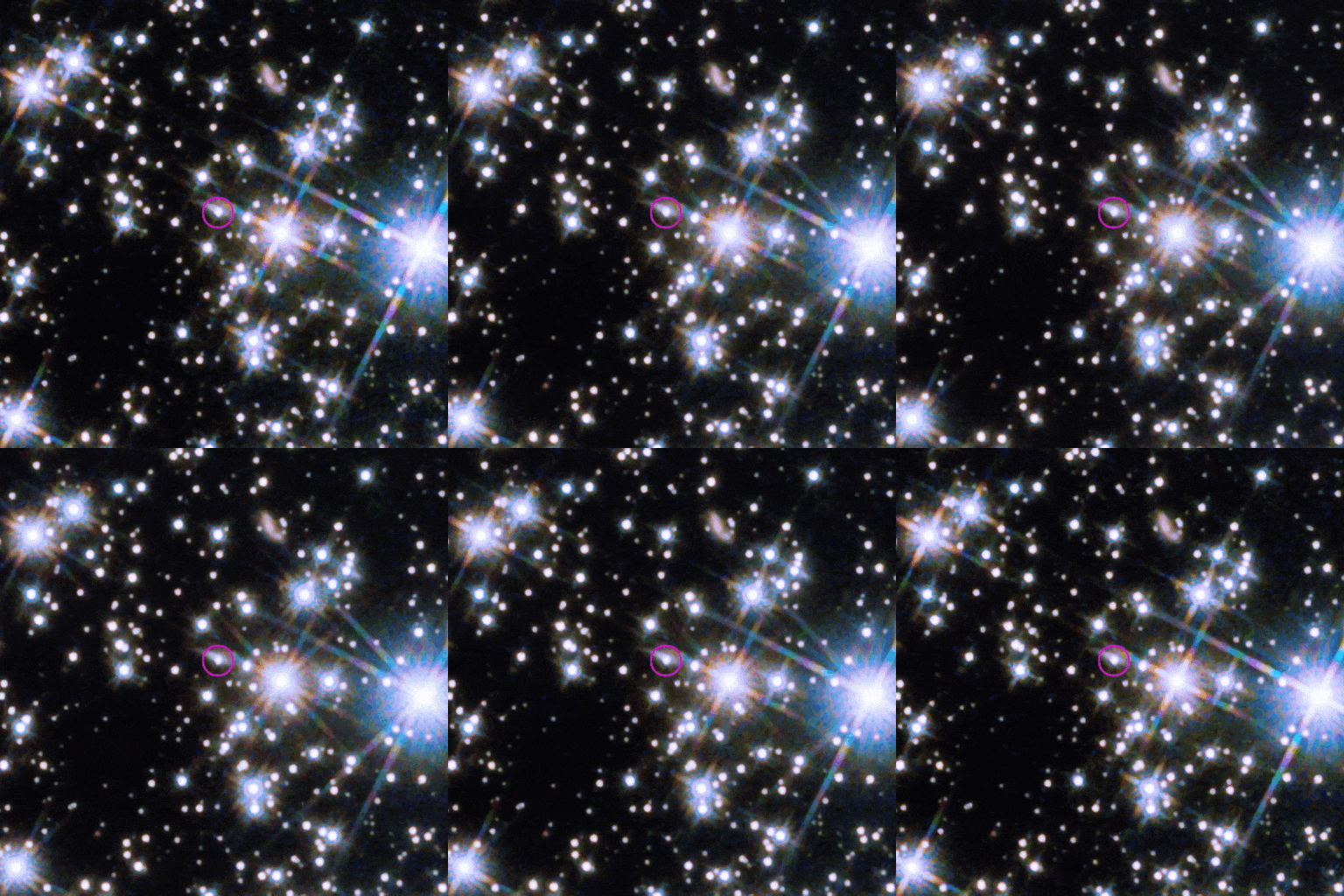
On Oct. 9, 2022, a pulse of intense gamma radiation swept through the solar system so exceptional that astronomers quickly dubbed it the BOAT—the brightest of all time. "The 'Burst Alert System' on Integral automatically alerted observatories worldwide about the discovery in just seconds. This was hours before any other alerts were issued, enabling the scientific community to act fast and explore this source in more detail. The Hubble Space Telescope’s Wide Field Camera 3 revealed the infrared afterglow (circled) of the BOAT gamma ray burst and its host galaxy, seen nearly edge-on as a sliver of light extending to the burst's upper left. This animation flips between images taken on Nov. 8 and Dec. 4, 2022, one and two months after the eruption. Credit: NASA, ESA, CSA, STScI, A. Levan (Radboud University); Image Processing: Gladys Kober
Works Cited
eoPortal (2017, November 23). INTEGRAL (INTErnational Gamma-Ray Astrophysics Laboratory) https://www.eoportal.org/satellite-missions/integral#omc-optical-monitoring-camera
The European Space Agency. (n.d.). Mission: Integral. https://esoc.esa.int/content/integral
ESA. (n.d.) https://www.cosmos.esa.int/web/integral/instruments-omc
ESA. (2019, September 1). https://sci.esa.int/web/integral/-/31149-summary
ESA. (n.d.). Seeing in gamma-ray wavelengths. https://www.esa.int/Science_Exploration/Space_Science/Integral/Seeing_in_gamma-ray_wavelengths
Ibid. Why do we observe gamma rays? https://www.esa.int/Science_Exploration/Space_Science/Integral/Why_do_we_observe_gamma_rays
Ibid. Integral science highlights. https://www.esa.int/Science_Exploration/Space_Science/Integral/Integral_science_highlights
Integral Science Observation Center. (2021, February 17). OMC Observer's Manual. https://integral.esac.esa.int/AODocumentation/OMC_ObsMan.pdf
Orbital Today. (2025, March 22). A Telescope’s Final Act: How Integral Will Burn Up in Earth’s Atmosphere. https://orbitaltoday.com/2025/03/22/retirement-time-for-the-esa-integral-spacecraft/

