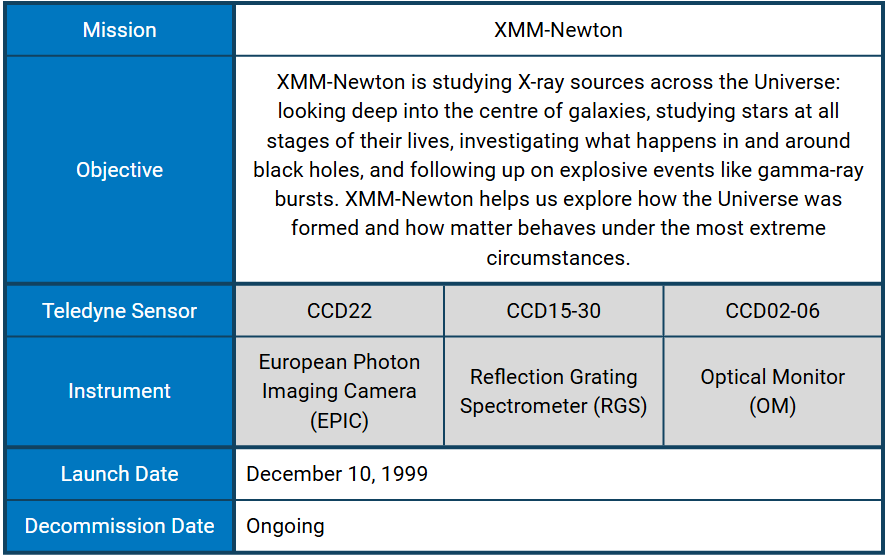
The long-running XMM-Newton (X-ray Multi-Mirror) mission has increased our understanding of the universe. A cornerstone mission of the European Space Agency's Horizon 2000 program, data gathered by the XMM-Newton observatory has supported 8,000 papers from 15,000 scientists.
Teledyne Space Imaging produced the CCD detectors deployed on all the spectrometers and imaging instruments on the mission. Optimised to detect emission features from extended and diffuse extragalactic sources, this high sensitivity and wide field of view, equivalent to the apparent size of the Moon as seen from Earth, enabled XMM-Newton to record 6.6 million UV and visible sources and 1 million X-ray sources as of May 2024.
XMM-Newton is named in honour of Sir Isaac Newton. Credited with the invention of spectroscopy, Newton’s work in the field of mathematics, optics and physics laid the foundations for modern science.
XMM-Newton travels along a 48-hour orbit around Earth. The highly elliptical orbit offers the most extended possible observation periods with less interference by the Earth’s shadow, and maintains a real-time data feed with ground stations. Additionally, the high orbit places the satellite above the disruptive effects of the radiation belt surrounding the Earth and its X-ray-absorbing atmosphere.
The observatory can detect a wide variety of celestial objects, ranging from cold comets and clouds of X-ray-absorbing gas to concentrations of very hot plasma near the event horizon of a black hole. Furthermore, cosmic sources radiate at multiple frequencies. Scientists knew that many systems in the universe emitted an abundance of X-rays, but lacked detailed models for how those emissions arise and what they indicate. XMM-Newton collects observations from all three of its instruments simultaneously, enhancing the depth of information.
Launched in 1999, XMM-Newton pioneered high orbit X-ray astronomy – exploring the stellar debris of supernova remnants, probing superdense neutron stars, investigating black holes, and tracking signatures of dark matter. ESA’s largest scientific spacecraft at the time, XMM-Newton, operates six co-aligned instruments: three EPIC imaging X-ray cameras, two RGS grating X-ray spectrometers, and the OM UV/VIS telescope.
While ESA controls the XMM-Newton programme, NASA played a significant role in the development of the scientific instruments.
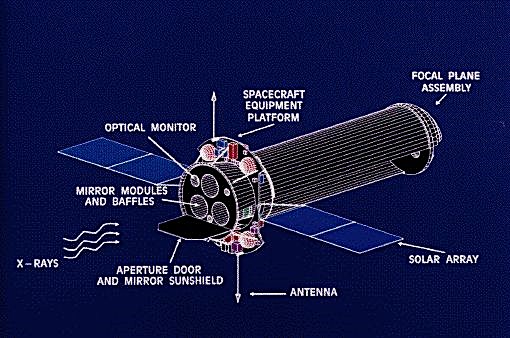
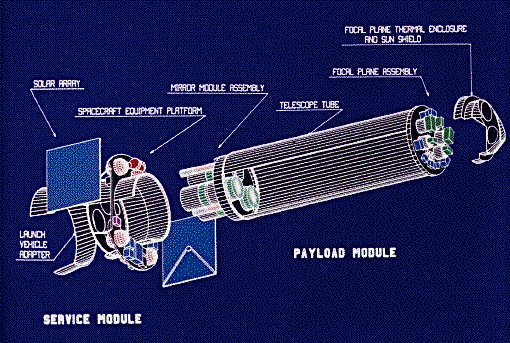
Schematics of the XMM-Newton spacecraft. Credit: XMM-Newton SOC, VILSPA
EPIC (European Photon Imaging Camera)
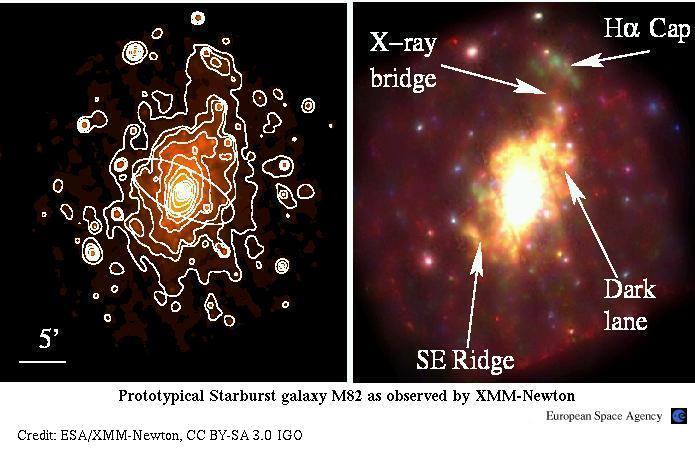
Left: The XMM-Newton view of M82. An adaptively smoothed and exposure-corrected image of the merged data from the MOS1, MOS2 and PN instruments in the 0.2 -10 keV waveband. The extent of the optical galaxy is shown by the ellipse (11.2×4.3 arcmin). Contours are shown to highlight the low surface brightness emission and are increased by a factor of 2. Right: The three-colour EPIC image of M82. The 0.2-0.5 keV, 0.5 -0.9 keV, and 0.9 -2.0 keV bands are shown in red, green, and blue, respectively. Image courtesy of I.R. Stevens, School of Physics and Astronomy, University of Birmingham, UK and ESA. Credit: ESA/XMM-Newton,
CC BY-SA 3.0 IGO
The EPIC (European Photon Imaging Camera) instrument comprises three X-ray telescopes, each equipped with a dedicated sensor array developed by Teledyne. Two of the cameras are MOS (Metal Oxide Semiconductor) CCD22 arrays. Each of these MOS cameras consists of seven front-illuminated CCD22 sensors, forming a 600 x 600 pixel imaging section to provide the highest spatial resolution on board XMM-Newton.

Image courtesy of Leicester University, University of Birmingham, CEA Service d'Astrophysique Saclay and ESA. Credit: ESA/XMM-Newton,
CC BY-SA 3.0 IGO
The third EPIC telescope utilises a deep-well, back-illuminated, pn-CCD sensor array, which is configured to provide the highest sensitivity. The pn camera supports spatially uniform detector quality across the entire field of view (FOV). This was achieved by Teledyne's monolithic fabrication of twelve 3 x 1 cm pn-CCDs on a single wafer.
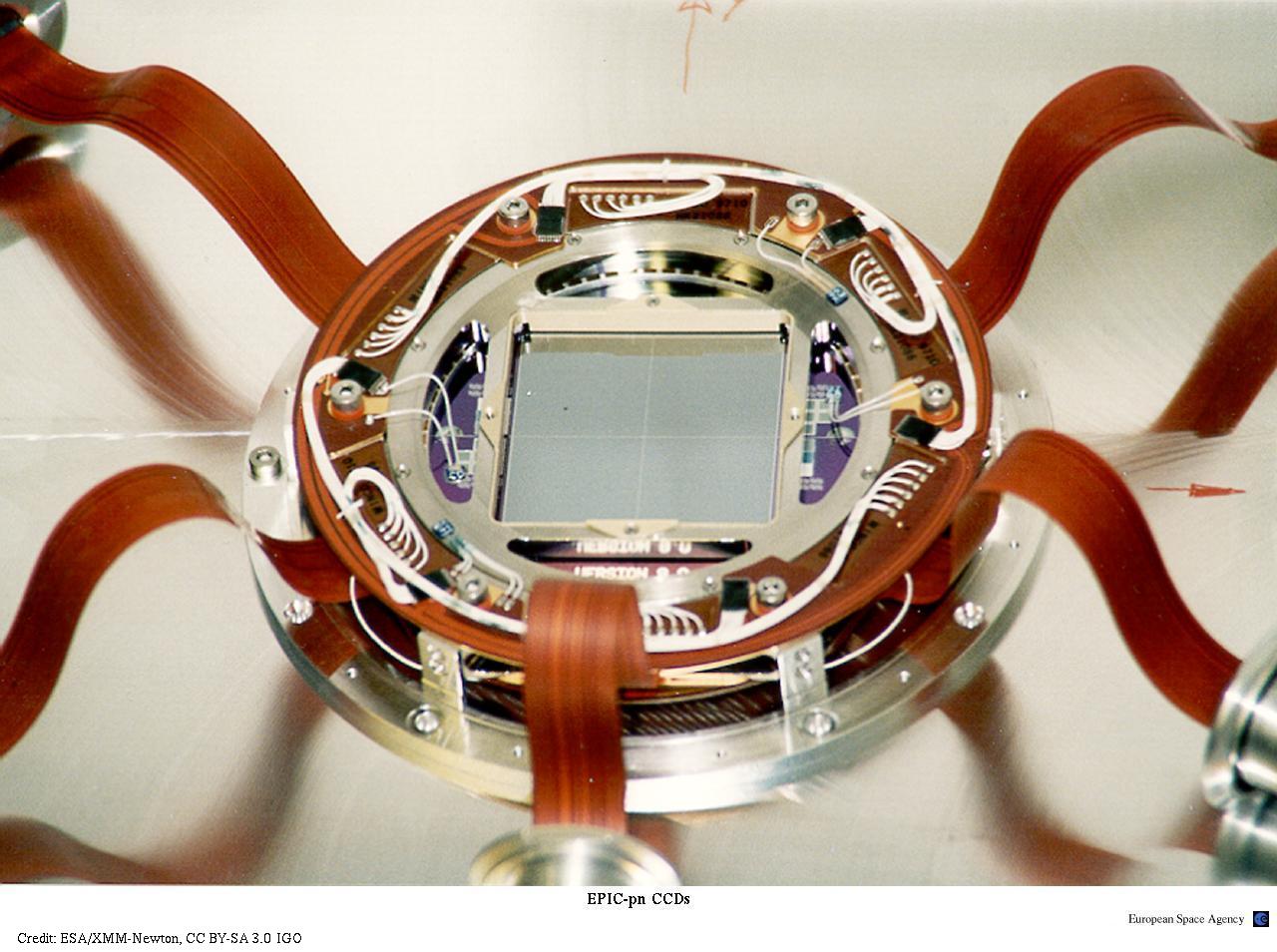
The 12 CCDs of the EPIC pn camera. Image courtesy of MPI-semiconductor laboratory, MPE, Astronomisches Institut Tübingen, Germany and ESA. Credit: ESA/XMM-Newton,
CC BY-SA 3.0 IGO
Incorporating over 170 wafer-thin mirrors stacked 25 μm apart, EPIC captures images that allow scientists to chart how the brightness of sources changes over time, providing information about the targets’ temperatures and surroundings.
RGS (Reflection Grating Spectrometer)
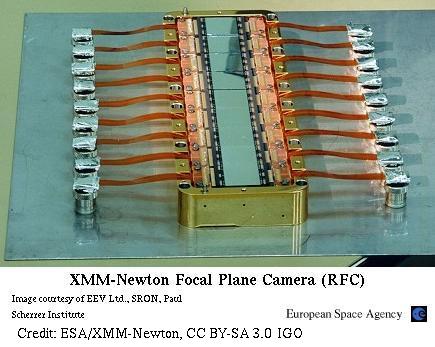
Image courtesy of EEV Ltd., SRON, Paul Scherrer Institute and ESA. Credit: ESA/XMM-Newton,
CC BY-SA 3.0 IGO
Atoms in the extreme environments around black holes or in stellar debris lose electrons and produce characteristic X-rays. Using a series of reflection gratings, RGS records high-resolution spectral information by “fanning out" the various wavelengths to determine the exact condition of individual elements, such as oxygen, carbon, and iron.
For redundancy, RGS includes two detectors, each containing nine large format back-illuminated CCD15-30, and two filter wheels with eleven apertures: one blanked off, six broad band filters (U, B, V, UVW1, UVM2 and UVW2), one white, one magnifier, and two grisms (UV and optical). For faster readout speed, the instrument can operate in either frame transfer mode or single-photon counting mode.
By examining these detailed spectroscopy patterns, scientists can gain insight into the fundamental physics that governs the chaotic movements of galaxies, including calculations of temperatures, densities, and pressures.
OM (Optical Monitor)
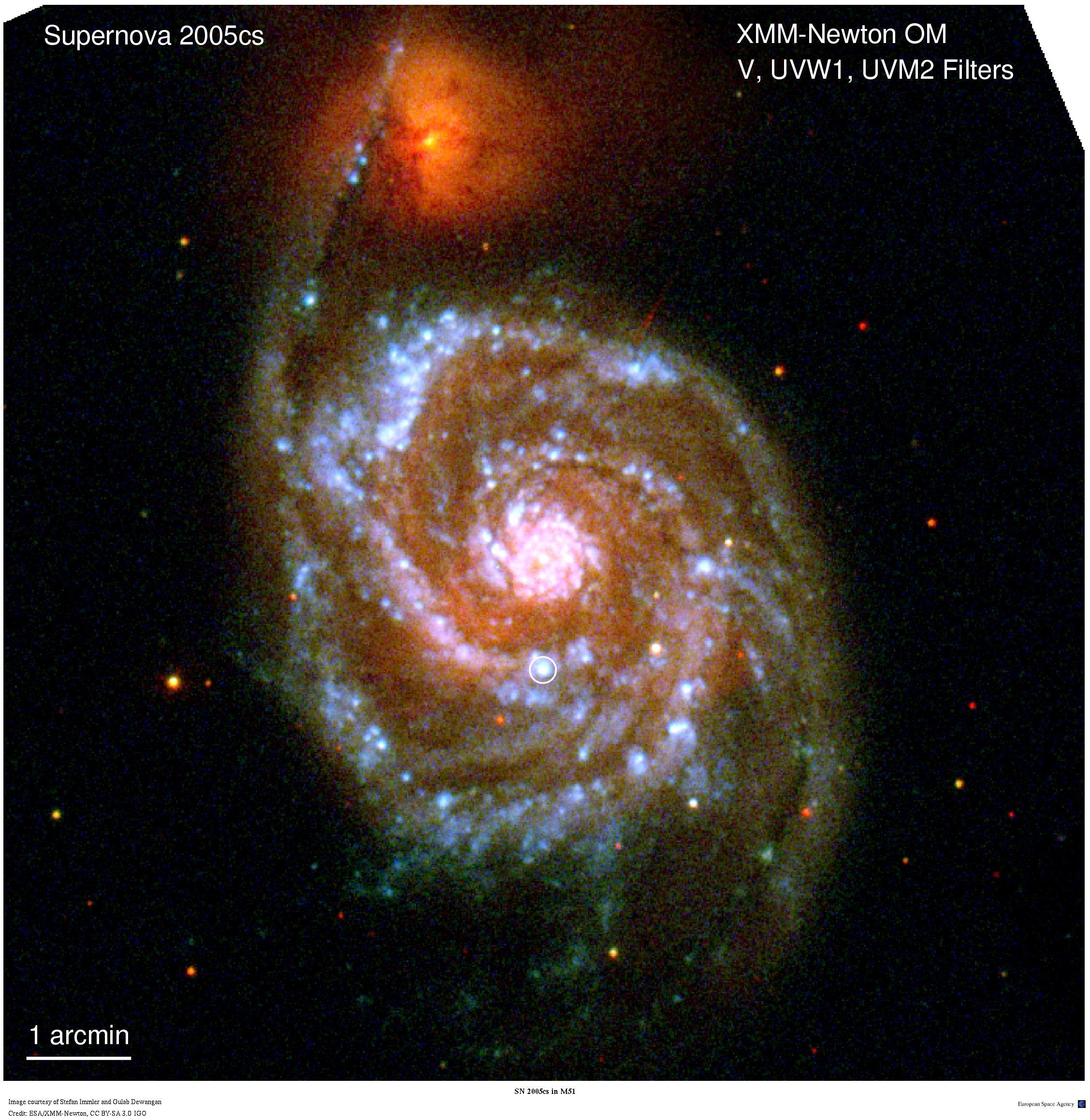
OM image of SN 2005cs, a Type II supernova in the nearby galaxy M51 observed as a Target of Opportunity on the 1st of July, 2005. The image is a false-colour image created by combining the Visible and Ultraviolet images. In the ultraviolet light, the supernova is far brighter than the galaxy's nucleus. Image courtesy of Stefan Immler, Gulab Dewangan, and ESA. Credit: ESA/XMM-Newton,
CC BY-SA 3.0 IGO
OM is a conventional but very sensitive optical/UV telescope. Described by ESA as “a scaled-down version of the Hubble Space Telescope," it observes simultaneously the same regions as the X-ray telescopes, but at ultraviolet and visible wavelengths. This provides astronomers with complementary data on the X-ray sources. Many objects change — undergoing flares and outbursts — so collecting X-ray, optical, and UV data simultaneously provides a wealth of information for study.
Mapping Black Holes with X-Ray “Sonar”
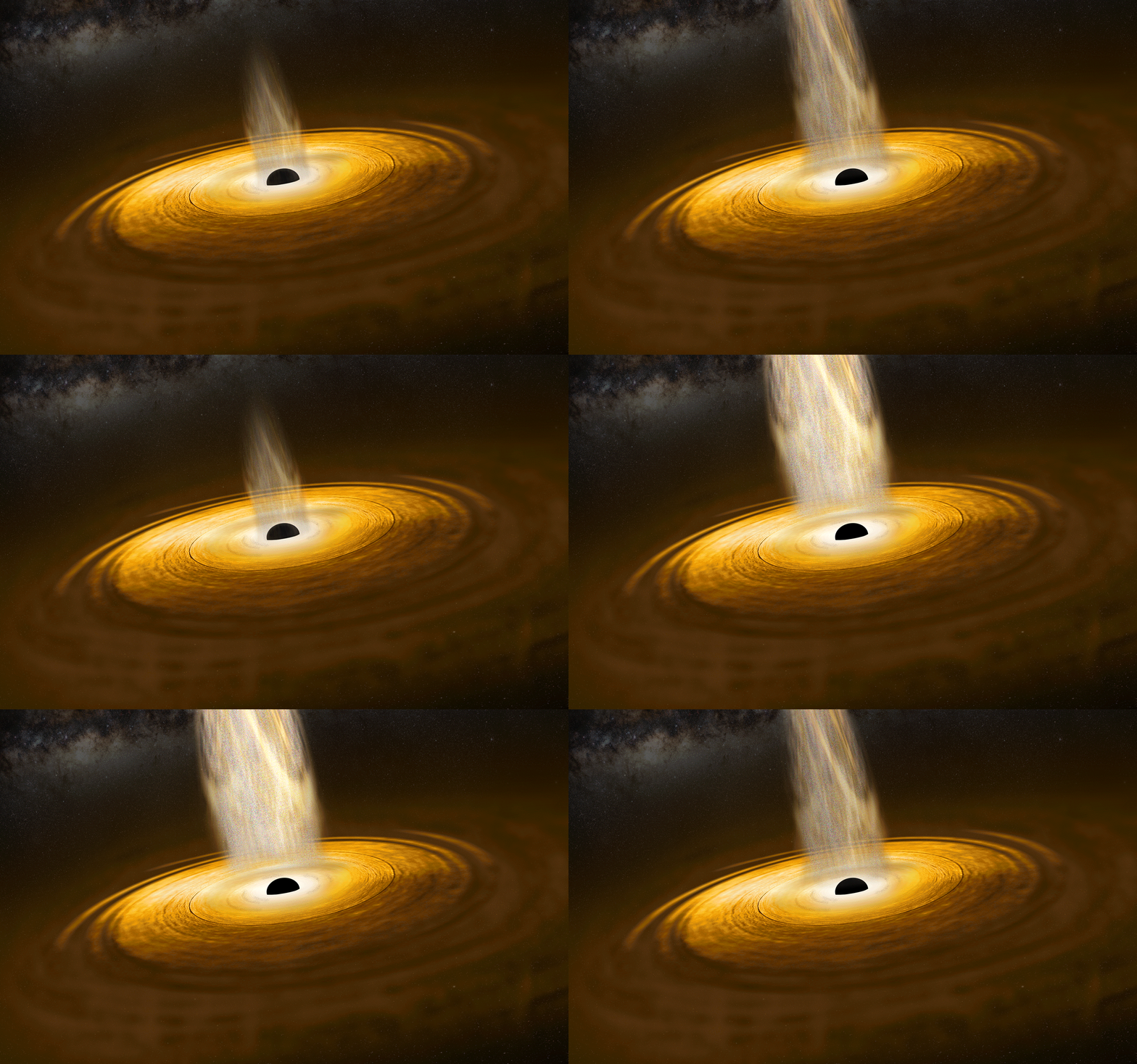
Illustrations show the surroundings of a black hole feeding on ambient gas as mapped using ESA’s XMM-Newton X-ray observatory. Credit: ESA, CC BY-SA 3.0 IGO
X-rays bounce all around the environments near black holes. These X-ray “echoes” can help us map the area like sonar uses sound waves to chart the ocean floor. By watching how light bounced off the superheated corona surrounding black holes, scientists were able to track how it changed over time. From this, they could more accurately determine its mass and spin.
XMM-Newton also detected X-ray flares bouncing off the gas falling into the black hole. These echoes were captured for the first time, reflected by the gas in the disc behind the black hole. By examining the delays between the primary flares and their echoes, astronomers can create a 3D map of the black hole's surroundings.
Collaborating with Other Teledyne Missions
Located 300 million light-years from Earth, Abell 1367 – or the Leo Cluster – is a young cluster containing around 70 galaxies. In 2017, a small, warm gas cloud of unknown origin was discovered in A1367 by the Subaru telescope, also equipped with Teledyne Space Imaging sensors, in Japan. A follow-up X-ray survey to study other aspects of A1367 revealed X-rays emanating from this cloud, indicating it to be larger than the Milky Way. Additional observations from the
Multi Unit Spectroscopic Explorer (MUSE) on the Very Large Telescope (VLT) gathered additional observations in visible light.
The cluster’s existence is unexpected, as it formed under very harsh conditions that should have torn apart the cluster before it could form. A magnetic field in the cloud would be able to suppress these instabilities and could have created the “orphaned” cluster. The parent galaxy of Abell 1367 is likely massive. A closer inspection of this orphan will also further our understanding of the evolution of the stripped interstellar medium at such a great distance from its parent galaxy. It will provide a rare laboratory to study other things, such as turbulence and heat conduction.
Other Achievements
- Determined that the Milky Way's Black Hole is believed to have woken up violently about 400 years ago and then turned off again about 100 years later.
- Identified the potential signatures of solar axions, dark matter particle candidates.
- Measured the spin rate of a supermassive black hole for the first time in collaboration with NuSTAR.
- Acquired the first large-scale map of the dark matter and baryon distributions in the universe.
- Detected for the first time a switching X-ray emission when monitoring a highly variable pulsar - reopened the debate about the physical mechanisms powering the emission from pulsars.
- Constructed the most extensive catalogue of cosmic X-ray emitting objects.
- Documented the mechanism that creates Jupiter’s unusual X-ray auroras, solving a 40-year-old mystery in collaboration with NASA's Juno spacecraft (flying with a Teledyne TH7890 sensor).
- Captured direct signs that the fiery hot gas dispersed among the galaxies is flowing and sloshing. Learning more about the motions of intracluster gas is key to understanding how galaxy clusters form and evolve.
- Showed that fierce winds from a supermassive black hole blow outward in all directions in collaboration with NuSTAR.
- Discovered 2XMM J083026+524133, the most massive cluster of galaxies seen in the distant Universe up to that time.
- Analysed spectra of a distant active galaxy, 1H0707-495, which revealed two bright features of iron emission (the iron L and K lines) in the reflected X-rays that had never appeared together in an active galaxy.
Credit: NASA’s Goddard Space Flight Center
Decades of XMM-Newton observations bolster research efforts while inspiring the upcoming generation of astronomers. A highly respected mission, XMM-Newton operations are extended until December 2026, and indicatively until the end of 2029.
Works Cited
eoPortal. (2017, July 17). XMM-Newton (X-ray Multi-Mirror Mission-Newton) Observatory.
https://www.eoportal.org/satellite-missions/xmm-newton#xmm-newton-x-ray-multi-mirror-mission-newton-observatory
NASA's Goddard Space Flight Center. (2019, December 10). XMM-Newton Celebrates 20 Years in Space
https://www.youtube.com/watch?v=JMFLWTcBsi8
National Aeronautics and Space Administration (NASA). (2019, December 10). X-ray Satellite XMM-Newton Celebrates 20 Years in Space.
https://www.nasa.gov/universe/x-ray-satellite-xmm-newton-celebrates-20-years-in-space/
The European Space Agency. (n.d.). Mission: XMM-Newton.
https://esoc.esa.int/content/xmm-newton
ESA. (n.d.). XMM-Newton factsheet.
https://www.esa.int/Science_Exploration/Space_Science/XMM-Newton/XMM-Newton_factsheet
ESA. (2023, March 7). Extended life for ESA's science missions.
https://sci.esa.int/web/director-desk/-/extended-life-for-esa-s-science-missions
ESA - Cosmos: The portal for users of ESA's Science Directorate's missions. (n.d.) About XMM-Newton. The European Space agency (ESA).
https://www.cosmos.esa.int/web/xmm-newton/about-xmm-newton

