The SPOT programme's official objective was to improve knowledge and management of Earth by exploring the planet's resources, detecting and forecasting phenomena involving climatology and oceanography, and monitoring human activities and natural phenomena. Teledyne Space Imaging sensors flew on six satellites, logging 74 years of flight time and imaging more than 100 billion square kilometres of Earth.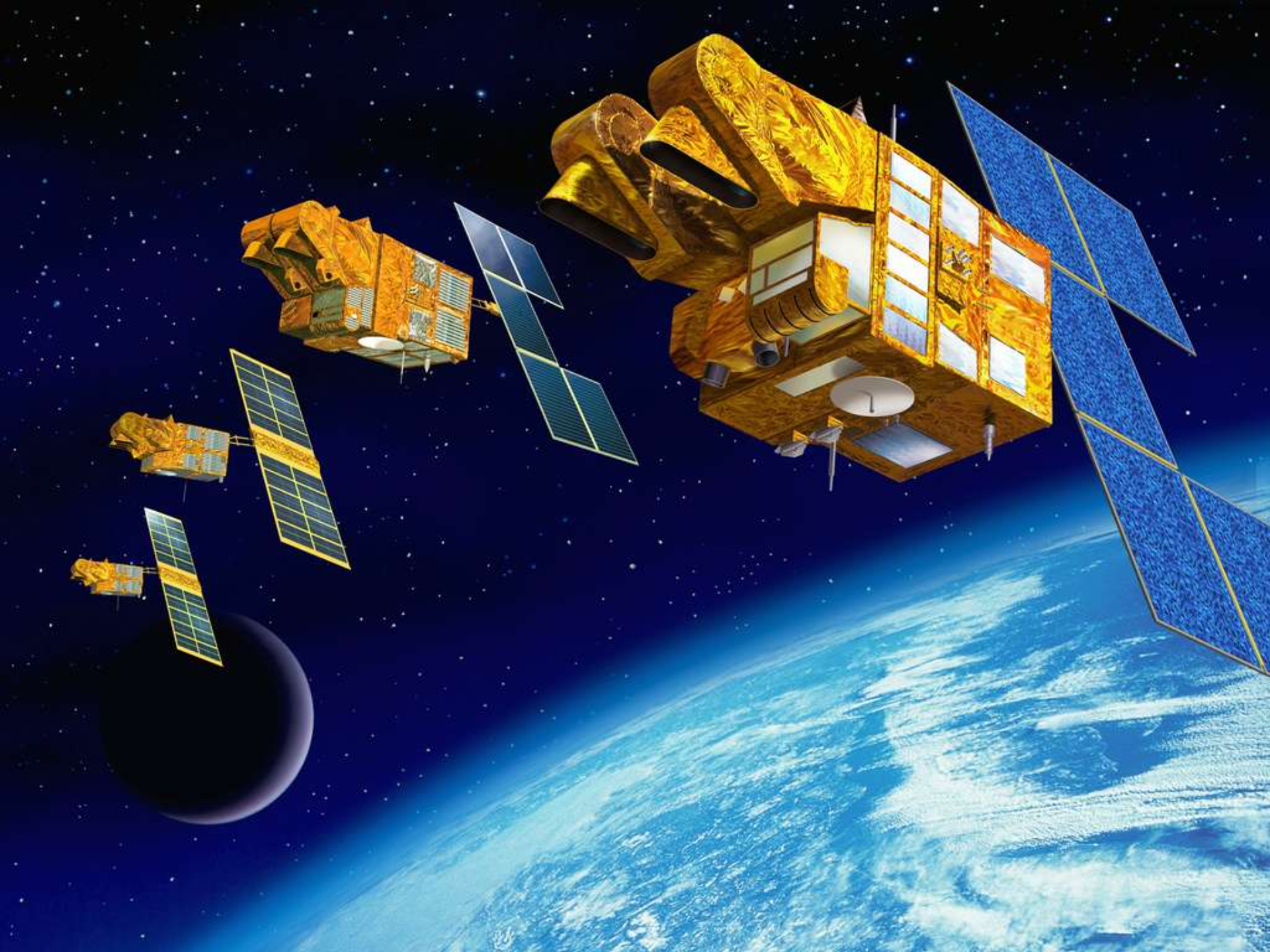
SPOT series. Credit: CNES/ill.D.Ducros, 2002
What is SPOT?
Since 1986, the SPOT programme (Satellite Pour l’Observation de la Terre) has imaged more than 30 million scenes. This data archive remains a vital tool for science, industry, and government across a range of applications: cartography, vegetation monitoring, agriculture, forestry, soils, geology, oil and mineralogical exploration, water resources, urban and rural land use, and environmental monitoring. Over the course of the programme, Teledyne Space Imaging provided 55 sensors for 15 scientific instruments.
Developed by France’s National Centre for Space Studies (CNES), SPOT was the first European Earth-observation satellite programme launched after the US Earth monitoring satellite Landsat-1. At the time, SPOT was the most sophisticated Earth observation programme producing images with a ground resolution of 10 metres – eventually improving to 1.5 metres – which outperformed the 30-metre resolution of contemporary satellites.
CNES oversaw the launch of SPOT 1-5, and Airbus Defence and Space finished the SPOT series launching SPOT 6 and 7. CNES continued the legacy of the original five SPOT satellites with the twin Pléiades satellites (also equipped with Teledyne Space Imaging sensors), offering improved imaging capabilities. Furthermore, Airbus' commercial SPOT satellites worked with the Pléiades satellites to produce very high-resolution imagery. Such collaboration established data continuity of Earth monitoring across decades of SPOT's instruments.
Every instrument on each SPOT satellite needed to support the same image characteristics: high-resolution, wide-area, optical imagery with a swath of 60km. All satellites in the programme would employ pushbroom imaging sensors with two modes of imaging: Panchromatic (PAN) mode and Multispectral (MS), which could operate either individually or simultaneously.
Jebel Amur, Algeria one of the first images taken by SPOT. Credit: CNES/distribution Spot Image
 Starting with SPOT 1, an innovation first equipped on the SPOT satellites were steerable mirrors to enable viewing on either side of the ground track – over a 950 km swath. These extended area satellite imagemaps became the benchmark for small and medium-scale mapping applications. SPOT’s pointing capability also increased the frequency of observation of a site by the satellite to 4 to 11 times per 26-day cycle.
Another advantage the mirrors offered was capturing images in tri-stereo: an image composed of three scenes taken from oblique angles: forward, backwards, and above. These accurate and detailed images were used to generate digital terrain models. Accordingly, the SPOT constellation provided the first usable elevation data for a sizeable portion of the planet's landmass.
The SPOT 1 and 2 satellites were each equipped with two High-Resolution Visible (HRV) instruments, each comprising four TH7801 sensors. They captured images in four spectral bands: panchromatic, green, red, and near-infrared (NIR). Panchromatic mode provided data at 10 m spatial resolution, whereas multispectral mode provided data at 20 m spatial resolution.
For a combined time of 36 years, SPOT 1 and 2 collected 9.2 million high-quality images of the Earth. The images from SPOT 2 alone covered almost 23.4 billion km2 – about 46 times the total surface of the Earth.
SPOT 1 was instrumental in the response to the Chornobyl nuclear disaster when it provided images of the highly contaminated zone leading to the evacuation of one hundred fifteen thousand people. This area – known as the exclusion zone – consisted of a 30 km buffer around the power plant and could only be accurately seen by satellite. SPOT 1 also helped identify the first signs of recovery, uncovering evidence of photosynthesis using the near-infrared sensor.
Using SPOT Data
Combining SPOT imagery with other information sources like demographic data has been a valuable aid for land planning and management at local, national, and global levels. For example, images from SPOT were used to monitor the growth of the 50 biggest cities in China, and observe the implementation of Manila's development plan in the Philippines.
SPOT contributed to the MARS-PAC programme (Monitoring Agriculture by Remote Sensing-Politique Agricole Commune) carried out by the European Union, providing several hundred images per year, covering 120 to 150 sites selected by the 15 member countries. This helped rapidly estimate surface areas and potential yields in Europe, and verify farmers’ subsidies relating to cultivated and fallow land.
The SPOT programme currently works with the GIS mapping engine operator Satshot to provide high-resolution satellite data over a large agricultural area of the United States. SPOT data is integrated into the Satshot platform, which can be used for deep analysis of specific farmland for improved operations and efficiency, such as season-wide crop health monitoring and stress estimation, crop damage assessment for insurance, land use sustainability management, land value, and other precision applications.
In June 2000, ESA and CNES founded the International Charter on Space and Major Disasters. Under this charter, the signatory partners allocated their satellite systems, including SPOT, to acquire imagery for managing natural disasters. By rapidly acquiring satellite imagery of disaster zones, SPOT enabled experts to produce risk maps and deliver regularly updated information to emergency operators. As we face more frequent extreme weather events, the need to improve the technology powering Earth observation missions like SPOT will only grow.
SPOT’s Legacy
Another example of SPOT's versatility, the Copernicus mission – launched in 2009 – uses the SPOT system to collaborate and process images of the Earth in new and revealing ways. Focusing on studying urban development and tracking land use, scientists used observations from SPOT-6 and SPOT-7 to create an extensive and detailed, planet-wide dataset called WorldStat. Around 4000 high-resolution SPOT images – covering approximately 10,000 square km of Earth's surface – were paired with 16 Copernicus Sentinel-2 images. The Sentinel-2 images were captured at regular intervals of about five days and added detail to the wide-angle SPOT images.
The data collected by the SPOT constellation is distributed for free to researchers through the European Space Agency's Third Party Missions (TPM) programme. Operating for over 45 years, TPM consists of a series of satellites specifically focused on Earth Observation, which are owned by commercial and public organisations worldwide. The programme currently comprises over 50 missions with data sourced from more than 60 instruments, which is supplied to users for research and development purposes.
Banner Image Credit: NASA image created by Jesse Allen using data provided courtesy of Jennifer Small, NASA GIMMS Group at Goddard Space Flight Center.

