What Are Comets and Why Do We Study Them?
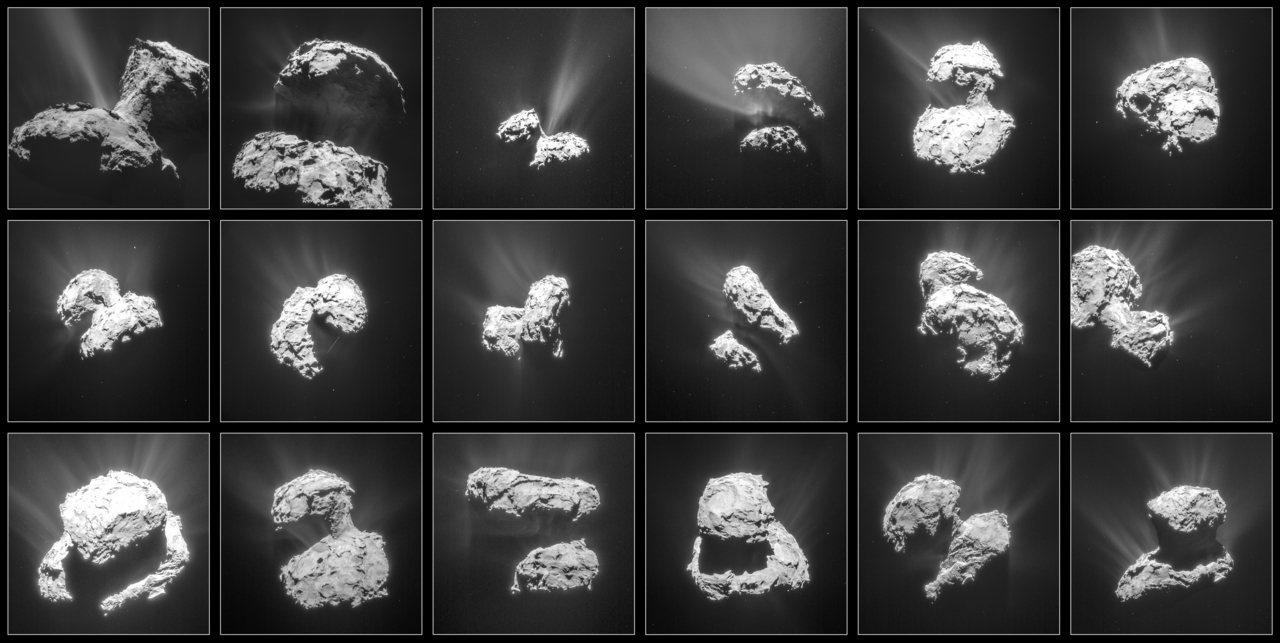 This montage of 18 images displays the activity of comet 67P/Churyumov-Gerasimenko from many different angles as seen by Rosetta's navigation camera (NavCam). The images were taken between 31 January 2015 (top left) and 25 March 2015 (bottom right), when the spacecraft was at distances of about 30 to 100 km (19 - 62 mi) from the comet. Credit: ESA/Rosetta/NAVCAM CC BY-SA IGO 3.0
4.6 billion years ago, our solar system formed out of a cloud of gas and dust. Most of this matter melded into the sun and surrounding planets, with much of the leftover material becoming asteroids and comets. While the Earth has been altered by weather and geologic activity, asteroids and comets lack an atmosphere, tectonic plates, or a molten core, so their composition has changed little over the millennia. Studying these pristine space objects can help scientists better understand the evolution of solar systems and the formation of complex molecules from atoms.
Comets are ancient cosmic icebergs; small bodies of frozen gas, ice, and dust ranging in circumference from 60 km (28 mi) to just 200 m (660 ft). As the early Universe churned, comets crashed into infant planets, delivering water and other complex organic molecules. Scientists believe that comets coming from the interstellar medium and/or the area around the still-forming Sun provided much of the water in today's oceans and may have played a crucial role in the evolution of life on Earth.
Travelling in highly elliptical orbits, comets spend most of their time far from the Sun, making them very difficult to see and analyse from Earth. The small, icy nucleus of a comet is too faint for detailed spectroscopic analysis. Even if it moves close enough for detailed observation – i.e. closer to the Sun – the nucleus is obscured from view by the coma; an all-enveloping shroud of gas and dust melting off the comet.
Previous missions – such as Giotto, which visited Comet Halley in 1986 – conducted high-speed flybys to capture precisely-timed measurements. While valuable, this data provided only a fleeting snapshot. A deeper understanding of comets would require long-term study.
What role, if any, did comets play in the evolution of life? How and why does a comet change during repeated approaches to the Sun? What lies at the heart of the nucleus, beneath its mysterious dark surface?
The Rosetta Mission
Using the CIVA camera on Rosetta’s Philae lander, the spacecraft snapped a ‘selfie’ at comet 67P from a distance of about 16 km from the surface of the comet. The image was taken on 7 October and captures the side of the Rosetta spacecraft and one of Rosetta’s 14 m-long solar wings, with the comet producing streams of dust and gas in the background. Credit: ESA/Rosetta/Philae/CIVA
Rosetta was an international enterprise, involving more than 14 European countries and the United States. It was launched as the third cornerstone mission of ESA's Horizon 2000 programme, following SOHO/Cluster and
XMM-Newton. A failure of an Ariane-5 rocket in December 2002 postponed the mission, causing it to miss the launch window to observe its original target – comet 46P/Wirtanen. It successfully launched two years later, re-targeting the periodic comet 67P/Churyumov-Gerasimenko (67P).
The mission was named after the famous Rosetta Stone, a slab of volcanic basalt found by Napoleonic soldiers on the island of Philae in the Nile near the Egyptian town of Rashid (Rosetta). An obelisk found on Philae – the name given to Rosetta’s lander – provided the French scholar Jean-Francois Champollion with the final clues for deciphering the hieroglyphs on the Rosetta Stone. As the Rosetta stone revolutionised the understanding of the human past, ESA’s Rosetta mission unlocked the mysteries of cosmic history.
A Scientific First: Landing and Orbiting 67P/G-C
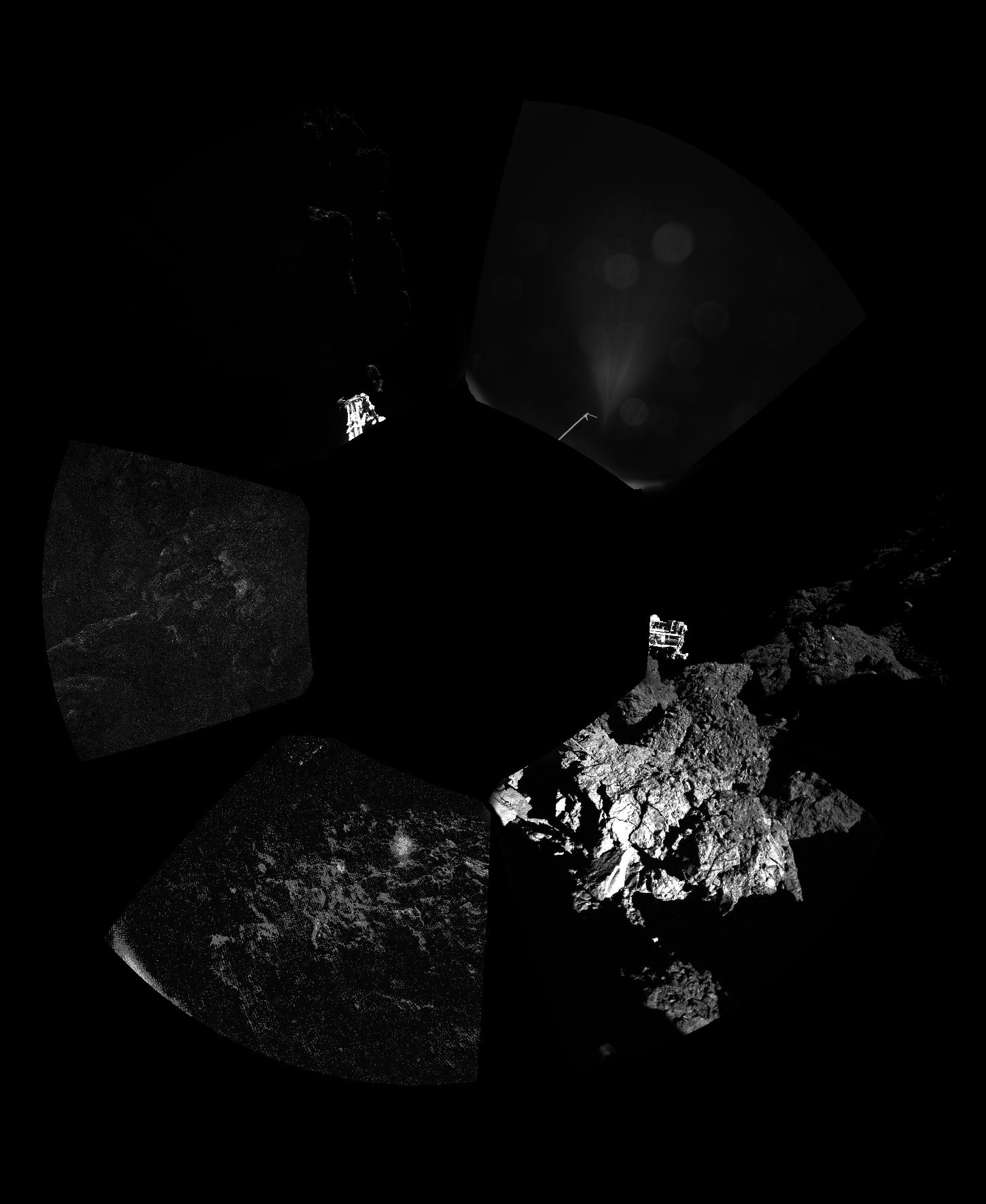
This is the first panoramic image from the surface of a comet. Taken by ÇIVA, the unprocessed image shows a 360º view around the point of final touchdown. The three feet of Philae’s landing gear can be seen in some of the frames. Credit: ESA/Rosetta/Philae/CIVA
Travelling for a decade and over eight billion kilometres, the spacecraft employed four planetary gravity assist manoeuvres: Earth-Mars-Earth-Earth. Rosetta also passed by and observed the asteroids 21 Lutetia and 2867 Šteins, with each flyby requiring months of intense preparation and coordination.
The craft endured 31 months in deep-space hibernation for the most distant leg of its journey out towards the orbit of Jupiter. This reduced power and fuel consumption to minimise operating costs.
On 6 August 2014, the spacecraft reached the comet, which was between 3 and 4 AU from the Sun, and performed a series of manoeuvres to eventually orbit the comet at a distance of 30 to 10 kilometres (19 to 6 mi). As 67P approached the Sun, the increased heat started to melt parts of Rosetta, adding more material to its tail or coma. Accordingly, Rosetta needed to stay further away from the comet to avoid the material in the coma affecting its orbit.
Landing on a comet presented many of the same challenges as other missions with Teledyne technology that landed on asteroids –
Hayabusa1 & 2 and
OSIRIS-REx missions. Like asteroids, comets are so small that they lack the strong gravitational pull of full-sized planets, which helps pull objects into and hold them to their surfaces.
The navigational instruments on both the Rosetta orbiter and the Philae lander were vital to mission success, helping select the best landing site on the comet's very uneven surface and automatically adjusting the landing process. Without downward thrusters – and with an escape velocity around 0.5 m/s – Philae was equipped with a harpoon to anchor the lander and relied on a carefully controlled descent to help control it.
On 12 November 2014, Philae deployed from the main spacecraft body, "falling" from a height of 25 km (15 mi) at about 1 m/s (3 ft/s) towards the comet along a ballistic trajectory. Despite the automated harpoon system not engaging, Philae was still able to land on the surface, bouncing twice after its first touchdown, coming to rest in the shadow of a cliff. This created an unanticipated opportunity to collect data at multiple locations, enabling comparisons between the touchdown sites. The lander’s planned mission ended after 64 hours when its batteries ran out, but not before it delivered a full set of results.
Philae was the first surface probe to conduct in situ analysis of primitive cometary material from the early solar system. The scientific objectives focused on examining the elemental, isotopic, molecular, and mineralogical composition of the cometary material; characterising the physical properties of the surface and subsurface material; and determining the large-scale structure and the magnetic and plasma environment of the nucleus.
After delivery of the lander, the orbiter continued to circle 67P/C-H to relay the data transmitted from Philae back to Earth. In total, Rosetta spent over two years orbiting Comet 67P between 2014 and 2016, becoming the first spacecraft to closely observe the development of a comet’s coma. As heat acts upon the nucleus, it thaws frozen water and gas streaming particles for millions of kilometres into space. Following its closest approach of about 186 million km (115 million mi) from the Sun – a moment known as perihelion – the comet then moved away again. This meant its surface was illuminated in different ways throughout the mission.
What Measurements Did Rosetta Take?
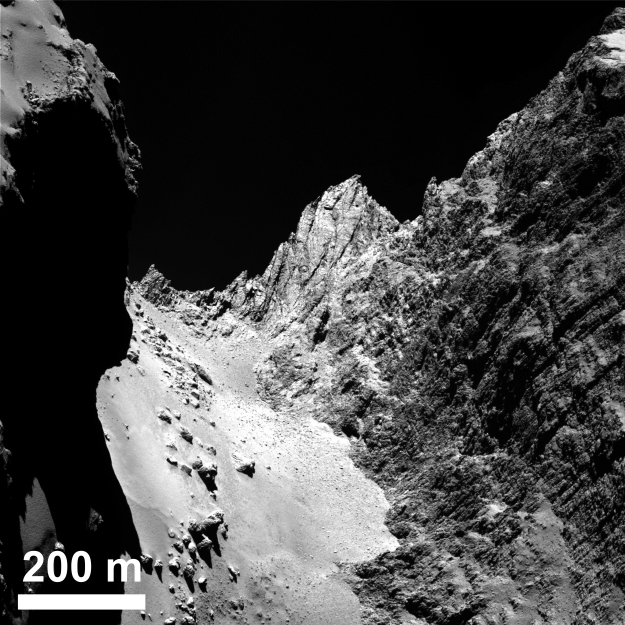
The boulder-strewn, smooth Hapi region in the comet's neck, with the Hathor cliff face to the right. Credit: ESA/Rosetta/MPS for OSIRIS Team MPS/UPD/LAM/IAA/SSO/INTA/UPM/DASP/IDA
Close-range images taken in visible light were combined to map every bump and surface crack in the alien landscape down to a resolution of just a few centimetres. Rosetta determined the basic properties of the nucleus by measuring its size, shape, mass, and density. Parallel mapping from infrared to millimetre wavelengths measured the corresponding surface temperatures, and identified individual icy and mineralogical components to determine their distribution on the surface.
Rosetta also examined the coma to measure the elemental, molecular and isotopic composition of the gas and dust, along with the dust size distribution. The length of study shed insight on how the level of comet activity influences the properties of the material it spews into space.
Instruments on the Orbiter
OSIRIS (Optical, Spectroscopic, and Infrared Remote Imaging System)
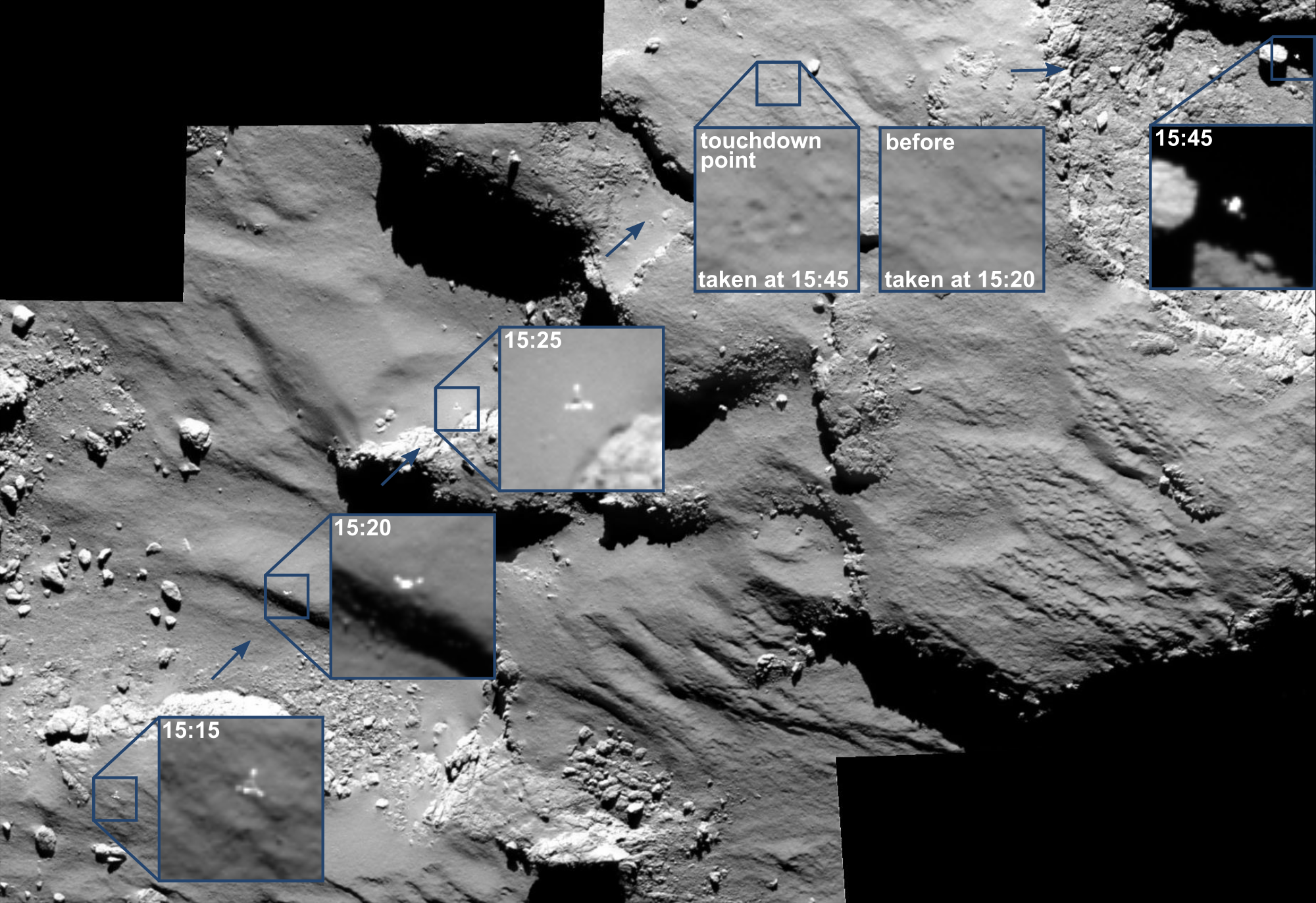 This mosaic, captured by OSIRIS, tracks Philae’s landing sequence over a 30-minute period. The lower images show the lander itself while the top images show the touchdown area where Philae bounced off the surface. Credit: ESA/Rosetta/MPS for OSIRIS Team MPS/UPD/LAM/IAA/SSO/INTA/UPM/DASP/IDA
OSIRIS was tasked with observing cometary rotation and studying the physical and chemical processes occurring around the cometary nucleus. It also mapped the cometary morphology to find a suitable landing spot for Philae. OSIRIS delivered about 100,000 images over the course of the Rosetta mission.
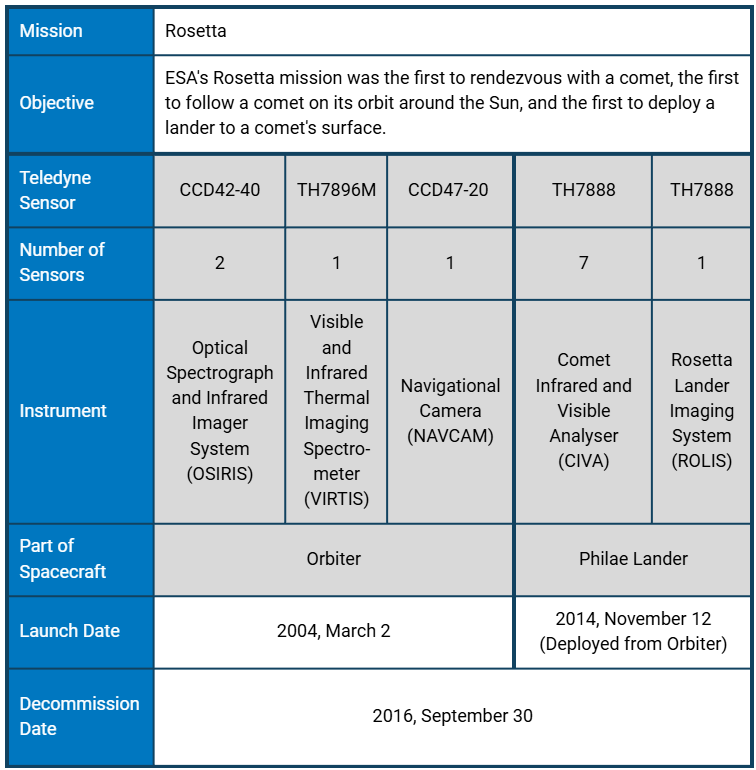
The instrument comprised two cameras: a high-resolution Narrow Angle Camera (NAC) and a Wide Angle Camera (WAC), both equipped with two filter wheels, each containing eight positions, and with backside-illuminated Teledyne CCD42-40 2048 x 2048 detectors with 13.5 µm pixels. The dual camera imaging system operated in the visible, near-infrared, and near-ultraviolet wavelength ranges.
The NAC was designed to obtain high-resolution images of the comet’s surface at distances from more than 500,000 km (300,000 mi) down to 1 km (.3 mi) with a resolution of ~2 cm per pixel. The camera also detected small ejected dust particles close to the cometary nucleus at a brightness ratio of 1/1000.
The WAC was optimised for the near-nucleus environment to focus on the dust coma and the gas emissions. 14 filters covered wavelengths from 0.24 to 0.72 μm to isolate gas emissions and measure the dust continuum. The WAC had a FOV of 12x12 degrees with an angular resolution of 20.5 arcsec per pixel.
Visible and Infrared Thermal Imaging Spectrometer (VIRTIS)
VIRTIS was an imaging spectrometer with three focal planes and two channels. The mapping channel used a Teledyne CCD to detect visible wavelengths from 0.25-1 μm and a Teledyne HgCdTe IR FPA to detect IR wavelengths from 1-5 μm. The spectroscopic channel provided high-resolution spectra at 2-5 μm using a Teledyne TH7896M IR FPA with 270 x 438-pixel detectors designed to provide high sensitivity and low dark current (about 1 fA at 80K), with a read noise lower than 300 e-.
VIRTIS mapped the nature of the solids and the temperature on the surface of the nucleus. It also identified comet gases, characterised the coma's physical conditions, and helped identify the best landing sites.
NAVCAM (Navigation Camera)
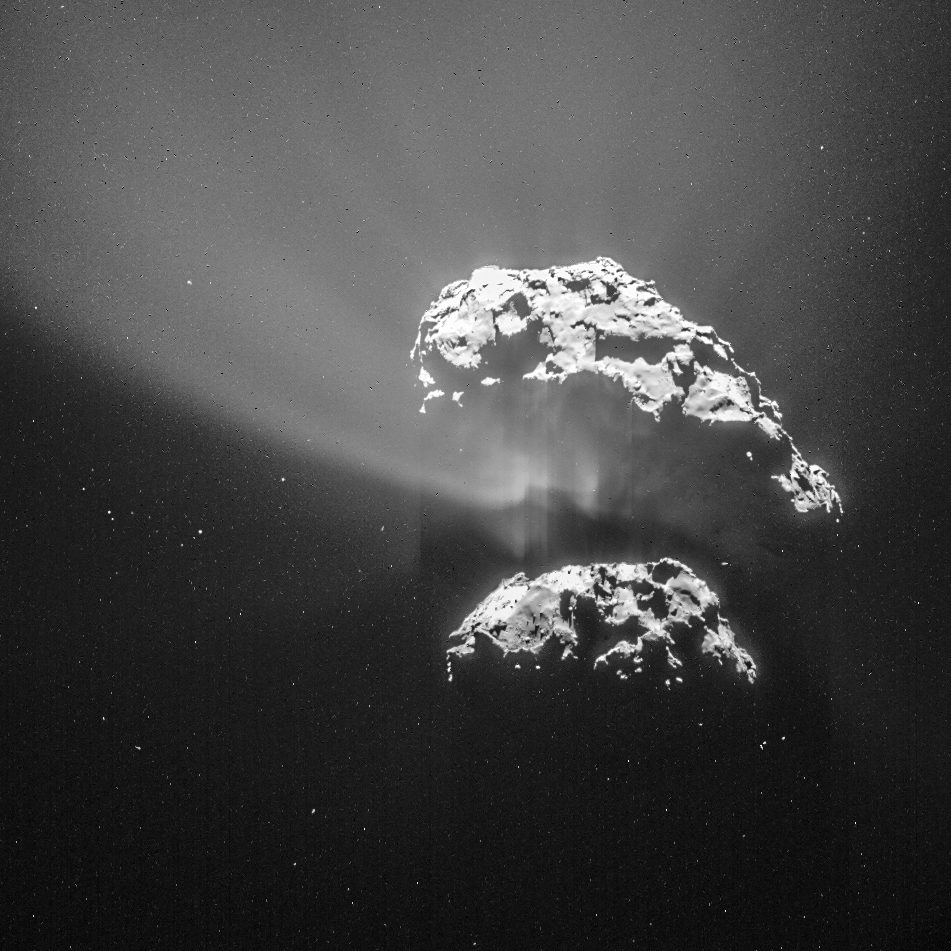 Credit: ESA/Rosetta/NavCam
The Rosetta spacecraft used a single camera with a 5º field of view and a 12-bit, 1024 x 1024-pixel Teledyne CCD47-20 detector for visual tracking during each of the spacecraft's approaches to its three targets.
Instruments on the Philae Lander
Comet Nucleus Infrared and Visible Analyser (ÇIVA)
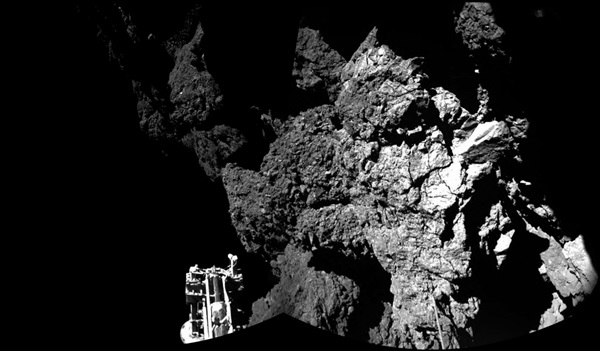
This mosaic of the first two images from CIVA shows Philae safely on the surface of Comet 67P. One of the lander’s three feet can be seen in the foreground. Credit: ESA/Rosetta/Philae/CIVA
ÇIVA consisted of seven micro-cameras – six mono and one stereo pair – to take panoramic images of the surface. A visible-light microscope and coupled infrared spectrometer studied the composition, texture and albedo of samples collected from the surface. It used a Teledyne TH7888 FPA to detect visible wavelengths from 0.4 - 0.7µm.
Rosetta Lander Imaging System (ROLIS)
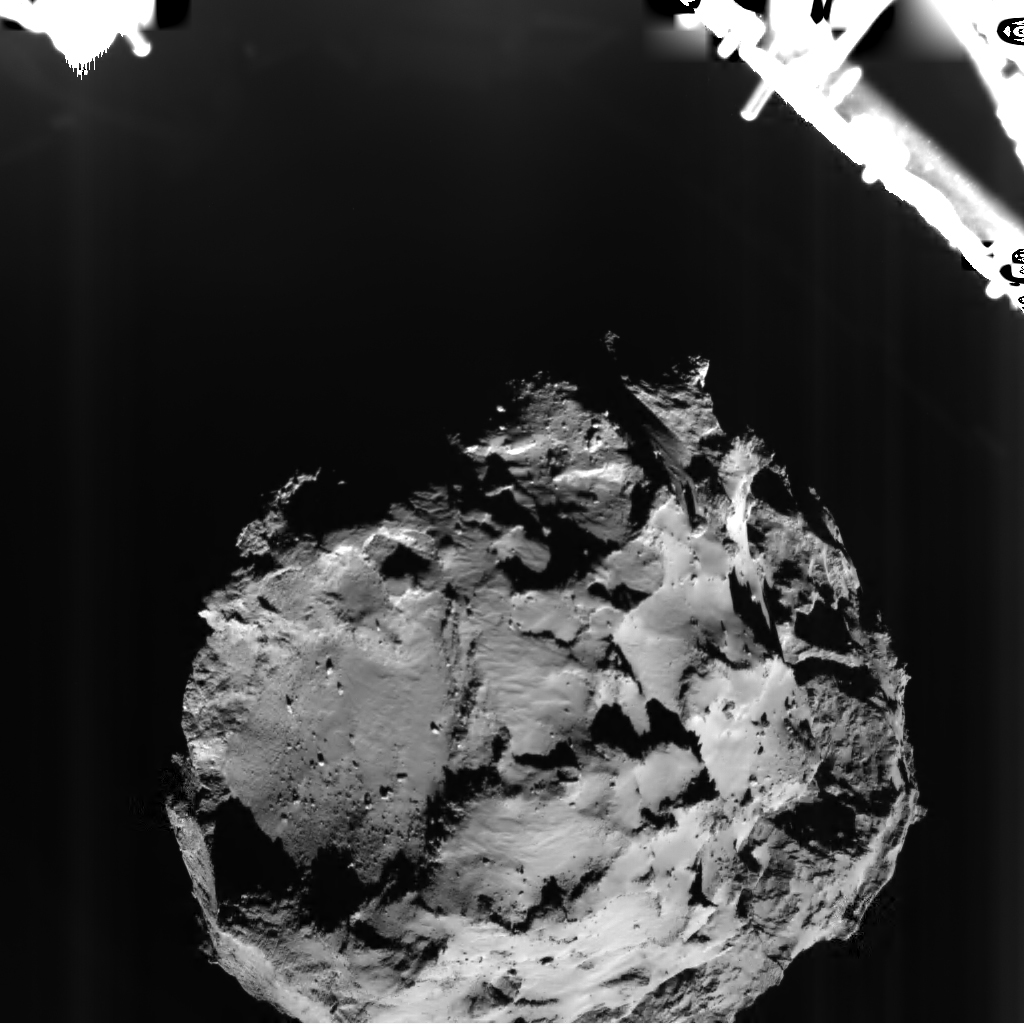
Image of Comet 67P acquired by the ROLIS instrument on the Philae lander during descent on Nov. 12, 2014, from a distance of approximately 3 kilometres (1 mi) from the surface. The image has a resolution of about 3 meters per pixel. Credit: ESA/Rosetta/Philae/ROLIS/DLR
ROLIS obtained high-resolution images during the descent to Agilkia, the designated landing site. It used a 1024 x 1024 pixel Teledyne TH7888 FPA and supported an unvignetted FOV of 57.7º x 57.7º in .47-.87µm visible wavelengths. Mounted on the bottom of the lander, ROLIS also examined the nucleus surface below Philae to study its structure and mineralogy. Even after the bouncy crash landing, ROLIS reactivated to acquire images of the comet’s surface at close range.
Scientific Findings
Basic Structure and Surface Composition
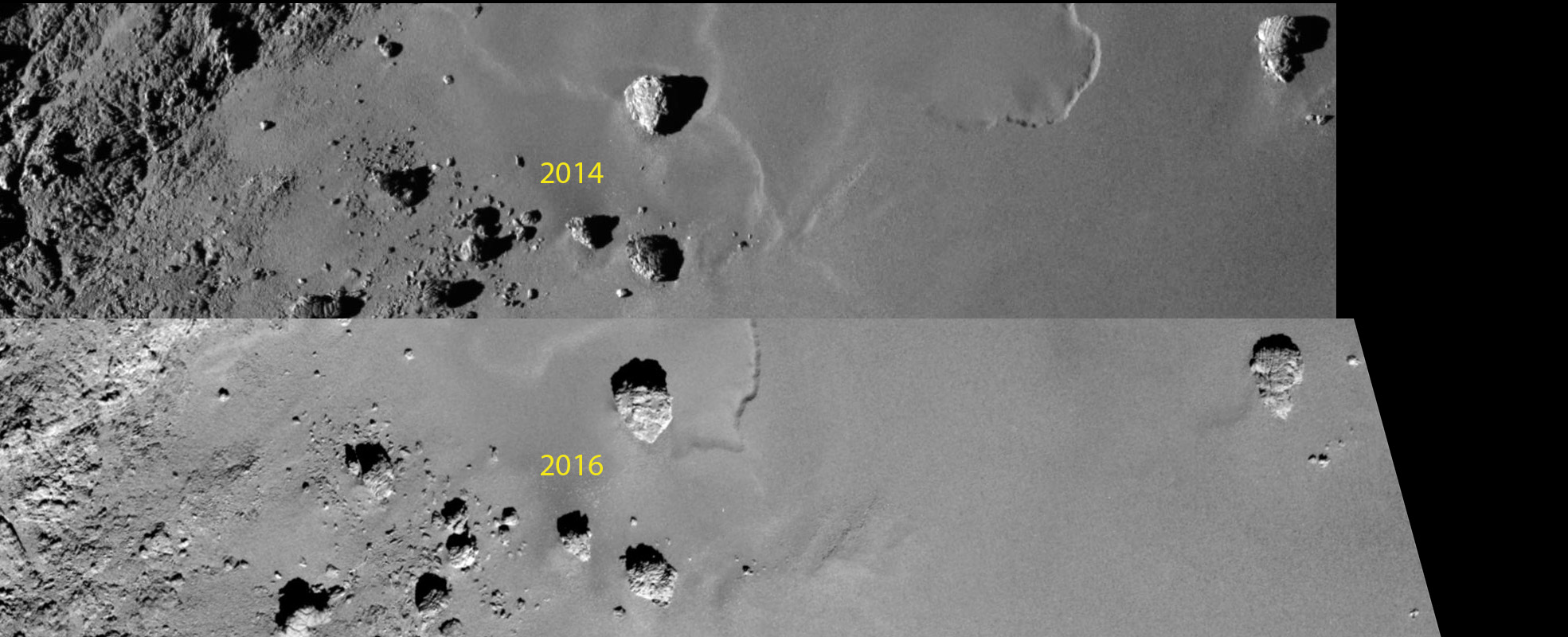
The Rosetta archive contains a huge number of images. Detecting small differences in
images to track ongoing changes on the comet required human examination, too complex for contemporary image processing algorithms. ESA and the Zooniverse launched Rosetta Zoo: a citizen science project that invited volunteers to engage in a cosmic game of 'spot the difference'. Thanks to visual inspections by many volunteers, the project produced maps of changes and active areas on the comet's surface. Credit: ESA/Zooniverse
After analysing the data collected by Rosetta, scientists determined that 67P has an overall composition dominated by water ice and dust, with a low density and a very high porosity of 70-80%. The interior structure likely comprises weakly bonded ice-dust clumps with small void spaces between them. 67P is a double-lobed body with extensive layering, suggesting that the lobes accumulated material over time before they merged.
Its nucleus has a composition similar to the interstellar medium, indicating that the comet contains unaltered presolar material. This composition is also shared by asteroids and some meteorites found on Earth, suggesting that at least some of the organic compounds in the early Solar System came directly from the wider interstellar medium. Importantly, other planetary systems may also have access to these compounds.
Scientists identified 19 regions, each with distinct boundaries. Following the ancient Egyptian theme of the Rosetta mission, these regions were named after Egyptian deities and grouped by the dominant terrain. Five categories of terrain types were determined: dust-covered terrain, brittle materials with pits and circular structures, large-scale depressions, smooth terrain, and exposed rocky surfaces.
Rosetta’s long-term monitoring revealed dynamic changes to the comet’s surface that were affected by its distance from the Sun and the corresponding levels of comet activity. The changes before and after the comet reached perihelion, which could be either unique transient phenomena or take place over longer periods, are linked to different geological processes: in situ weathering and erosion, sublimation of water-ice, geological stress, and mechanical stresses arising from the comet’s spin.
These forces create many landscape changes: collapsing cliffs, rolling boulders, opening pits, and creating dune-like dust ripples. Furthermore, these surface changes contribute to the shape of the coma as they release jets and broad sprays of dust and gas. Some intense jets release 60–260 tonnes of material in a few minutes.
Discovery of Building Blocks of Life
Rosetta revealed that 67P contains ingredients crucial for the origin of life on Earth. This includes the amino acid glycine, which is commonly found in proteins, and phosphorus, a key component of DNA and cell membranes. Several million infrared spectra gathered with VIRTIS revealed signs of hydrogen and carbon chains known as organic aliphatic compounds – the first time such compounds were found on the surface of a cometary nucleus.
Organic molecules were found in the coma as well. Rosetta made the first in situ detection of oxygen molecules outgassing from a comet, a surprising observation that suggests they were incorporated into the comet during its formation. Water vapour, carbon monoxide and carbon dioxide are the most prolific, with a rich array of other nitrogen-, sulphur- and carbon-bearing species, and even ‘noble gases’ also recorded.
The surface of 67P displays a ubiquitous absorption feature around the infrared wavelength of 3.2 µm. Scientists determined that the comet is predominantly covered in a mixture of dark dust and ammonium salts, which gives the surface a dark appearance. A similar absorption feature has been documented on several asteroids, both in the main belt and in Jupiter’s Trojan family, as well as on Jupiter’s moon Himalia. This suggests that these bodies also contain ammonium salts, hinting at a link in the chemical composition between asteroids, comets and possibly the proto-solar nebula. This provides a possible scenario for the delivery of nitrogen – a key chemical element of lifeforms on Earth – to the inner planets of the Solar System.
Detection of Water Ice and the Discovery of Carbon Dioxide Ice
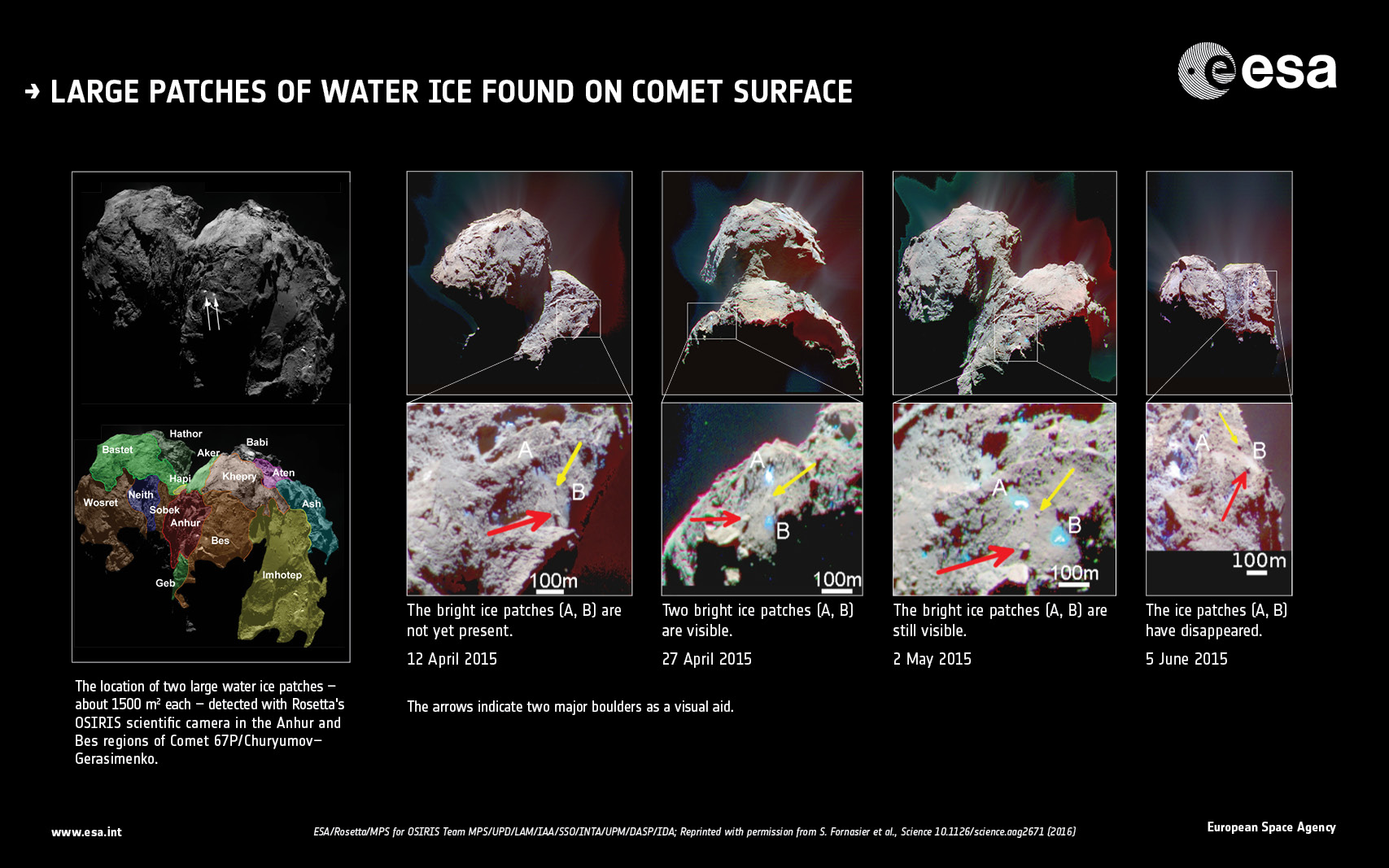 At the end of April 2015, Rosetta's OSIRIS narrow-angle camera detected two unusually large patches of water ice, each the size of an Olympic swimming pool. This graphic shows the appearance of the two bright spots (labelled A and B), which persisted for about 10 days before completely disappearing. Credit: ESA/Rosetta/MPS for OSIRIS Team MPS/UPD/LAM/IAA/SSO/INTA/UPM/DASP/IDA; Reprinted with permission from S. Fornasier et al., Science 10.1126/science.aag2671 (2016)
Data gathered by VIRTIS identified regions on 67P’s surface where water ice appears and disappears in sync with its rotation period. Analysis suggests that water ice on and a few centimetres below the surface sublimates when heated by sunlight, turning it into gas that flows away from the comet, forming the coma. The comet’s rotation then covers the area in darkness, rapidly cooling the surface. However, the underlying layers remain warm from sunlight absorption, causing subsurface water ice to continue sublimating upward through the comet's porous interior. As soon as this underground water vapour reaches the cold surface, it condenses and freezes into a thin layer of fresh ice. On the next comet day, the Sun rises again, melting the newly formed ice layer and restarting the cycle.
VIRTIS also spotted carbon dioxide ice, the first detection of solid carbon dioxide on any comet, although it is not uncommon in the Solar System. The carbon dioxide ice layer covered an area, the patch, about the size of a football pitch, was observed on two consecutive days, but when scientists reimaged that region three weeks later, it was gone.
Asteroid Lutetia Flyby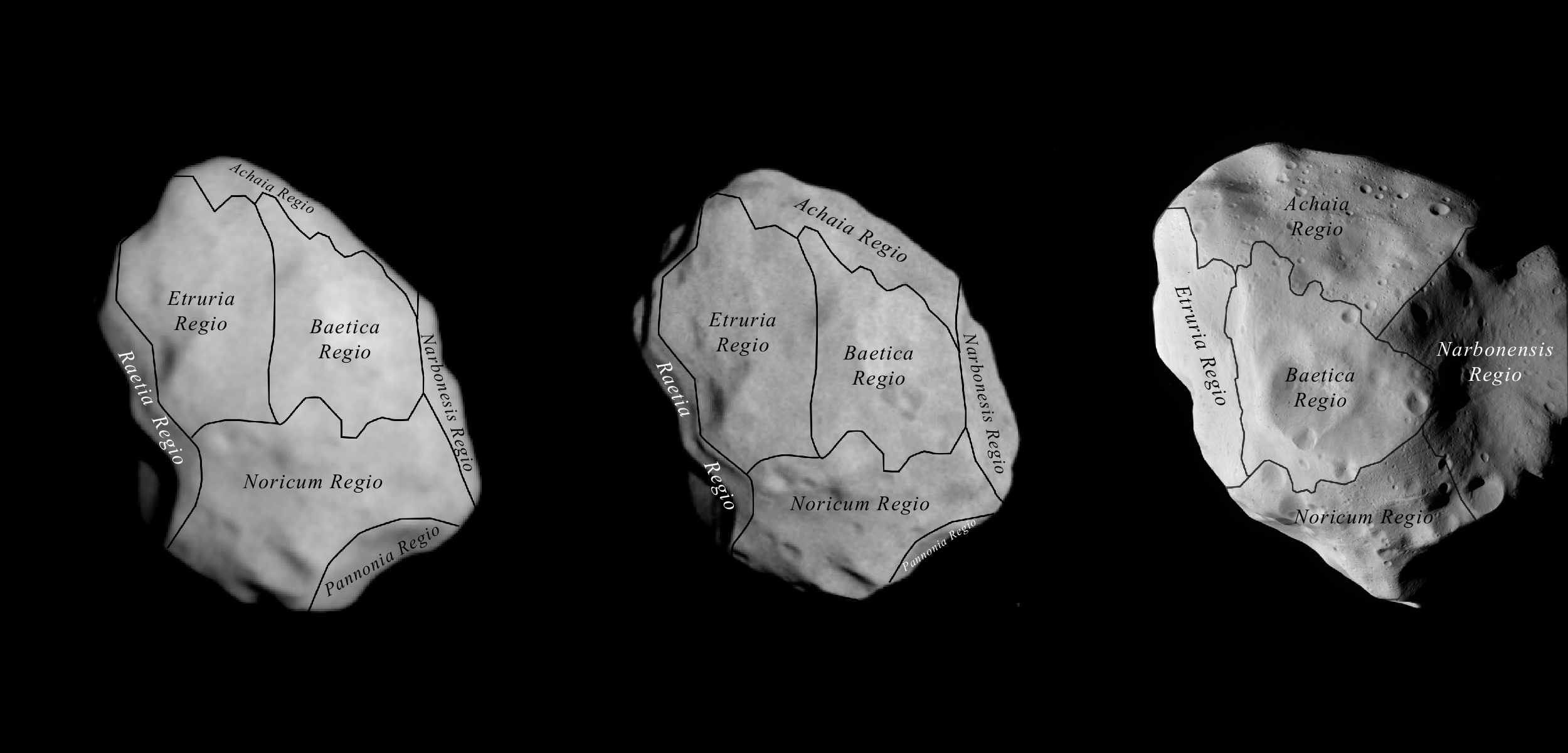
A Rosetta map of asteroid Lutetia dividing it into regions named after provinces of the ancient Roman Empire. Credit: ESA 2010 MPS for OSIRIS Team MPS/UPD/LAM/IAA/RSSD/ INTA/UPM/DASP/IDA
On 10 July 2010, Rosetta flew past the asteroid Lutetia, collecting data at a distance of 3,170 km (2,000 mi). Despite the brief encounter, the OSIRIS instrument took 462 pictures to map over 50% of the asteroid's surface. Its diverse surface displayed a number of geological features – including more than 350 craters – on a far larger scale than any seen on other asteroids. OSIRIS also revealed a vast network of grooves, fractures and rift valleys, which are similar in appearance to those on the Martian moon Phobos.
Further insights into the nature of Lutetia's surface were provided by VIRTIS, which obtained hyperspectral images, spectral reflectance maps and temperature maps of the asteroid. Analysis of the VIRTIS data showed a remarkable uniformity in the surface spectral properties, suggesting that the surface is covered by an extensive layer of dust particles between 50 and 100 μm, comparable to the powdery regolith on the Moon. No spectral evidence for silicates, hydrated minerals or water was found, demonstrating that Lutetia's surface materials have not been altered by water. VIRTIS also determined that the asteroid's surface temperature ranged from 170 K to 245 K.
The data compiled by Rosetta indicated that Lutetia is likely a primordial planetesimal, one of the building blocks from which the planets formed. Having survived numerous impacts, Lutetia can be regarded as an important missing link between smaller asteroids and terrestrial planets.
As 67P receded from the Sun, the solar-powered spacecraft would no longer receive enough sunlight to operate. Rosetta had also depleted most of its propellant, so it would not be efficient to place the spacecraft in hibernation again to wait for better solar conditions further along the comet’s orbit.
After completing its main science observations, the Rosetta spacecraft ended its mission by hard-landing on the comet on 30 September 2016. Rosetta targeted a region on the small lobe of 67P close to a region of active pits in the Ma'at region. The descent gave Rosetta the opportunity to study the comet's gas, dust and plasma environment very close to its surface, as well as take very high-resolution images. The information collected on the descent to this fascinating region was returned to Earth before the impact.
A total of eight comets have now been visited by spacecraft, building a picture of the basic properties of these cosmic time capsules.
Works Cited
Berner, C., Bourillet, L., van Casteren, J., Ellwood, J., Kasper, M., Kletzkine, P., Schulz, R., Schwehm, G. (2002, November). Rosetta: ESA's Comet Chaser. ESA Science. https://www.esa.int/esapub/bulletin/bullet112/chapter1_bul112.pdf
Max-Plank Institute. (n.d.). OSIRIS: Optical, Spectroscopic, and Infrared Remote Imaging System. MPS. http://www.mps.mpg.de/1845506/OSIRIS
Orbiter instruments- OSIRIS: Optical, Spectroscopic, and Infrared Remote Imaging System. ESA. http://sci.esa.int/rosetta/35061-instruments/?fbodylongid=1642
G. Piccioni, P. Drossart, E. Suetta, M. Cosi, E. Ammannito, A. Barbis, R. Berlin, A. Boccaccini, G. Bonello, M. Bouyé, F. Capaccioni, G. Cherubini, M. Dami, O. Dupuis, A. Fave, G. Filacchione, Y. Hello, F. Henry, S. Hofer, G. Huntzinger, R. Melchiorri, J. Parisot, C. Pasqui, G. Peter, C. Pompei, J. M. Rèess, A. Semery, A. Soufflot and the VIRTIS Co-I team: A. Adriani, F. Angrilli, G. Arnold, K. Baines, G. Bellucci, J. Benkhoff, B. Bezard, J.-P. Bibring, A. Blanco, M. I. Blecka, R. Carlson, A. Coradini, A. Di Lellis T. Encrenaz, S. Erard, S. Fonti, V. Formisano, T. Fouchet, R. Garcia, R. Haus, J. Helbert, N. I. Ignatiev, P. Irwin, Y. Langevin, S. Lebonnois, M. A. Lopez Valverde, D. Luz, L. Marinangeli, V. Orofino, A. V. Rodin, M. C. Roos-Serote, B. Saggin, A. Sanchez-Lavega, D. M. Stam, F. Taylor, D. Titov, G. Visconti, M. Zambelli. (n.d.). VIRTIS: The Visible and Infrared Thermal Imaging Spectrometer. https://sci.esa.int/documents/34571/36233/1567256521119-VIRTISweb.pdf
ESA Science and Technology. (n.d.). Rosetta. https://sci.esa.int/web/rosetta/
ESA Science and Technology. (2020, September 21). Unique ultraviolet aurora spied at Rosetta's comet. https://www.esa.int/Science_Exploration/Space_Science/Rosetta/Unique_ultraviolet_aurora_spied_at_Rosetta_s_comet
ESA Science and Technology. (2020, March 13). Ammonium salts found on Rosetta’s comet. https://www.esa.int/ESA_Multimedia/Images/2020/03/Ammonium_salts_found_on_Rosetta_s_comet
ESA Science and Technology. (2020, January 20). Building blocks of life spotted on Rosetta’s comet hint at composition of its birthplace. https://www.esa.int/Science_Exploration/Space_Science/Rosetta/Building_blocks_of_life_spotted_on_Rosetta_s_comet_hint_at_composition_of_its_birthplace
ESA Science and Technology. (2016, April 7). The colour-changing comet.https://www.esa.int/Science_Exploration/Space_Science/Rosetta/The_colour-changing_comet
ESA Science and Technology. (2019, February 18). Rosetta’s comet sculpted by stress. https://www.esa.int/Science_Exploration/Space_Science/Rosetta/Rosetta_s_comet_sculpted_by_stress
ESA Science and Technology. (2017, March 21). Before and after: unique changes spotted on Rosetta’s comet.https://www.esa.int/Science_Exploration/Space_Science/Rosetta/Before_and_after_unique_changes_spotted_on_Rosetta_s_comet
ESA. (2015, October 10). First detection of molecular oxygen at a comet. https://www.esa.int/Science_Exploration/Space_Science/Rosetta/First_detection_of_molecular_oxygen_at_a_comet
ESA Science and Technology. (2015, September 15). Rosetta reveals comet's water-ice cycle.https://sci.esa.int/web/rosetta/-/56513-rosetta-reveals-comet-s-water-ice-cycle
ESA Science and Technology. (2015, August 13). Rosetta's big day in the Sun.https://www.esa.int/Science_Exploration/Space_Science/Rosetta/Rosetta_s_big_day_in_the_Sun
ESA Science and Technology. (2016, November 17). Icy surprises at Rosetta's comet.https://sci.esa.int/web/rosetta/-/58575-icy-surprises-at-rosetta-s-comet
ESA Science and Technology. (2016, November 9). Summer fireworks on Rosetta’s comet. https://www.esa.int/Science_Exploration/Space_Science/Rosetta/Summer_fireworks_on_Rosetta_s_comet
ESA Science and Technology. (2015, June 23). Rosetta mission extended. https://www.esa.int/Science_Exploration/Space_Science/Rosetta/Rosetta_mission_extended
ESA Science and Technology. (2014, November 19). Rosetta continues into its full science phase. https://www.esa.int/Enabling_Support/Operations/Rosetta_continues_into_its_full_science_phase
ESA Science and Technology. (2015, January 22). Getting to know Rosetta's comet. https://sci.esa.int/web/rosetta/-/55295-getting-to-know-rosetta-s-comet
ESA Science and Technology. (2015, January 22). Getting to know Rosetta's comet. https://www.gov.uk/government/news/philae-finds-hard-ice-and-organic-molecules
ESA Science and Technology. (2016, September 30). Mission complete: Rosetta’s journey ends in daring descent to comet. https://sci.esa.int/web/rosetta/-/58382-mission-complete-rosetta-s-journey-ends-in-daring-descent-to-comet
ESA Science and Technology. (2011, October 27). Rosetta reveals mysterious Lutetia.https://sci.esa.int/web/rosetta/-/49543-rosetta-reveals-mysterious-lutetia
ESA Science and Technology. (2015, October 28). First detection of molecular oxygen at a comet. https://www.esa.int/Science_Exploration/Space_Science/Rosetta/First_detection_of_molecular_oxygen_at_a_comet
ESA Science and Technology. (2016, May 27). Rosetta's comet contains ingredients for life. https://sci.esa.int/web/rosetta/-/57858-rosettas-comet-contains-ingredients-for-life
ESA Science and Technology. (2015, October 28). First detection of molecular oxygen at a comet. https://www.esa.int/Science_Exploration/Space_Science/Rosetta/Icy_surprises_at_Rosetta_s_comet

