Floating at the edge of the Solar System, Pluto -- much like the mythical home of its namesake -- is very hard to get to. In fact, it remained unexplored long after the other planets, prompting the United States Postal Service to issue a stamp in 1991 declaring "Pluto: Not Yet Explored".
Emblematic of the lack of information about Pluto, when NASA's New Horizons launched in 2006, Pluto was classified as a planet. Over nine years later, when the probe became the first mission to observe Pluto up close, flying just 7,800 kilometres (4,800 miles) from the surface, the IAU had reclassified it as a dwarf planet. Furthermore, the limited knowledge of the Pluto system created unprecedented dangers for the New Horizons probe. At the time of planning the flight path, astronomers had confirmed only three moons around Pluto. The discovery of Kerberos and Styx during the spacecraft's journey implied there could be more unseen satellites.
Status aside, Pluto and its surroundings can tell us a lot about the formation of our Solar System. Pluto is part of the vast Kuiper Belt, a vast region past Neptune that starts about 30 AU from the Sun and extends to about 50 AU. Containing hundreds of thousands of rocky, icy bodies, each larger than 100 ki (62 mi) across, and over a trillion comets, the primitive objects found in the Kuiper Belt contain a record of the ancient materials from which the planets were made.
As the only spacecraft to visit this distant planet, New Horizons is the primary source of information on Pluto's geology, composition, and atmosphere. Ongoing data collection from its suite of scientific instruments continues to fuel groundbreaking research and to answer fundamental questions.
Pluto has a thin nitrogen atmosphere, with methane as a minor component, and haze reaching at least 200 kilometres (125 miles) above the surface — ten times higher than scientists expected. It also displays evidence of vast changes in atmospheric pressure. New Horizons showed that Pluto has a diameter of 2,370 kilometres (1,473 miles), less than one-fifth the diameter of Earth, and only about two-thirds as wide as Earth's moon. One of the coldest places in the solar system, Pluto probably has a rocky core.
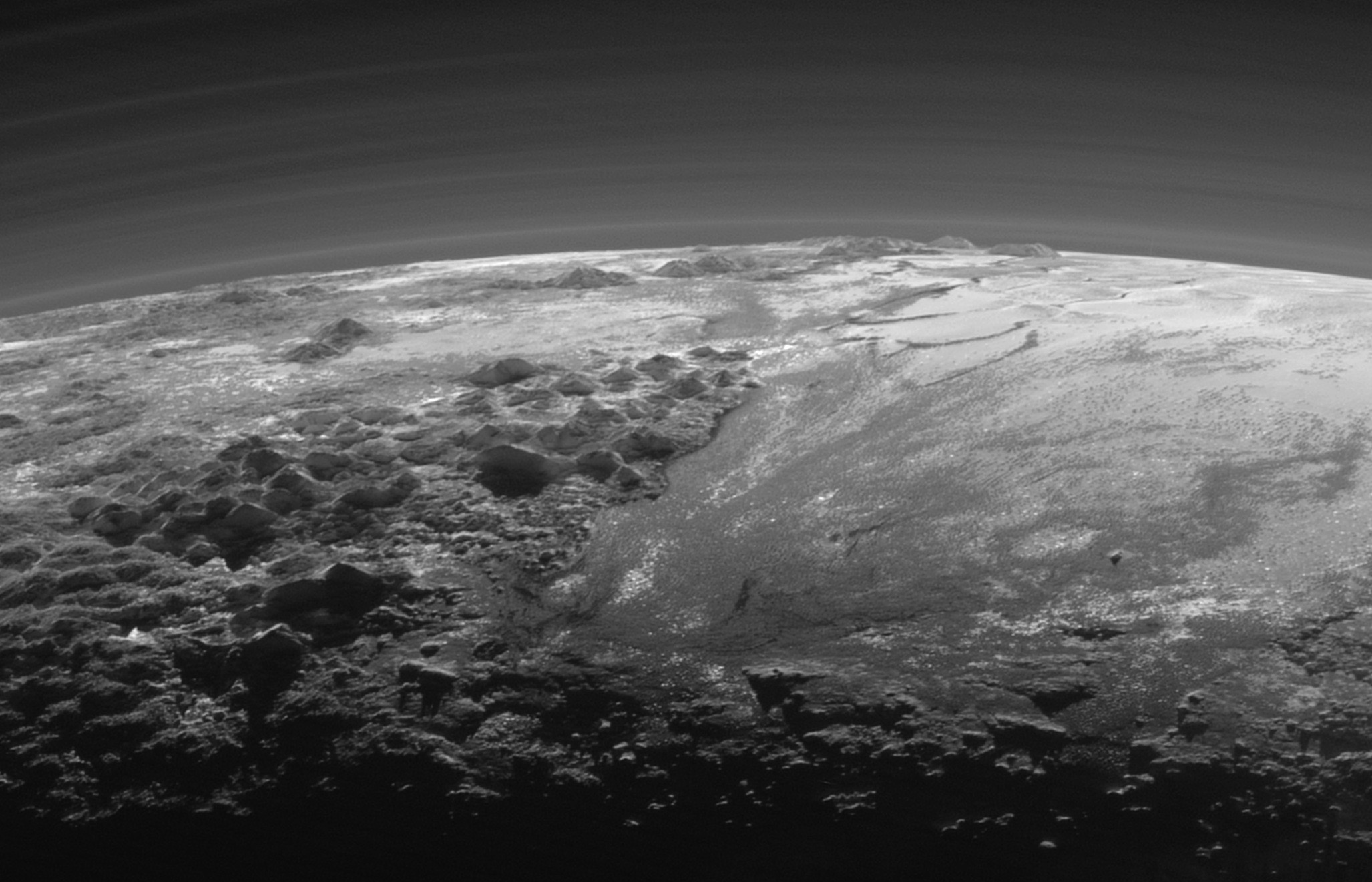 NASA’s New Horizons spacecraft looked back toward the sun 15 minutes after its closest approach to Pluto on July 14, 2015, capturing this near-sunset view of the dwarf planet’s icy mountains and flat ice plains. The image was taken from a distance of 18,000 kilometres (11,000 miles) from Pluto; the scene is 780 miles (1,250 kilometres) wide. Credit: NASA/JHUAPL/SwRI
New Horizons is revealing a diverse, potentially changing, landscape -- hinting at previous and possibly ongoing geologic changes. The extremely cold surface of Pluto -- around -226 to -240°C (-375 to -400°F) -- has created an icy crust of nitrogen, methane, and carbon dioxide, with water-ice mountains rivalling some of the largest mountain ranges on Earth. Recent geological processes such as landslides large enough to bury a small city, as well as flat and cratered areas on the dwarf planet's surface, point to its varied geological activity, composition and evolution over time. It's possible that at some point in time, Pluto had running or standing liquid volatiles on its surface in the past. There are even hints that Pluto could have an internal water-ice or liquid ocean.
New Horizons is the first mission in NASA’s New Frontiers program, which also includes the Juno and OSIRIS-REx missions. The design of the spacecraft was based on a lineage traced back to the CONTOUR mission which also contained Teledyne technology. It was even powered by a spare radioisotope thermoelectric generator from the Cassini mission. From its unique perch travelling through the Kuiper Belt, New Horizons is making observations that can’t be made from anywhere else.
Dispatched at 58,500 kph (36,400 mph), New Horizons was at that time the fastest launch on record, and it received a gravity boost from Jupiter to reduce the travel time to Pluto by three years. Getting to the Pluto system quickly reduced mission costs and maximised the scientific return. Since 1989, Pluto has been moving farther from the Sun, receiving less heat each year. As Pluto gets colder, scientists expect its atmosphere to freeze out, so the earlier arrival time enabled observation of a thicker atmosphere. Additionally, the farther away from the Sun, the less light is available to illuminate details.
Astrobiologists have become particularly interested in the possibilities within the New Horizons database. The Cassini mission discovered that Titan – one of Saturn's moons – has a hydrological cycle supporting ethane and methane lakes that could hypothetically support methane-based lifeforms. Data from New Horizons has revealed conditions on Pluto that are similar to those on Earth, fueling speculation that Pluto's complex chemistry may contain pre-biological ingredients.
About three months before the closest approach, New Horizons began generating maps of Pluto and Charon in green, blue, red, and a special wavelength band sensitive to methane frost on the surface. Pluto and Charon each rotate once every 6.4 Earth days. For the last two Pluto days before the encounter – 11 to 12 Earth days – New Horizons compiled maps and gathered spectral measurements of Pluto and Charon every half-day. Comparisons of these maps can reveal changes over a Pluto day, as might be caused by new snow or other weather. During the half-hour when the spacecraft was closest to Pluto or its largest moon, it took close-up pictures in both visible and near-infrared wavelengths.
Exotic Ice Formations Found on Pluto
Video credit: NASA's Ames Research Center. Pluto's surface hosts blades of methane ice that soar to skyscraper heights. Pluto is so cold that methane can freeze out of the atmosphere — skipping straight from gas to solid without ever becoming liquid. When the climate is a bit warmer, parts of the methane ice sublimate, returning to gas form.
Ralph Telescope
 Credit: NASA/JHUAPL/SwRI
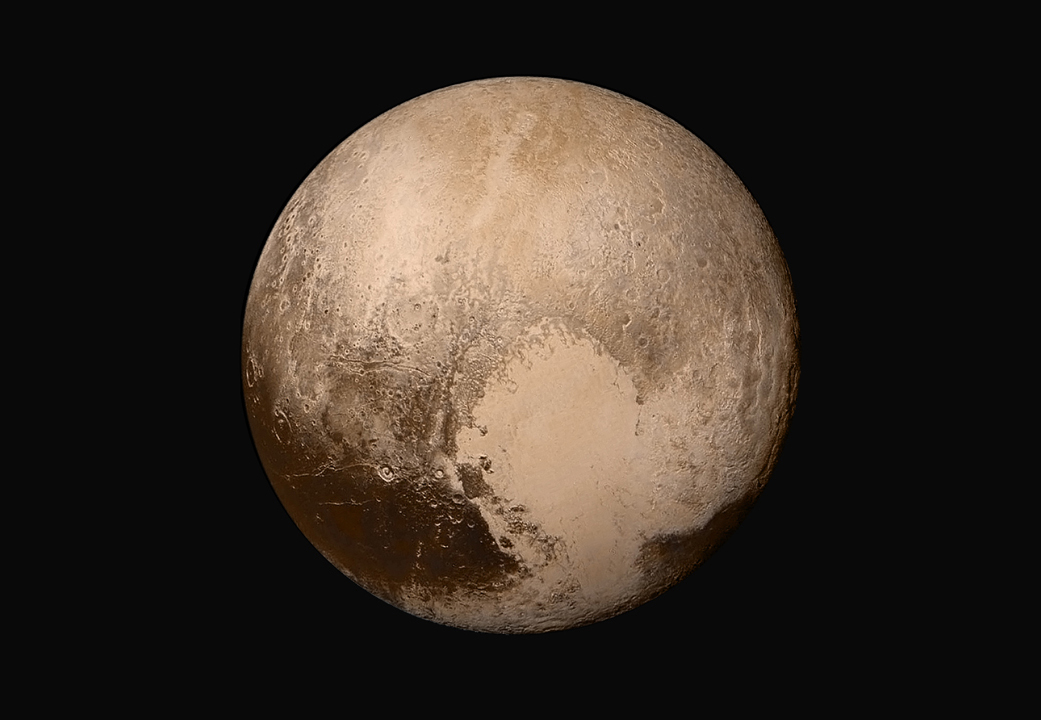
Obtained at a distance of 450,000 ki (280,000 mi), this enhanced colour image of Pluto combines four images from LORRI with colour data from Ralph to create this sharp global view. Scientists are using enhanced colour images to detect differences in the composition and texture of Pluto’s surface. The darkest terrain appears at the equator, mid-tones at the middle latitudes, and a brighter, icy expanse dominates the North Polar region. It is believed that this pattern could form from seasonal transport of ice from the equator to the pole.
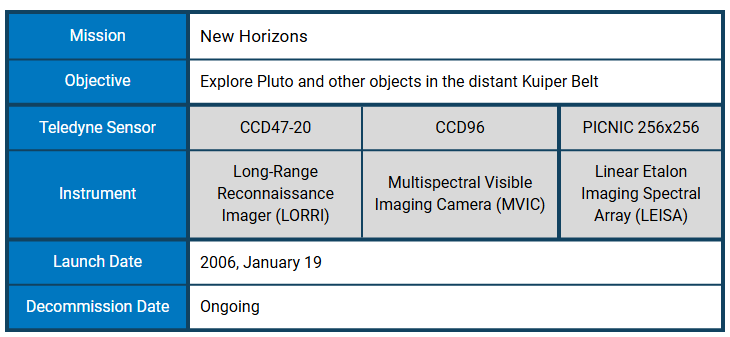
New Horizons' Ralph is a composite instrument package consisting of a single telescope that feeds two sets of focal planes: the MVIC colour imager and the LEISA NIR imaging spectrometer. Ralph is a name, not an acronym, taken from one of the main characters of the American television show The Honeymooners.
Multispectral Visible Imaging Camera (MVIC)
 Credit: NASA/Johns Hopkins University Applied Physics Laboratory/Southwest Research Institute/Alex Parker
MVIC is an imager that operates at both visible and near-infrared (NIR) wavelengths using seven independent CCD arrays on a single-substrate focal plane -- a Teledyne CCD96.
MVIC uses two 5,024 × 32 CCD arrays, operated in time delay integration (TDI) mode to provide sensitive panchromatic hemispheric maps of Pluto at a double-sampled spatial resolution of 1 x 1 kilometre or better. Four additional 5024 x 32 TDI CCDs provide hemispheric maps in blue (.4–.55 μm), red (.54–.7 μm), near-IR (.78–.975 μm) and a narrow methane absorption band (.86–.91 μm).
TDI operates by synchronising the parallel transfer rate of each of the 32 CCD lines with the relative motion of the image across the detector surface. In this way, very large-format images are obtained as the spacecraft scans the FOV across the target's surface and reorients downtrack scene elements. Sequential measurements across the 32 lines are combined into one line in the final image; thus the presence of 32 lines increases the effective integration time by the same factor, providing high signal-to-noise measurements. The measured spacecraft rotation rate can be fed back to the instrument to optimise the frame transfer rate. This means that after a scan has been initiated, the spacecraft determines the actual rotation rate and sends that information to Ralph, which then calculates the frame rate that minimises smear in the along-track direction.
MVIC TDI operation captures images of objects at low light levels using multiple lines of elements to increase scan time without compromising on scene illumination. Multiple lines of elements integrating simultaneously allow the instrument to scan more quickly for any given level of illumination. TDI operation can also be configured to produce images of fixed width and variable height, with height depending on the scan rate and observation duration.
In addition to the TDI arrays, MVIC has a 5024x128-pixel pan-frame-transfer single-frame array that is exposed to light and then transfers all of its lines to an image with the same dimensions as the CCD.
Objectives:
Hemispheric panchromatic maps of Pluto and Charon at best resolution >0.5 km/pixel
Search for and map atmospheric hazes at a vertical resolution <5 km
High-resolution panchromatic maps of the terminator region
Panchromatic wide-phase-angle coverage, panchromatic stereo images, orbital parameters, and bulk parameters of Pluto, Charon, Nix, and Hydra
Search for satellites and rings
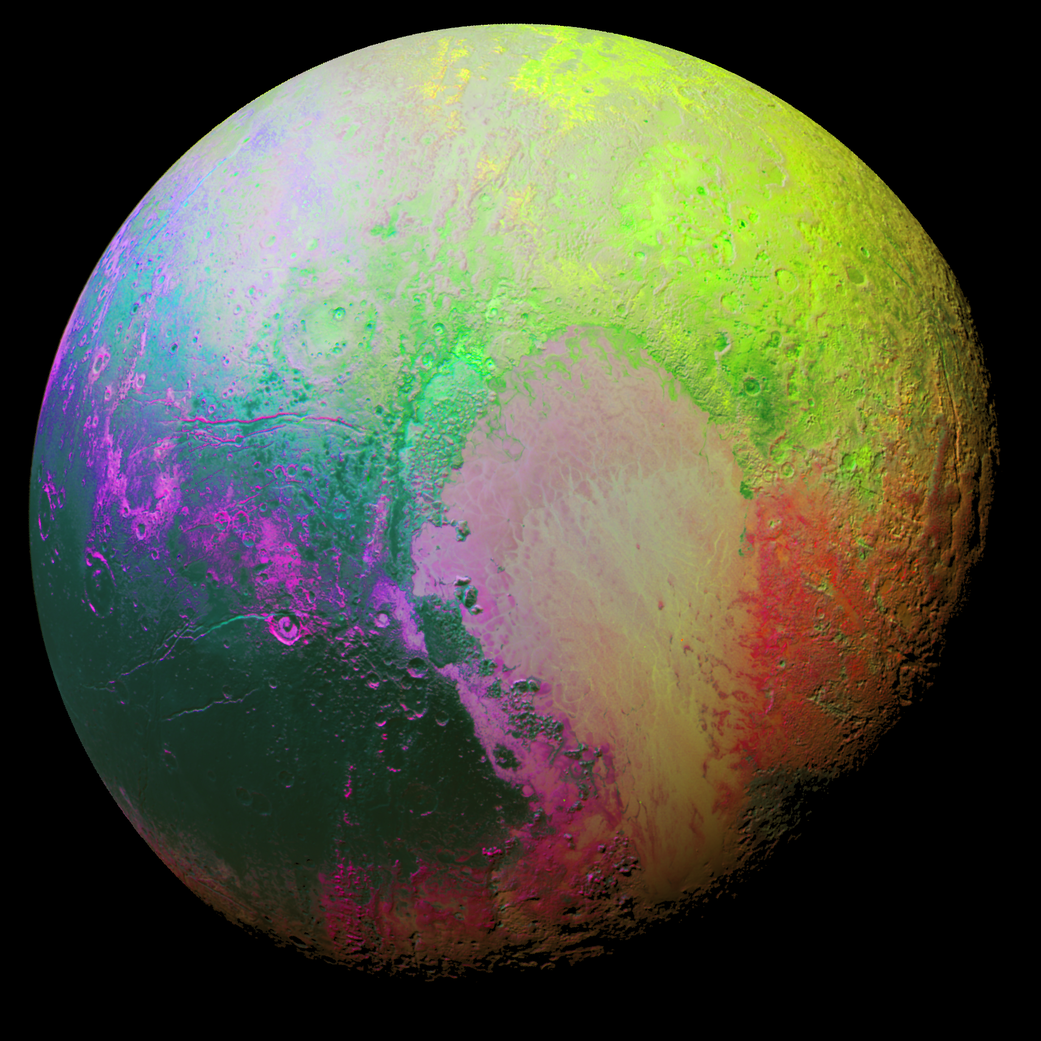
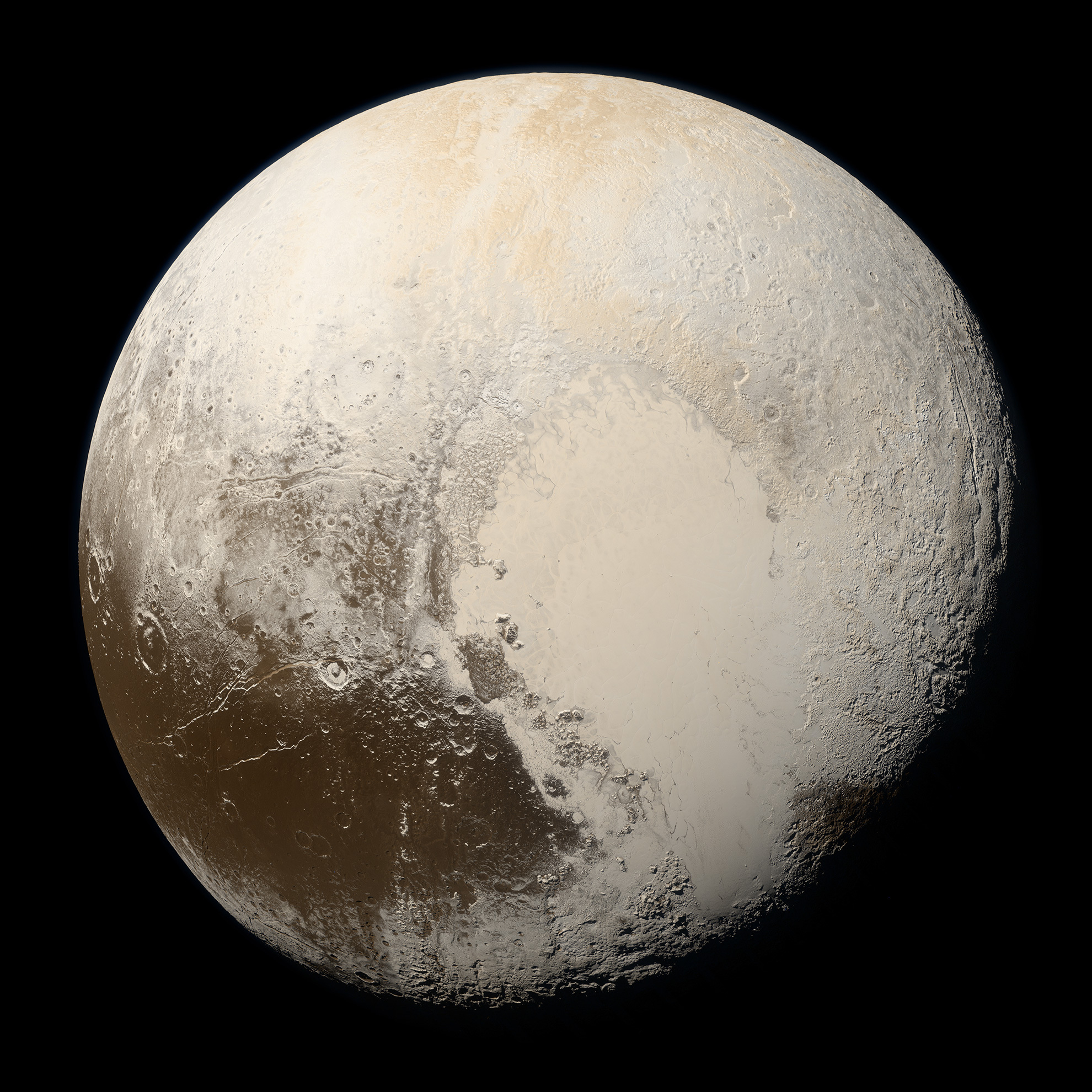
New Horizons scientists made this false-colour image of Pluto using a technique called principal component analysis to highlight the many subtle colour differences between Pluto’s distinct regions. The image data were collected by the spacecraft’s Ralph/MVIC colour camera, from a range of 35,000 kilometres (22,000 miles). Credit: NASA/JHUAPL/SwRI
Linear Etalon Imaging Spectral Array (LEISA)
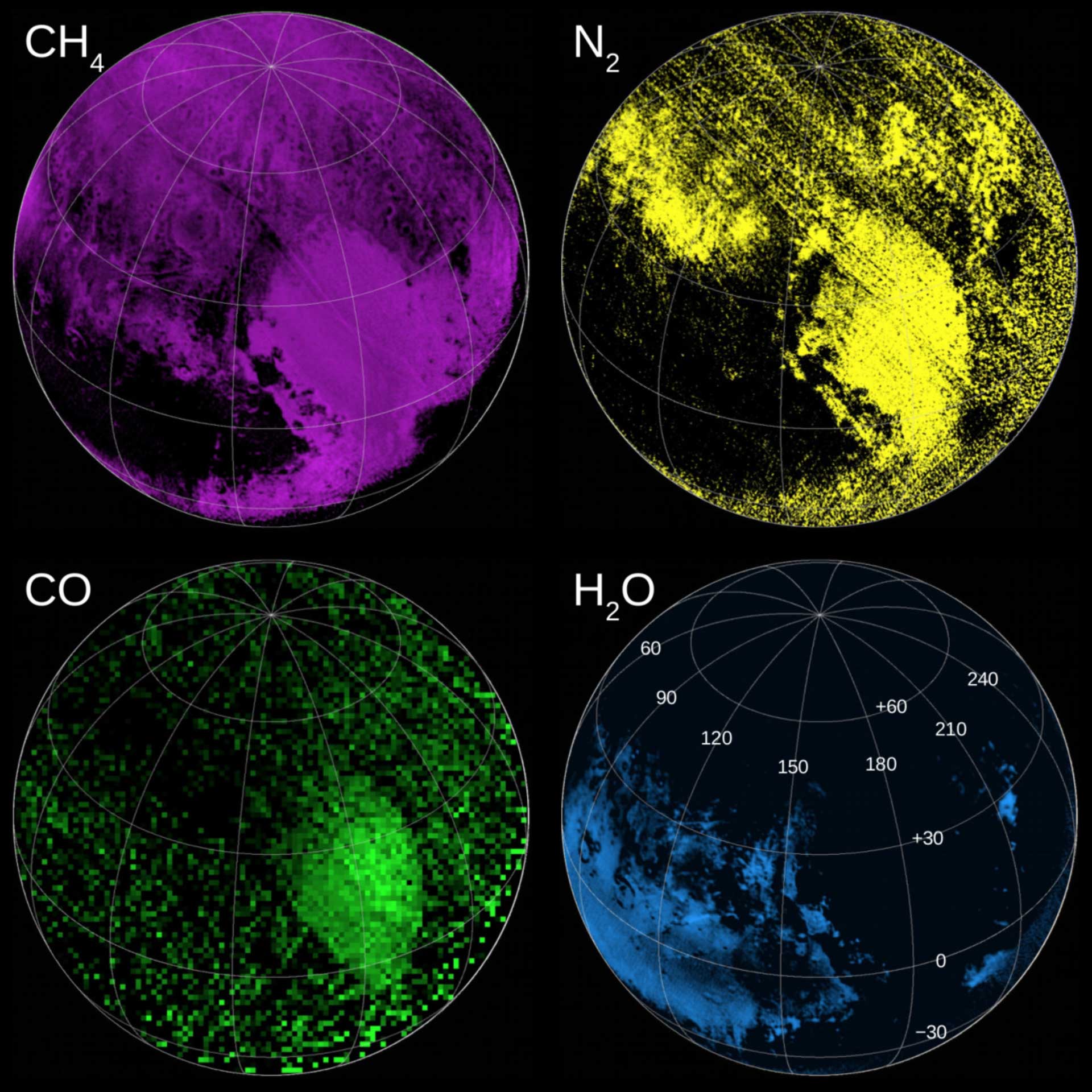
These composition maps were assembled using data from the Linear Etalon Imaging Spectral Array (LEISA) component of New Horizons’ Ralph instrument. Credit: NASA / Johns Hopkins University Applied Physics Laboratory / Southwest Research Institute.
LEISA is an IR spectral imager that creates spectral maps in the compositionally important 1.25- to 2.5-μm shortwave IR (SWIR) spectral region. It images a scene through a wedged etalon -- linear variable filter -- placed about 100 micrometres above a 256x256 pixel Mercury Cadmium Telluride (HgCdTe) detector array -- a custom PICNIC array produced by Teledyne. An image is formed simultaneously on both the etalon and the array. The HgCdTe was grown on a CdTe substrate using Molecular Beam Epitaxy (MBE) to provide good lattice matching and low dark currents. The detector was bump-bonded to a standard PICNIC multiplexer, and the resulting hybrid was mounted to a molybdenum pad. This process reduces mechanical stress induced during cooling to operational temperature. It is estimated that the assembly can safely undergo at least 1000 thermal cycles.
LEISA forms a spectral map by scanning the 0.9° × 0.9° FOV across the surface in a push-broom fashion, sequentially sampling each point in the scene at each wavelength. This is similar to the method of the MVIC TDI channels. The difference between a LEISA scan and an MVIC TDI scan is that in LEISA, row-to-row image motion builds up a spectrum, whereas in MVIC, motion increases the signal over a single spectral interval.
The frame rate is synchronised to the scan rate, so a frame is read out each time the image advances by a single-pixel IFOV (Instrument FOV). As the spacecraft scans the target across the field of view, it can reach the edge of a dead band. This will cause thrusters to fire, putting the target closer to the desired location. As a result, the target can make a zig-zag pattern as it moves through the FOV.
The LEISA filter comprises two bonded segments. The first, a high-spectral-resolution segment with Wavelength/ΔWavelength = 560, covering a wavelength range from 2.1 to 2.25 μm, provides surface temperature maps using temperature-dependent changes in the spectral structure of solid nitrogen near the alpha-to-beta phase transition at 35 K. The second, a low-spectral-resolution segment with Wavelength/ΔWavelength = 240, covering a wavelength range from 1.25 to 2.5 μm, provides information primarily for surface composition mapping.
Objectives:
Hemispheric near-infrared spectral maps of Pluto and Charon at best resolution exceeding 10 km/pixel
Hemispheric distributions of methane (CH4), molecular nitrogen (N2), carbon monoxide (CO), and water (H2O) over the surface of Pluto and the water frost distribution over the surface of Charon at a best resolution exceeding 10 km/pixel.
Surface temperature mapping of Pluto and Charon
Phase-angle-dependent spectral maps of Pluto and Charon
Long-Range Reconnaissance Imager (LORRI)
New Horizons' Extreme Close-Up of Pluto’s Surface
This mosaic strip was taken by LORRI and spans the hemisphere facing the New Horizons spacecraft as it flew past Pluto. The width of the strip ranges from more than 90 kilometres (55 miles) at its northern end to about 75 kilometres (45 miles) at its southern end. The perspective changes along the strip, starting with a horizontal view across the surface and shifting down until the perspective looks straight down onto the surface. The landscape changes as well, starting with hummocky, cratered uplands, crossing over parallel ridges of the 'washboard' terrain, chaotic and angular mountain ranges, craterless, cellular plains, coarse areas of sublimating nitrogen ice, zones of thin nitrogen ice, and rugged, dark, mountainous highlands scarred by deep pits. Credits: NASA/JHUAPL/SwRI
The Long Range Reconnaissance Imager (LORRI) is a panchromatic visible-light camera designed to provide high-spatial resolution images under the low-ambient-light conditions present at the large heliocentric distances of the Pluto system. LORRI is equipped with a Teledyne CCD 47-20 detector with a 1024 × 1024-pixel optically active area (“1 × 1” format) that can be re-binned during readout to 256 × 256 pixels (“4 × 4” format) for maximum sensitivity on unresolved targets. The back-thinned, backside-illuminated CCD operates in a standard frame-transfer mode, with a high quantum efficiency of ~90% at peak. LORRI does not have any colour filters -- it provides panchromatic imaging over a wide bandpass extending from 0.35 μm to 0.85 μm. The instrument is capable of detecting surface features as small as 300 meters (984 feet).
A unique aspect of LORRI is its extreme thermal environment: the instrument is situated inside a near-room-temperature spacecraft while pointing primarily at cold space. This environment forced the use of a silicon carbide optical system, which is designed to maintain focus over the operating temperature range without a focus adjustment mechanism. Another challenging aspect of the design is that the spacecraft is thruster-stabilised with no reaction wheels. This placed stringent limits on the available exposure time and the optical throughput needed to achieve the required high-resolution observations. As of late 2016, there are no known dead or hot pixels on the LORRI detector.
LORRI also serves as the primary optical navigation camera on New Horizons.
Objectives:
Hemispheric panchromatic maps of Pluto and Charon at best resolution >0.5 km/pixel
Search for atmospheric haze at a vertical resolution <5 km
Long time base of observations, extending over 10–12 Pluto rotations
Panchromatic maps of the far-side hemisphere
High-resolution panchromatic maps of the terminator region
Panchromatic wide-phase-angle coverage, panchromatic stereo images, orbital parameters, and bulk parameters of Pluto, Charon, Nix, and Hydra
Search for satellites and rings
The First Interstellar Parallax Experiment
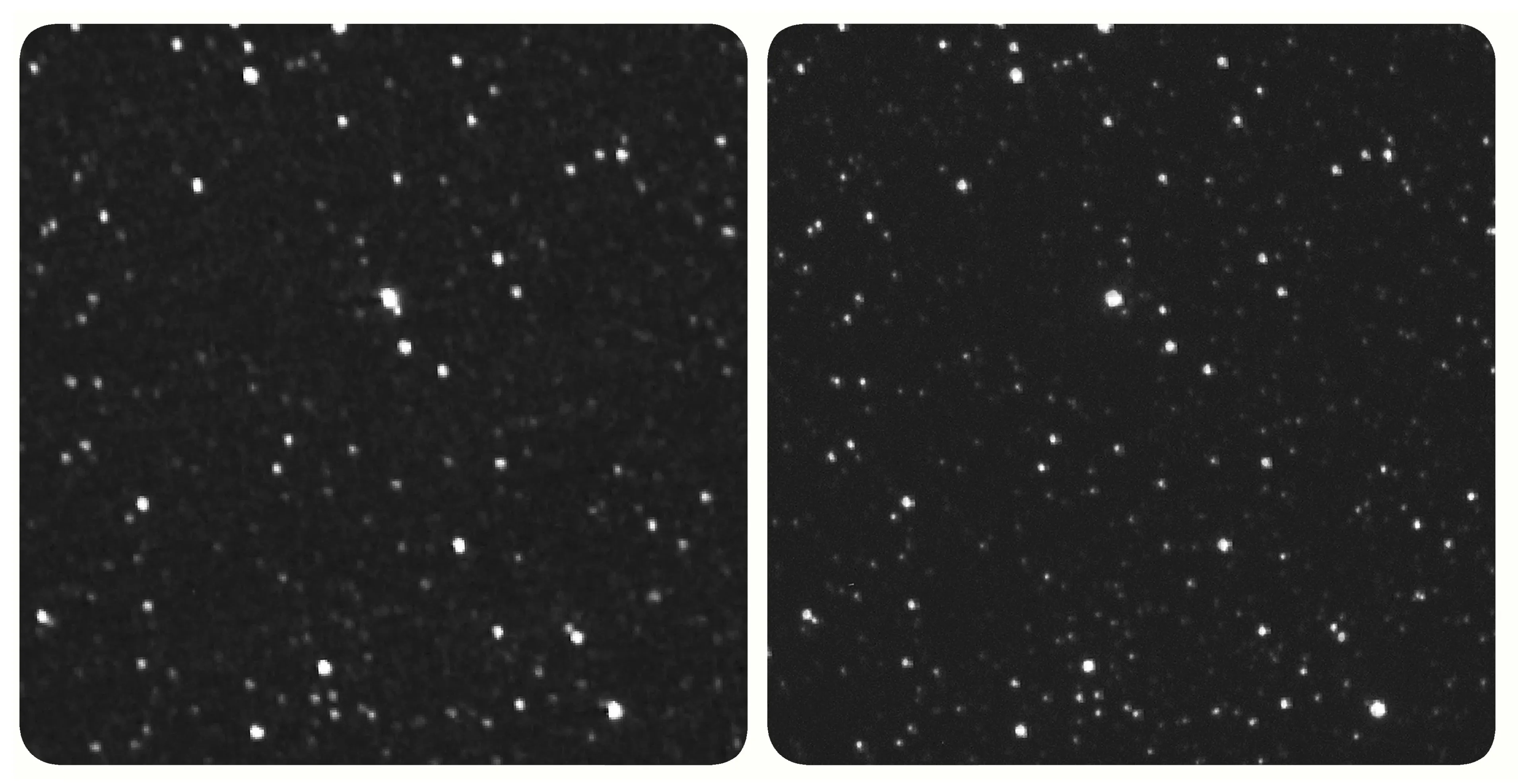
New Horizons is so far away from Earth that some stars appear to be in different positions than seen from Earth. When New Horizons images are paired with pictures of the same stars taken on the same dates by telescopes on Earth, the parallax shift is instantly visible. The combination yields a 3D view of the stars “floating” against their background star fields. This Parallel Stereo of Proxima Centauri is the largest parallax baseline ever made — over 4 billion miles. The New Horizons image is on the left. The image on the right was taken by the Las Cumbres Observatory, operating a remote telescope at Siding Spring Observatory in Australia. Credit: NASA
Exploring the Kuiper Belt
New Horizons has used (LORRI to observe a number of Kuiper Belt objects (KBOs) and dwarf planets at unique phase angles. KBOs teach scientists about planetesimals, the building blocks of planets, which are thought to exist in protoplanetary and debris disks. The spacecraft has also provided images of centaurs -- objects similar in size to asteroids, but similar in composition to comets -- at extremely high phase angles to search for forward-scattering rings or dust. LORRI captured images of KBOs 2012 HZ84 and 2012 HE85, which were the farthest objects from Earth ever captured by a spacecraft, and the closest-ever images of KBOs up to that point.
By December 2023, New Horizons had discovered about 100 KBOs and flown close enough to about 20 of them to observe characteristics such as shape, rotational period, possible moons, and surface composition.
Charon
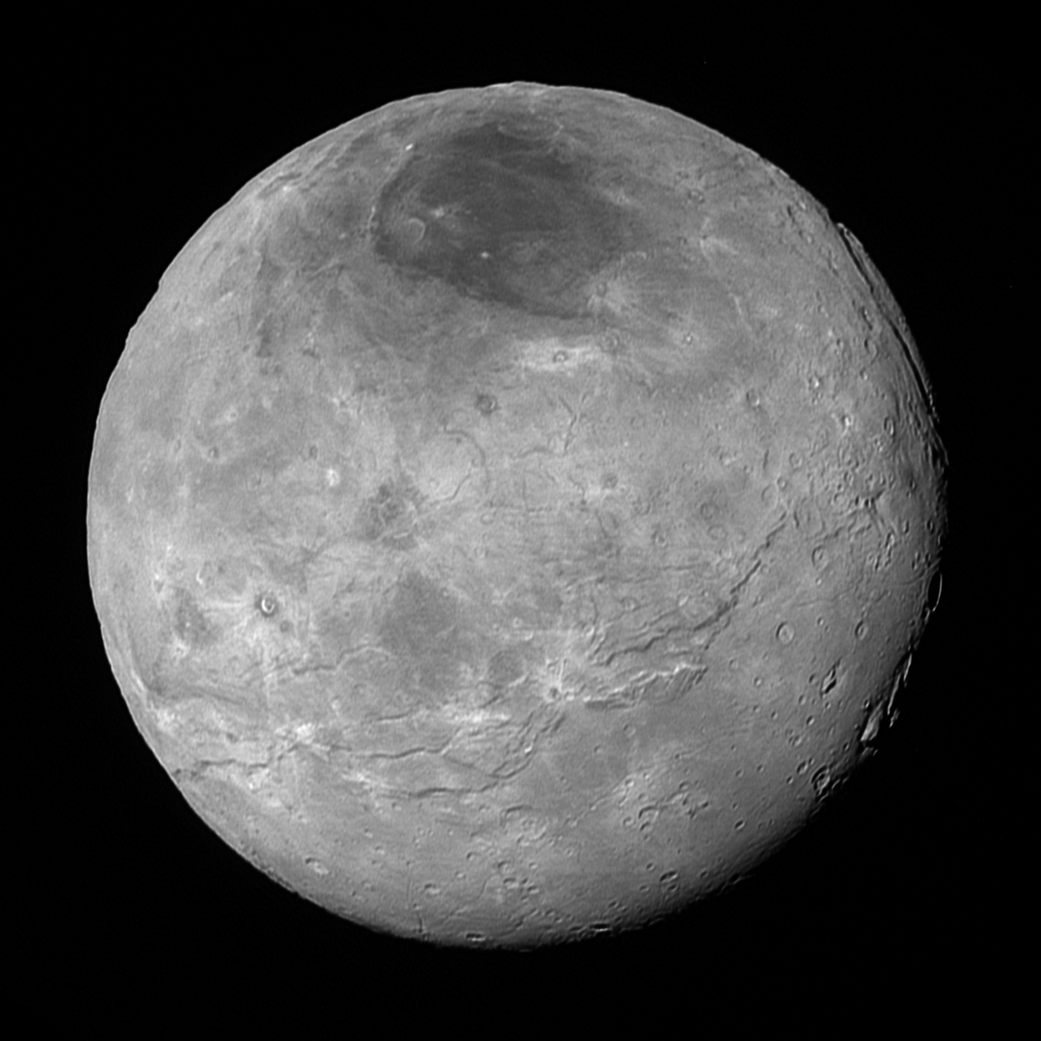
This global map of Pluto’s largest moon, Charon has revealed the presence of canyons on the moon's surface. The deepest of those canyons plunges downward for 9.7 kilometres (6 miles). A long swath of cliffs and troughs stretches for 970 kilometres (600 miles) across the satellite's middle. Much of Charon's surface is free of craters, suggesting the surface is young and geologically active. Scientists saw evidence of landslides on its surface, the first time such features have been spotted in the Kuiper Belt. The moon may also have a form of plate tectonics. The leading hypothesis for the formation of Pluto and Charon is that a nascent Pluto was struck with a glancing blow by another Pluto-size object. Most of the combined matter became Pluto, while the rest spun off to become Charon. Pluto's other four moons may have formed from the same collision that created Charon. Credit: NASA/Johns Hopkins University Applied Physics Laboratory/Southwest Research Institute
The music accompanying this video of the approach to Arokoth (originally nicknamed Ultima Thule) was created by Queen guitarist Brian May. In 2008, May completed his PhD in astronomy after taking a 30-year hiatus to pursue his music career. Alan Stern -- the principal investigator of the New Horizons team -- asked May to make a soundtrack for the New Horizons mission. The final section of the video shows the view looking back towards the Sun of the ‘crescent’ of the KBO after the encounter. Credit: © brianmay.com
Arrokoth is one of many frigid bodies way out in the Kuiper Belt, the solar system's "third zone" beyond Neptune's orbit. Small Kuiper Belt objects such as Arrokoth are time capsules of a sort, having existed more or less unchanged for more than 4 billion years. Arrokoth is a gentle fusion of two objects that once orbited each other. The larger of the two lobes, called Wenu, is itself a pile of 12 rocks huddled around a bigger slab.
According to IAU conventions, the discoverers of a cosmic body have the privilege of naming it. The Hubble Space Telescope — which discovered Arrokoth in 2014 — has its science operations in Baltimore. New Horizons is operated from Johns Hopkins University’s Applied Physics Lab in Laurel, Maryland. 'Arrokoth' means “sky” and is from the Algonquian Languages, spoken by the Powhatan tribes indigenous to the Maryland area. Accordingly, NASA received the consent of Powhatan tribal representatives before proposing the name.
What's On the Horizon?
Credit: NASA/Johns Hopkins University Applied Physics Laboratory/Southwest Research Institute
In flight for over 20 years, New Horizons is over 65 AU from the Sun. This means it now takes well over 9 hours for a radio signal to reach the spacecraft from Earth. With complementary telescopic observations of the Kuiper Belt from Earth, New Horizons, as the only spacecraft operating in and collecting new information about the Kuiper Belt, has a unique opportunity to learn more about the outer reaches of our Solar System.
In July 2026, operators successfully woke New Horizons from a nearly yearlong hibernation -- its longest ever -- with the Spacecraft reporting full functionality. Hibernation periods enable the spacecraft to conserve fuel and reduce operational complexity while a compelling flyby candidate is sought. While the science community is not currently aware of any reachable Kuiper Belt object, New Horizons is continuing operations allowing for the possibility of using the spacecraft for a future close flyby of such an object, should one be identified. The probe is expected to exit the Kuiper Belt around 2029.
Now into its second extended mission, the probe is expected to have sufficient propellant and power to operate through the 2040s, at distances beyond 100 AU from the Sun. Eventually, it will leave the solar system, joining the Voyagers and Pioneers on their ever outward journey. Once at that distance, New Horizons could potentially transition into a region where interstellar dust particles dominate the environment.
Works Cited:
Anne J. Verbiscer et al (2022, April 27). American Astronomical Society. DOI 10.3847/PSJ/ac63a6
Cooper, Keith. (2026, July 16). Astronomers discover landslides on Pluto large enough to bury entire cities on Earth. https://www.space.com/astronomy/pluto/astronomers-discover-landslides-on-pluto-large-enough-to-bury-entire-cities-on-earth
David, Leonard. (2022, July 14). Far beyond Pluto: What's next for NASA's New Horizons probe? Space.com. https://www.space.com/beyond-pluto-nasa-new-horizons-next-steps
David, Leonard. (2015, July 11) Meet Ralph, the New Horizons Camera Bringing Pluto into Sharp Focus. https://spacenews.com/new-horizons-about-to-bring-an-unknown-world-into-sharp-focus/
NASA. (n.d.). New Horizons. https://science.nasa.gov/mission/new-horizons/
Dutfield, Scott, Choi, Charles. Q. (2023, April 29) Pluto: Everything you need to know about the dwarf planet. https://www.space.com/43-pluto-the-ninth-planet-that-was-a-dwarf.html
Fountain, Glen H., Weaver, Harold A., Reuter, Dennis C., Stern, S. Alan, Linscott, Ivan R., McComas, David J., Hill, Matthew E., and Horányi, Mihály. Johns Hopkins APL Technical Digest, Volume 37, Number 1 (2023), The New Horizons Instrument Suite. https://www.jhuapl.edu/sites/default/files/2024-09/37-01-Fountain.pdf
Howell, Elizabeth. (2017, February 28). Does Pluto Have The Ingredients For Life? https://astrobiology.nasa.gov/news/does-pluto-have-the-ingredients-for-life/
Kuthunur, Sharmila. (2023, March 16). New Horizons Pluto probe notches 3 new discoveries in outer solar system. https://www.space.com/nasa-new-horizons-pluto-probe-lpsc-2023-discoveries
May, Brian. (2019, March 19). The Grand Ultima Thule Flyby! https://brianmay.com/brians-soapbox/2019/03/the-grand-ultima-thule-flyby/
NASA - astrobiology. (n.d.). New Horizons - The First Mission to the Pluto System and the Kuiper Belt. https://astrobiology.nasa.gov/missions/new-horizons/
NASA. (2015, November 12). Psychedelic Pluto. https://www.nasa.gov/image-article/psychedelic-pluto/
NASA. (2024, February 20). NASA’s New Horizons Detects Dusty Hints of Extended Kuiper Belt. https://www.nasa.gov/missions/new-horizons/nasas-new-horizons-detects-dusty-hints-of-extended-kuiper-belt/
NASA-JPL. (2016, May 27). New Horizons' Best Close-Up of Pluto's Surface. https://www.jpl.nasa.gov/images/pia14458-new-horizons-best-close-up-of-plutos-surface/
NASA PDS: Small Bodies Node. (2026, August 12). New Horizons Mission. https://pds-smallbodies.astro.umd.edu/data_sb/missions/newhorizons/index.shtml
Ibid. New Horizons LORRI Instrument Overview. https://pds-smallbodies.astro.umd.edu/holdings/pds4-nh_documents:lorri-v1.0/documents/lorri_inst_overview.pdf
Ibid. New Horizons LEISA Instrument Overview. https://pds-smallbodies.astro.umd.edu/holdings/pds4-nh_documents:ralph-v2.0/documents/leisa_inst_overview.pdf
Ibid. New Horizons MVIC Instrument Overview. https://pds-smallbodies.astro.umd.edu/holdings/pds4-nh_documents:ralph-v2.0/documents/mvic_inst_overview.pdf
Space.com-astronomy. (2017, January 20). Destination Pluto: NASA's New Horizons Mission in Pictures. https://www.space.com/16533-pluto-new-horizons-spacecraft-pictures.html
Talbert, Tricia. (2023, September 29). NASA’s New Horizons to Continue Exploring Outer Solar System. https://www.nasa.gov/missions/new-horizons/nasas-new-horizons-to-continue-exploring-outer-solar-system/
Talbert, Tricia. (2021, April 15). NASA’s New Horizons Reaches a Rare Space Milestone. https://www.nasa.gov/solar-system/nasas-new-horizons-reaches-a-rare-space-milestone/
Tricia Talbert. (2020, June 10). NASA’s New Horizons Conducts the First Interstellar Parallax Experiment. https://www.nasa.gov/solar-system/nasas-new-horizons-conducts-the-first-interstellar-parallax-experiment/
Talbert, Tricia. (2015, July 24). New Horizons Discovers Flowing Ices on Pluto. https://www.nasa.gov/solar-system/new-horizons-discovers-flowing-ices-on-pluto/
Wall, Mike. (2019, November 12). Meet Arrokoth: Ultima Thule, the Most Distant Object Ever Explored, Has a New Name. https://www.space.com/ultima-thule-beyond-pluto-new-name-arrokoth.html
Williams, Matthew (2017, September 27). New Study Provides Explanation for Pluto's Giant Blades of Ice. https://www.universetoday.com/articles/new-study-provides-explanation-plutos-giant-blades-ice

