 The Sun may not have water-based clouds, but it does have an atmosphere full of superheated gases. At the surface, coils of magnetised plasma jettison waves of radiation and heat. All this activity churns the solar wind, which blows through the outer reaches of the Sun’s corona and eventually reaches the Earth. As scientists gain an understanding of this space weather, we increase our ability to predict its universal impact.
Aditya-L1 before heat shield closure. Credit: SUIT Payload Operations Center
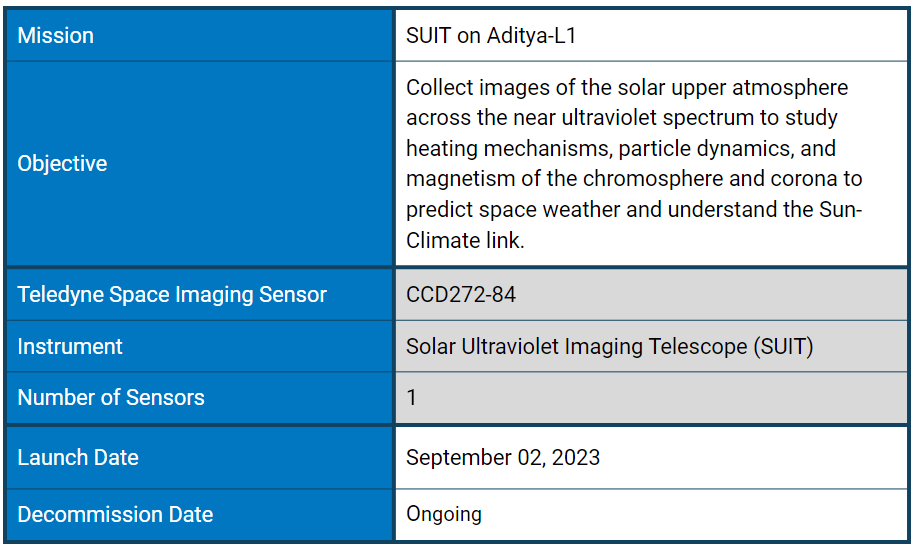
The Solar Ultraviolet Imaging Telescope (SUIT) onboard India’s first solar observation mission – Aditya-L1 – will measure and monitor the full height of the Sun’s atmosphere from the surface of the photosphere, out to the lower chromosphere, and through the corona. SUIT captures the solar radiation emitted at near ultraviolet wavelengths recording full-disk images of the Sun every 30 minutes; a scientific first.
Named after the 12 Aditya Hindu goddesses often associated with the Sun (Surya) in modern Sanskrit, ISRO’s Aditya-L1 coronography satellite launched on September 2nd, 2023. L1 refers to the orbit location; Sun-Earth Lagrange 1 – a gravitational point between the Earth and the Sun. This orbit allows SUIT to make continuous and unobstructed observations of the Sun while maintaining a position roughly perpendicular to the Earth-Sun line.

The halo orbit at L1 places SUIT’s sensitive UV detector – Teledyne e2v’s CCD272-84 – far away from the interference that is caused by Earth’s magnetic field. A 4096 x 4906 back-illuminated detector with a 12-micron pixel size, it is optimised with an anti-reflection coating to minimise ghosting through multiple reflections from the focusing lens and filters. The 272-84 detector is similar to its space-qualified CCD203-82, which was used in the Atmospheric Imaging Assembly (AIA) and Helioseismic and Magnetic Imager (HMI) onboard the Solar Dynamics Observatory (SDO). Optical integration of SUIT. Credit: SUIT Payload Operations Center
This data will enable heliophysics to study solar activity such as flares, coronal mass ejections, sunspots, plages, and quiet Sun regions that drive solar weather. To enhance the observations of solar flares, SUIT is optimised with an onboard intelligence system designed for detection, precise localisation, and exposure control. This intelligent mechanism regulates detector saturation to ensure an accurate depiction of solar activity.
SUIT captured a flurry of solar activity during the week of May 8-15 in active region AR13664 on the Sun – one of the biggest sunspots on record. SUIT observed several X-class – the highest designation – and M-class flares later associated with Coronal Mass Ejections (CMEs) between May 8 and 9. This later produced a major geomagnetic storm on May 11. The work of tracing these solar storms will improve the ability of scientists to predict space weather to provide enough notice to prepare Earth's systems for the disruption.
Images and descriptions from ISRO
Developed by the Inter-University Centre for Astronomy and Astrophysics of Pune, SUIT uses 11 wavelength filters between 200 to 400 nanometers to dissect the atmospheric spectrum. Three broad-band & eight narrow-band filters allow heliophysics to observe near-simultaneous solar activity across the full-disk and specific areas. Combinations of filters can offer complimentary results such as the Mg ll spectral channels NB3 and NB4, which measure plasma density in the chromosphere. Other bands slice into regions of interest: NB2 276 peers deep into the chromosphere, where solar flares can have a great impact, ultimately affecting space weather.
Shutter Operation of SUIT
An onboard camera captured this video showing the opening and closing of the SUIT telescope’s aperture, which allows solar radiation into the device and to the thermal filters. However, if a full blast of solar radiation were to enter the optical cavity, the sensitive mirrors and detector – which must be kept cool for optimal imaging conditions – would overheat and get damaged. On SUIT, a metal-dielectric thermal filter reflects the majority of solar flux below 200 nm and above 400 nm. Furthermore, only 1% of the filtered radiation is allowed into the optical chamber, ensuring peak system performance.
What Can We Gain From It?
Beyond the ability to predict space weather, SUIT provides crucial information to understand how the Sun's magnetic atmosphere affects solar production and the ultimate impact of that solar UV radiation on Earth's climate. Solar observation missions measure and monitor spatially resolved solar spectral irradiance that governs the chemistry of oxygen and ozone in the stratosphere of the Earth’s atmosphere. A deeper comprehension of these elements will help guide our decisions regarding environmental protection.
SUIT took its first images on December 6, 2023. In less than a year, it has returned some amazing images, contributing to a trove of heliophysics data which promises exciting insights in the coming years. As ISRO project director Nigar Shaji reflected at Aditya-L1’s launch, “It will be an asset to the heliophysics of the country and the global scientific fraternity.“

